
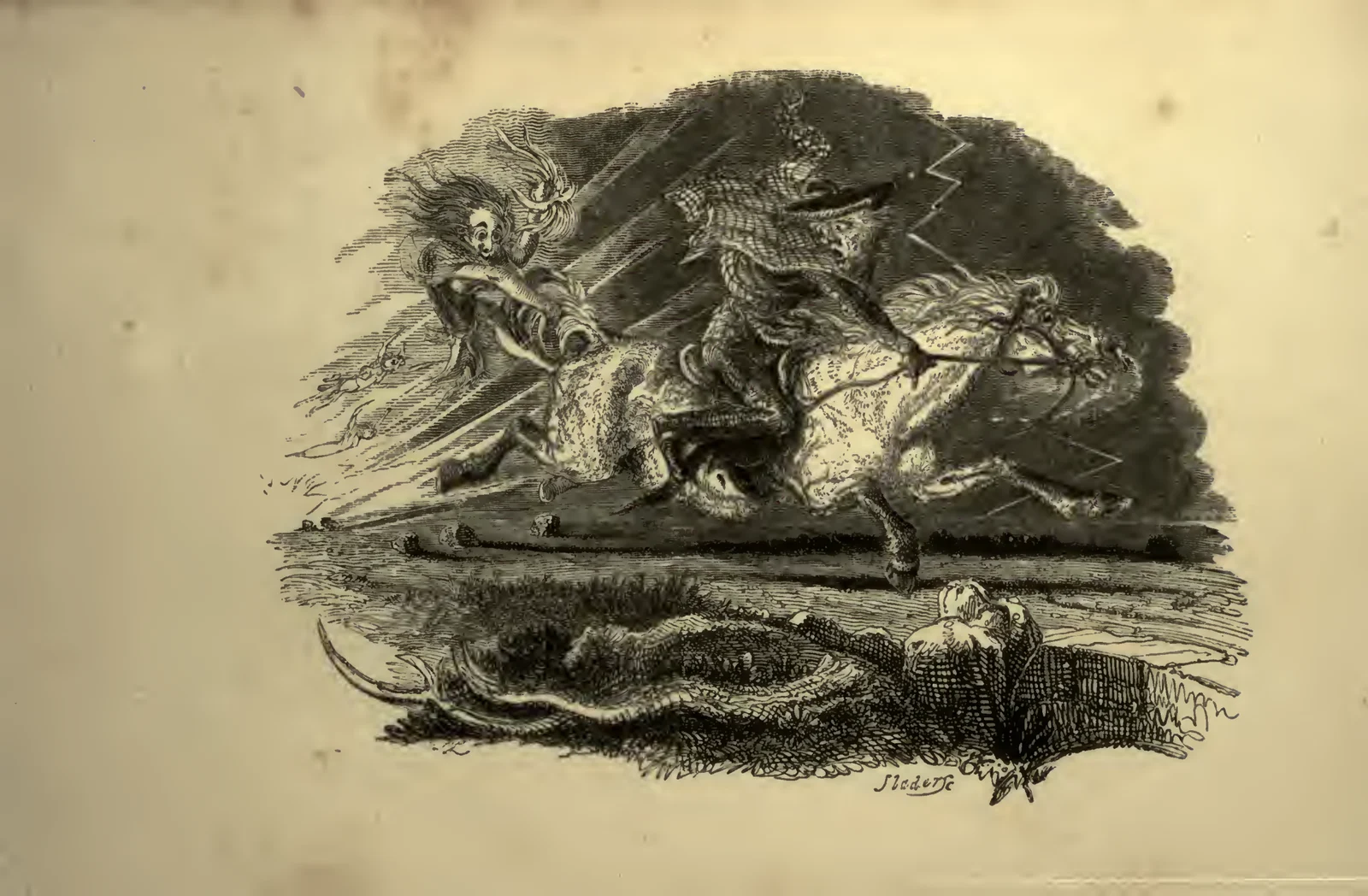
An 1830 engraving shows Tam on his galloping mare beside a bridge, pursued by wild-haired figures; the leading pursuer reaches toward the mare’s tail in Nannie’s chase.
Nannie pursues Tam and Maggie toward the bridge in Thomas Landseer’s 1830 illustration of Burns’s Tam O’Shanter, engraved by Slader. The full historical sheet is retained.
Overview
In Robert Burns’s Tam O’Shanter, a drunken rider sees witches and warlocks dancing inside Alloway’s ruined church, accompanied by Satan playing pipes in the form of a large shaggy black dog. Nannie is the attractive young dancer in a short linen shift purchased for her by her grandmother. The narrator also attributes later livestock deaths, destroyed boats and damaged crops to her. Tam’s fascinated praise of the short shift gives her the familiar Cutty-Sark designation and breaks his concealment: the lights disappear and the company pursues him.
Nannie runs ahead of the other witches and reaches Tam’s grey mare Maggie as the horse springs toward the bridge. The poem states that the pursuers dare not cross running water. Nannie catches Maggie by the hindquarters, but the leap carries the rider safely away while leaving the mare’s tail in the witch’s grip. The ending warns readers against costly drinking and desire. This is a named poet’s comic supernatural narrative, not a trial record or identification of a historical woman; the running-water barrier belongs to its chase.
Origins & earliest records
Robert Burns, Tam O’Shanter, in The Poetical Works of Robert Burns, edited by Alexander Smith (New York: Frederick A. Stokes, 1887), pp. 95–99.
Records & interpretation
Complete Scots narrative poem in an identified nineteenth-century edition, including the dance, pursuit and torn-tail ending.
Selected bibliography
Documented works and useful reading. This is not a list of every appearance.
- 01
Tam O’Shanter, pp. 95–99
Actual Stokes title page and contents checked; complete poem. Edition date is not asserted as original composition date.
Family & connections
A source-supported family tree or inspiration record has not yet been compiled for this profile. Related reading below indicates a connection in subject matter, not a proven lineage or creative influence.
References
Sources supporting this profile. Linked pages have their own scope and editorial standards.
- Primary literary poemBurns: Tam O’Shanter, 1887 editionResearch access: 2026-10-05
- Primary edition metadataThe Poetical Works of Robert Burns: title page and contentsResearch access: 2026-10-05
Image credits
Original narrative illustration, Burns’s Nannie chase; entire illustrated page retained, landscape reading orientation.An 1830 engraving shows Tam on his galloping mare beside a bridge, pursued by wild-haired figures; the leading pursuer reaches toward the mare’s tail in Nannie’s chase.
Nannie pursues Tam and Maggie toward the bridge in Thomas Landseer’s 1830 illustration of Burns’s Tam O’Shanter, engraved by Slader. The full historical sheet is retained.