
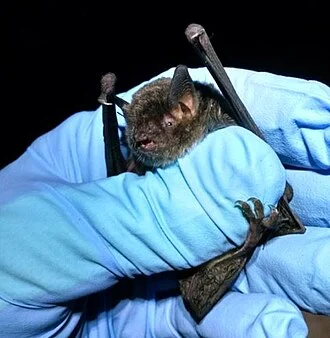
A grey bat held in a blue-gloved hand with its wings partly spread.
Gray bat held in a gloved hand. The source does not establish the capture locality or health of this individual.
Overview
ADW identifies uniformly coloured dorsal hairs and a wing membrane joining near the ankle rather than the toe base. It places this insectivorous bat in Vespertilionidae.
Specialized cave roosts occur in southeastern limestone karst. Summer caves tend to be warmer than winter hibernacula, while foraging along rivers and lakes connects cave protection with aquatic landscapes.
FWS describes grey fur that can bleach reddish-brown by early summer, alongside disturbance, contamination, altered waterways and cave modification as threats. Listing in 1976 and a 1982 recovery plan focused attention on summer and winter caves; those historical dates do not establish current abundance or completed recovery.
Origins & earliest records
Naming and evolutionary origin are not established here.
Evidence & interpretation
Institutional and official species accounts.
Selected bibliography
Documented works and useful reading. This is not a list of every appearance.
- 01
Gray Bat (Myotis grisescens)
Selected bibliography; official species account, as no further literature was reviewed.
Family, evolution & connections
Taxonomic classification
A hierarchy of classified groups, not a chain of direct ancestors.
Source note: Family follows ADW; species authority not verified.
- FamilyVespertilionidae
- SpeciesMyotis grisescens
References
Sources supporting this profile. Linked pages have their own scope and editorial standards.
- Institutional species accountGray bat: ADW accountResearch access: 2026-10-07
- Official species accountGray bat: FWS accountResearch access: 2026-10-07
Image credits
Attributed biological photographA grey bat held in a blue-gloved hand with its wings partly spread.
Gray bat held in a gloved hand. The source does not establish the capture locality or health of this individual.