
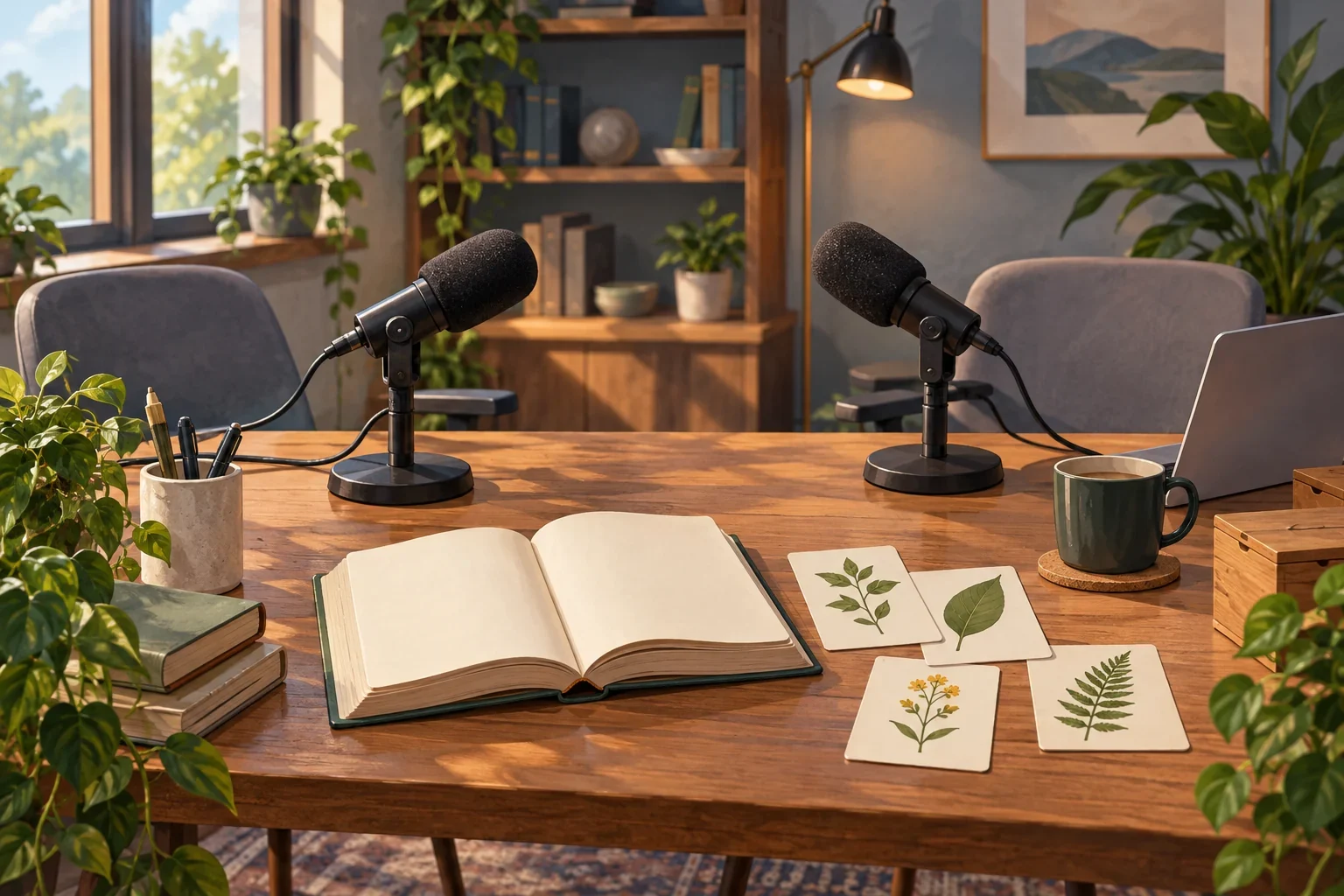
Imagined cooperative narration tools and plant-vocabulary research cards.
Setting, tools and layout imagined; not ethnographic evidence.
Overview
Uta Reuster-Jahn’s study, as described by its publisher, examines Mwera narrative sessions recorded in two villages. It attends to exchanges between narrators and responding listeners, including moments of co-narration. Transcripts and translations preserve those performances. This bounded corpus shows interaction in storytelling without establishing one fixed performance style for every Mwera community.
Joseph K. Mbila’s Mwera–Swahili dictionary, edited by Reuster-Jahn, presents alphabetically arranged translations examined by a native-speaking collaborator. The publisher highlights plant vocabulary and terms connected with agricultural economic life. These documented lexical themes support a language-resource perspective, without copying dictionary entries or claiming to describe every household’s livelihood.
History & identity
Living communities through selected institutional and research accounts.
Sources & representation
Selected public institutional passages retained.
Selected bibliography
Documented works and useful reading. This is not a list of every appearance.
- 01
- 02
Language & cultural connections
Source-supported language and cultural connections have not yet been compiled for this profile.
References
Sources supporting this profile. Linked pages have their own scope and editorial standards.
- Publisher research descriptionErzählte Kultur und Erzählkultur bei den Mwera in Südost-TansaniaResearch access: 2026-10-12
- Publisher dictionary descriptionMwera–Swahili Dictionary: Kamusi ya Kimwera–KiswahiliResearch access: 2026-10-12
Image credits
AI contextual interpretationImagined cooperative narration tools and plant-vocabulary research cards.
Setting, tools and layout imagined; not ethnographic evidence.