
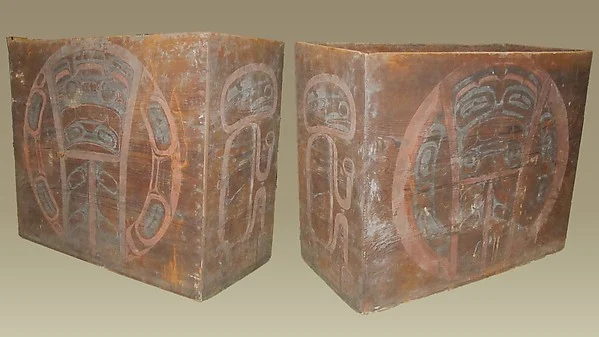
Two museum views of the same weathered wooden box drum, showing faded red and dark painted faces on its broad sides.
Nineteenth-century box drum in the Met’s musical-instrument collection. Its current catalogue names both Kwakwaka’wakw and Musqueam; this mixed attribution is retained rather than assigning an exclusive maker or treating the object as a uniform community practice.
Overview
Musqueam, xʷməθkʷəy̓əm, are a living Indigenous community of the Fraser River estuary in what is now Vancouver. The community’s account emphasizes that reserve land occupies only a small part of its territory. It connects the name Musqueam with a flowering plant and a traditional account of a double-headed serpent shaping a creek. This is a community account of place and identity, rather than a biological origin theory. The same account describes cultural continuity despite residential schools and restrictions on ceremonies, and presents respectful conduct, listening and acknowledging what one does not know as continuing responsibilities.
Language work brings those responsibilities into organized teaching and documentation. The Musqueam Language and Culture Department traces revitalization activity to the 1970s and describes research, archival materials and new learning resources. Its writing system uses the North American Phonetic Alphabet, including a convention of lower-case letters. A partnership with the University of British Columbia’s First Nations and Endangered Languages program began in 1997. Community members receive priority in the courses described by the department, while wider university participation is also possible. Studying hən̓q̓əmin̓əm̓ therefore describes educational participation, not automatic membership in the community.
The place-names project draws together language work, title-and-rights research and recorded oral histories. Its public introduction describes a map and a children’s place-name book, along with photographs and audio intended to reconnect names with their locations and histories. It also explicitly warns that the map remains under review. That qualification matters: a developing educational resource should not be represented as a final inventory of territorial knowledge. The written introduction is the source here; the linked recordings and complete book have not been independently examined.
Public education takes several forms. The teaching kit Musqueam: giving information about our teachings brings together historical material, language, stories, personal profiles and a timeline. Musqueam 101, established in 2001 with UBC, creates another setting through community meals, speakers and discussion rather than formal course registration. The community also participates in the Reciprocal Research Network with Stó:lō organizations, the U’mista Cultural Society and the Museum of Anthropology. These initiatives show distinct ways of sharing knowledge and strengthening community authority over its interpretation. Their public descriptions do not imply that every teaching or cultural practice is unrestricted.
History & identity
Community histories and territorial relationships precede the contemporary educational institutions described here.
Sources & representation
Complete Our Story body, language-program body and place-map introduction read; educational-resources teaching-kit, Musqueam101 and network sections read. No complete linked kit, map, book or audio claim.
Selected bibliography
Documented works and useful reading. This is not a list of every appearance.
- 01
Musqueam: giving information about our teachings
Teaching-kit reference from community resource page; complete kit not read.
- 02
Musqueam: giving information about our teachings — Speaking Out: Voices of the Community
English Chapter 5; interviews dated 2014, publication year unresolved.
Language & cultural connections
Source-supported language and cultural connections have not yet been compiled for this profile.
Located primary passages
Specific passages supporting details in this entry, grouped by their published witness.
Musqueam: giving information about our teachings — Speaking Out: Voices of the Community
Publication year unresolved; 2024 filename is not an imprint.
- Named speakers emphasize community authorship, respectful learning and protecting territory for future generations. The introduction foregrounds community accounts rather than relying exclusively on outsiders.
Complete opening 91–92 (standalone PDF 1–2); acknowledgements 169 (full PDF 175).
Remaining kit, classroom activities and linked films unread/unwatched. Collaboration credits do not establish every section’s authorship; no independent language translation claimed.
References
Sources supporting this profile. Linked pages have their own scope and editorial standards.
- Community institutionMusqueam: Our StoryResearch access: 2026-10-05
- Community institutionMusqueam Language and Culture DepartmentResearch access: 2026-10-05
- Community institutionMusqueam place-names projectResearch access: 2026-10-05
- Community institutionMusqueam educational resourcesResearch access: 2026-10-05
Image credits
Institutional two-view photograph of a historically catalogued wooden box drumTwo museum views of the same weathered wooden box drum, showing faded red and dark painted faces on its broad sides.
Nineteenth-century box drum in the Met’s musical-instrument collection. Its current catalogue names both Kwakwaka’wakw and Musqueam; this mixed attribution is retained rather than assigning an exclusive maker or treating the object as a uniform community practice.