
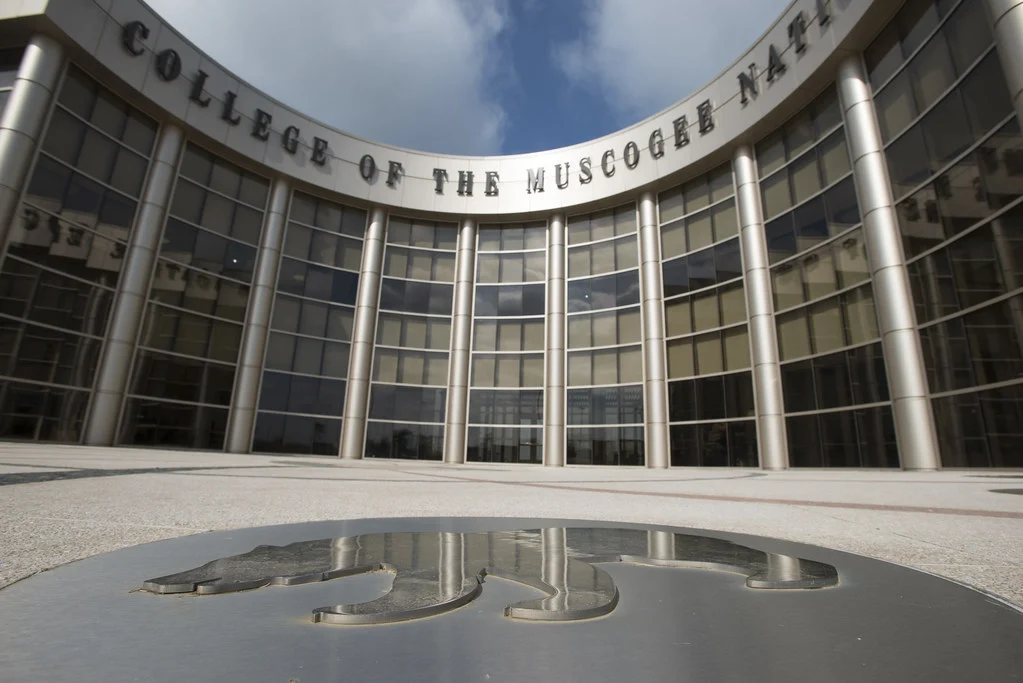
Exterior of the College of the Muscogee Nation in Okmulgee, Oklahoma, photographed by Lance Cheung for USDA in2015
The photograph shows the College of the Muscogee Nation in Okmulgee, Oklahoma, in 2015. Its named building provides context for the nation’s contemporary educational institutions. It is an institutional scene, rather than a portrait of citizens or evidence that every member of the nation attends the college.
Overview
The Muscogee Nation in Oklahoma carries histories rooted in the southeastern United States, including the Ocmulgee region. The National Park Service describes a historical confederacy organized around towns with substantial autonomy, incorporating communities with different backgrounds, including Yuchi and Alabama people. The colonial name Creek therefore should not suggest one uniform ancestral village or language. Forced removal in the 1830s brought profound losses and displacement to Indian Territory, where people rebuilt institutions and established Okmulgee as a capital. This entry concerns the living nation and selected cultural institutions; it does not assign every Muskogean-language community to the same modern polity.
The nation’s language program makes internal diversity explicit. Its teaching committee selected particular pronunciations and spellings for consistency while explaining that other dialect forms remain valid. Resources range from introductory lessons to sentence building, games and recorded hymns, alongside vocabulary intended for health workers and family occasions. This places language in practical contemporary settings as well as ceremonial or historical ones. Learning a course’s preferred form is not the same as demonstrating political citizenship, and unfamiliarity with that form does not determine whether someone belongs to the community.
The College of the Muscogee Nation presents higher education as part of cultural continuity and self-determination. Its institutional account connects academic learning with language, elders’ knowledge and responsibility to the nation, while explicitly welcoming both tribal and non-tribal students. Respect and other named values inform its stated educational goals. This is evidence of the college’s mission and approach, not a claim that all citizens attend it or share identical beliefs. A contemporary Indigenous college also shows that cultural life includes professional and intellectual development, rather than existing only in reconstructed scenes of the past.
A June 2025 report by Frances Herrod for Mvskoke Media documents collaborative language publishing. It introduces Jack Martin’s Mvskoke Language Patterns and describes the dictionary work of Martin and Margaret McKane Mauldin, together with a digital dictionary developed with Linda Wood and Julia Mainzinger. It also identifies Martin, Mauldin and Juanita McGirt’s editorial and translation work on Earnest Gouge’s New Fire narratives. These credits distinguish storytellers, speakers, linguists and software contributors. The report provides a bibliographic route to contemporary learning resources and earlier recorded literature; it does not replace a full reading of each book or listening to its audio.
History & identity
Southeastern town histories and forced removal are distinguished from modern institutions in Oklahoma.
Sources & representation
Complete NPS historical page and full written language-resource, college-mission and Mvskoke Media article bodies inspected. Current legal enrollment rules and linked books/audio are outside this account.
Selected bibliography
Documented works and useful reading. This is not a list of every appearance.
- 01
Mvskoke Language Patterns
Publication reported by Frances Herrod in June2025; complete book and audio not inspected.
- 02
An Interview with Joy Harjo, U.S. Poet Laureate
Web interview; original version American Poets, Spring–Summer 2019.
Language & cultural connections
These connections link languages or specific cultural works and institutions; they do not establish biological ancestry or ethnic identity.
Mvskoke Language Program curriculum
The program committee selected a dialect for consistent teaching, while expressly recognizing other pronunciations and spellings as valid. Curriculum selection does not rank communities.
Located primary passages
Specific passages supporting details in this entry, grouped by their published witness.
An Interview with Joy Harjo, U.S. Poet Laureate
2019 web version
- Harjo describes Mvskoke-language speech and song-making among her influences, alongside maternal poems and music and other writers. She argues for diverse Native poetic traditions and interconnected artistic lineages. This is her individual literary perspective, not a biological genealogy or universal community statement.
Complete introduction and five written question-and-answer exchanges; final copyright note.
Linked extended video, poems, anthology and whole books unreviewed; no ritual or poetry excerpts reproduced.
References
Sources supporting this profile. Linked pages have their own scope and editorial standards.
- Heritage institutionNPS: Muscogee historical accountResearch access: 2026-10-05
- Community language programMuscogee Nation Language Program: ResourcesResearch access: 2026-10-05
- Tribal collegeCollege of the Muscogee Nation: AboutResearch access: 2026-10-05
- Community journalismFrances Herrod, Mvskoke Media: language publishing,2025Research access: 2026-10-05
Image credits
Contextual cultural institution photographExterior of the College of the Muscogee Nation in Okmulgee, Oklahoma, photographed by Lance Cheung for USDA in2015
The photograph shows the College of the Muscogee Nation in Okmulgee, Oklahoma, in 2015. Its named building provides context for the nation’s contemporary educational institutions. It is an institutional scene, rather than a portrait of citizens or evidence that every member of the nation attends the college.