
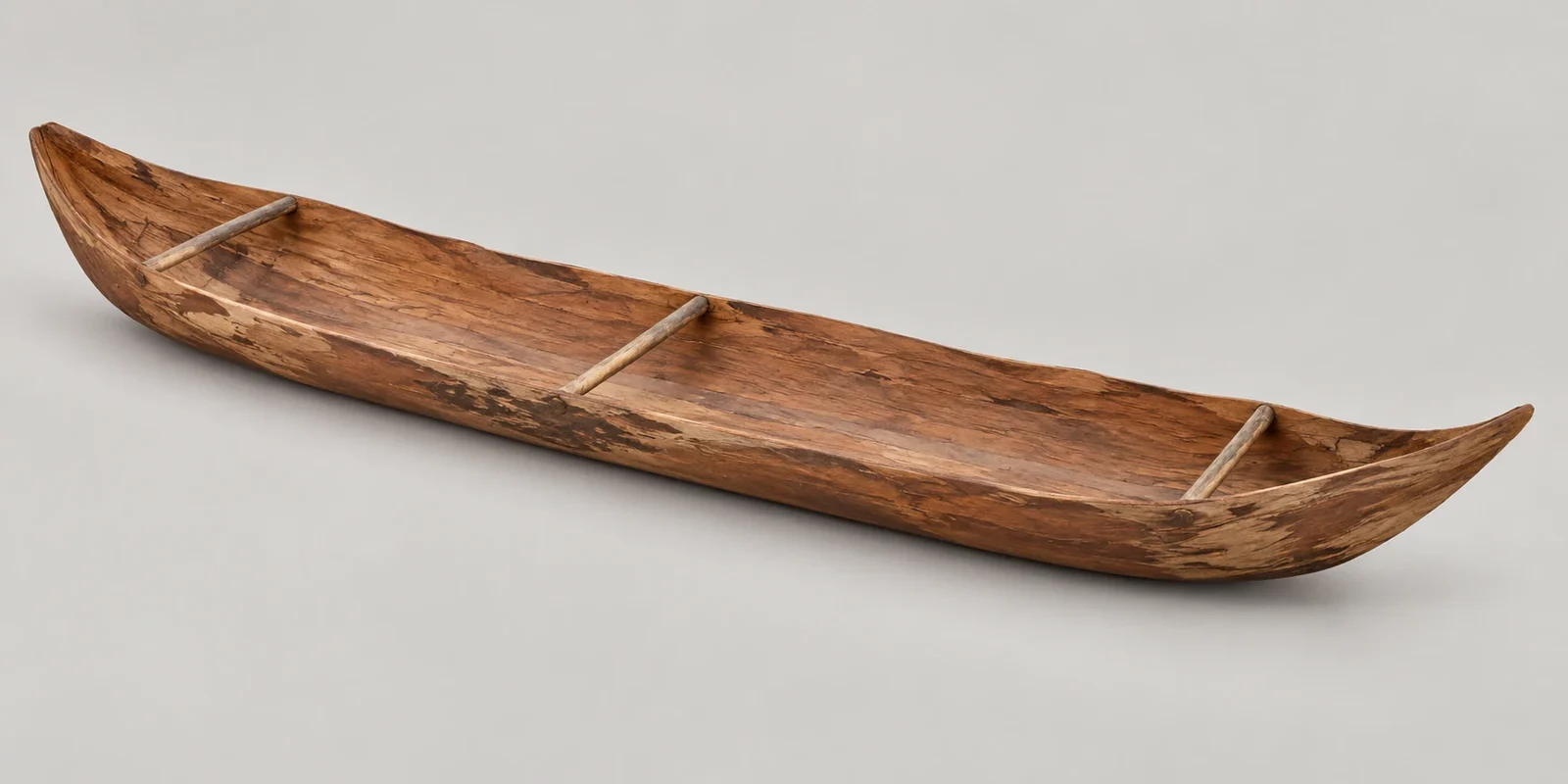
AI-generated interpretation of a documented historical implement; not a photograph or authenticated replica.
Overview
Eyre describes the mun as a canoe formed from a single sheet of bark taken from a gum tree. The sheet is lowered carefully, heated until pliable and shaped with wooden props. These remain until the bark sets, which he places at about a day, although he notes that a canoe may be used sooner. After launching, stretchers are fitted across the ends and middle to resist the bark curling inward. This is a construction based on the shaped sheet itself, rather than planks fastened to a separate hull frame. The original Plate IV places the complete long, shallow hull across the top of the page, with transverse supports visible within it.
For an ordinary fishing canoe, Eyre gives a length of fifteen feet, width of three feet and depth of eight inches. He describes the bottom as nearly flat, with one end narrower and raised; this end travels first. His account distinguishes these proportions from larger examples said to carry seven or eight people. The long implement called moo-aroo supplies propulsion: the user stands near the centre and works it on alternate sides, or pushes against the river bottom in shallow water. Those details explain the relationship between shallow hull, internal supports and propulsion without treating the drawing as a measured technical plan.
The name, construction sequence and dimensions belong to Eyre’s nineteenth-century account. Its preface identifies his work around the Murray River and credits other observers, including Moorhouse’s notes concerning Adelaide communities. The selected passage does not name an individual canoe maker or establish the illustrated specimen’s precise place of manufacture. It cannot represent every Australian Aboriginal watercraft tradition. A contextual object study can therefore show the documented bark form while leaving modern community identity, exact tree species, colour and ceremonial associations unspecified.
History & identity
Edward John Eyre’s colonial exploration and customs account, incorporating observations and testimony from others.
Sources & representation
Complete selected construction and use passages, preface, Plate IV legend and original scanned Plate IV reviewed.
Selected bibliography
Documented works and useful reading. This is not a list of every appearance.
- 01
Journals of Expeditions of Discovery into Central Australia
Both volumes treated as one publication. Selected volumeII implements account, pp.310–314; PlateIV figures1 and5; explanation p.511.
Language & cultural connections
Source-supported language and cultural connections have not yet been compiled for this profile.
References
Sources supporting this profile. Linked pages have their own scope and editorial standards.
- Historical colonial accountEyre’s construction and use descriptionsResearch access: 2026-10-21
- Digitized original illustrationOriginal1845 volumeII, PlateIV figures1 and5Research access: 2026-10-21
Image credits
AI-generatedAI-generated interpretation of a documented historical implement; not a photograph or authenticated replica.