
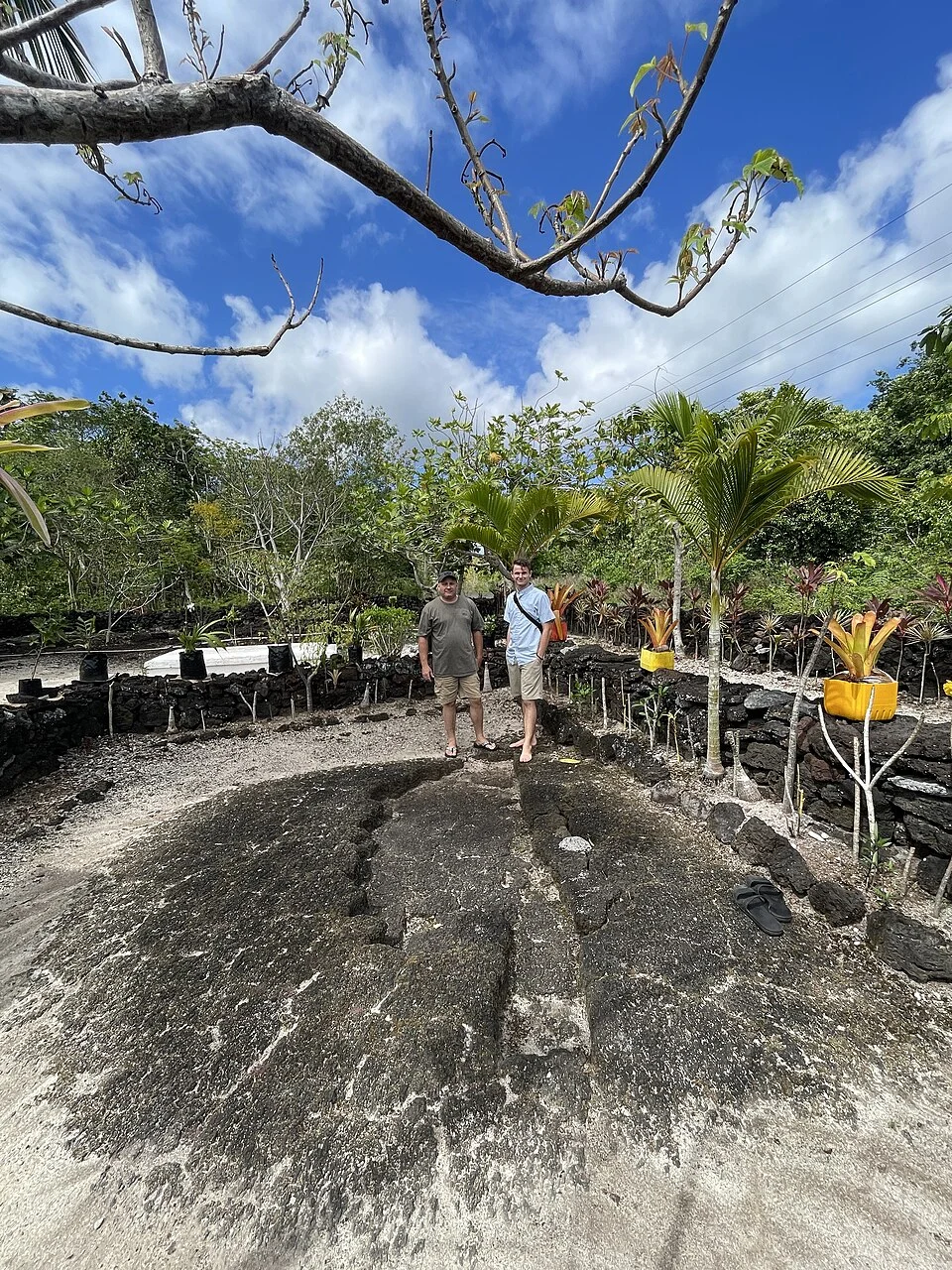
Moso's Footprint, named lava formation on Savai'i, with visitors
Photograph of the specifically named Moso's Footprint lava formation, a related landscape-tradition witness also identified by the Samoa Tourism Authority. It depicts the named place and visitors, not Moso himself or a biologically verified footprint.
Overview
Turner records Moso through different local representations and manifestations, including human and animal forms. One account places him among people by day and among gods at night. Another describes a man denied canoe passage from Tutuila to Savaiʻi. Moso answers his appeal and carries him over the sea, asking only for a bunch of coconuts when they reach the shore. In one village his representative is a stone, while another uses a white-shell-decorated bowl called Lipi. These objects situate encounters differently from the account of a ruler who moves among mortals by day and among gods at night. Turner also describes a human manifestation taking food from neighbouring plantations and vanishing when pursued. The appearance and disappearance support that particular account’s supernatural attribution without showing that every person accused of food theft was regarded in the same way.
The traveller forgets that promise. Near dawn Moso searches for the unwashed man still bearing sea salt, finds him and punishes him and the settlement. This is a specific narrative about neglected obligation, not a description of every protective manifestation. The Samoa Tourism Authority also presents the Savaiʻi lava formation called Moso's Footprint as associated with a giant's step across the ocean. That landscape interpretation is a separate public witness, rather than a measured footprint of an identified animal. Other household accounts associate Moso with a pet pigeon, a domestic fowl, an octopus or a Fuia bird. Turner reports that the Fuia’s morning or evening arrival could be read as acceptance, while absence suggested displeasure; its lack of midday appearance is separately linked to the sun’s glare. Names such as Long Moso and Moso the strong occur with different animal associations, including turtle, mullet and ray. Those differences are preserved as recorded local manifestations rather than collapsed into a creature with simultaneous bird, fish and human anatomy. The collector’s dismissive judgments about intermediaries are not adopted as descriptions of the communities.
Origins & earliest records
Turner's 1884 collection provides several separately situated manifestations and a rescue narrative at its conclusion; the inspected edition is a 1984 reprint. Samoa Tourism independently documents the continuing footprint-site association. These witnesses establish published versions and landscape interpretation, rather than proving a single chronology for every Moso account.
Records & interpretation
The historical narrative supplies selective manifestations and the broken promise after a sea rescue. The tourism authority supplies the separate lava-landform association. Together they show several modes of cultural transmission. The physical crack is evidence of an actual site, while its giant-footprint interpretation does not constitute zoological proof of Moso's body.
In the literature
“after a swim of a hundred miles”
Chapter XXII, concluding rescue and broken-promise story · Turner’s historical English rendering
Moso transports the stranded man from Tutuila to Savaii.
Selected bibliography
Documented works and useful reading. This is not a list of every appearance.
- 01
Samoa, a Hundred Years Ago and Long Before
Chapter IV, section 15; Chapter XXII, concluding Tutuila-to-Savaiʻi rescue and broken coconut promise.
Family & connections
A source-supported family tree or inspiration record has not yet been compiled for this profile. Related reading below indicates a connection in subject matter, not a proven lineage or creative influence.
Located primary passages
Specific passages supporting details in this entry, grouped by their published witness.
Primary source witness
George Turner, first printed London 1884; selected hosted text explicitly identifies the Institute of Pacific Studies, University of the South Pacific 1984 reprint. Chapter/numbered-section locators used because printed page numbers are not retained. Historical missionary-mediated accounts; differing village and household traditions remain distinct.
- Turner distinguishes stone and bowl representatives, human manifestations, selectively visible visits and household animal forms. The latter include pigeon, fowl, cuttle-fish, creeper bird, turtle, mullet and stingray in different families, rather than a single fixed body.
Specified numbered sections and complete episodes read; this is not a claim to have read the whole book. Turner’s missionary judgments and comparative labels are not adopted as contemporary Indigenous testimony. Prayer/song formulas omitted; no universal morphology or current practice inferred.
Primary source witness
George Turner, first printed London 1884; selected hosted text explicitly identifies the Institute of Pacific Studies, University of the South Pacific 1984 reprint. Chapter/numbered-section locators used because printed page numbers are not retained. Historical missionary-mediated accounts; differing village and household traditions remain distinct.
- Moso carries a stranded man across the sea in return for coconuts. When the man forgets the promised payment, Moso identifies his unwashed salt-covered body before dawn and kills him and the settlement’s people; Turner links the story with a phrase for sudden death.
Specified numbered sections and complete episodes read; this is not a claim to have read the whole book. Turner’s missionary judgments and comparative labels are not adopted as contemporary Indigenous testimony. Prayer/song formulas omitted; no universal morphology or current practice inferred.
Encyclopedia background
An additional attributed reference, separate from the editorial profile above.
Read the open encyclopedia overview
According to myth, Moso's Footprint in Samoa was made when the giant Moso stepped over to Fiji from Samoa, and the other footprint can be found on Viti Levu of Fiji. It is a 2m long depression in basalt.
Text from Wikipedia contributors, “Moso's Footprint”. CC BY-SA 4.0. Extracted introduction; formatting changed. Retrieved 5 October 2026. The source article may have changed since retrieval.
References
Sources supporting this profile. Linked pages have their own scope and editorial standards.
- Primary textGeorge Turner: Samoa, selected 1984 reprint of 1884 textResearch access: 2026-10-05
- CommunitySamoa Tourism Authority: Moso's FootprintResearch access: 2026-10-05
Image credits
Thematic illustrationMoso's Footprint, named lava formation on Savai'i, with visitors
Photograph of the specifically named Moso's Footprint lava formation, a related landscape-tradition witness also identified by the Samoa Tourism Authority. It depicts the named place and visitors, not Moso himself or a biologically verified footprint.