
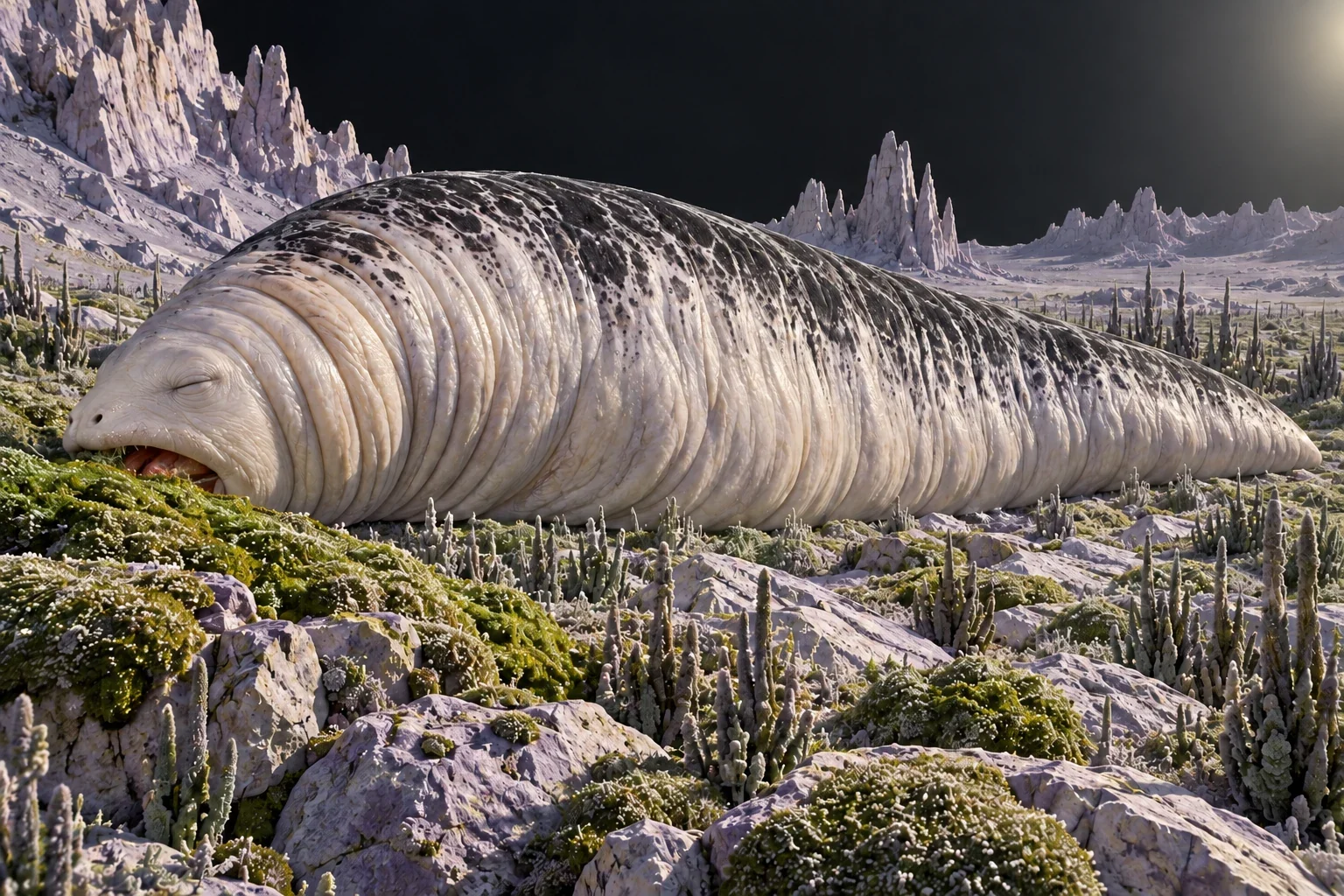
Modern AI interpretation of Wells's Mooncalf as an immense low-bodied animal with corrugated pale skin, dark back markings and eyes closed in sunlight. Unknown feet remain concealed; fine head details, colour and landscape arrangement are imagined.
Modern AI interpretation of Wells's Mooncalf as an immense low-bodied animal with corrugated pale skin, dark back markings and eyes closed in sunlight. Unknown feet remain concealed; fine head details, colour and landscape arrangement are imagined. Full-frame display derivative; no upscaling.
Overview
The mooncalf is the gigantic grazing animal encountered by Bedford and Cavor while searching for their lost sphere in Wells’s lunar jungle. Their first view is obstructed by moving stems, and Bedford warns that later observations have coloured his memory of it. He estimates a body perhaps two hundred feet long and roughly eighty feet around. Those figures are the narrator’s approximations, not measured zoological data or a fixed size for every individual.
The animal’s body lies close along the ground. It has corrugated white leathery skin darkening into patches along the backbone, flanks that rise and fall with heavy breathing, and a small head partly engulfed by a fat neck. Bedford describes small nostrils, a wet broad mouth and eyes kept tightly shut in sunlight. The first encounter reveals no feet. A faithful interpretation can therefore retain the low, slug-like mass and obscure its underside rather than supplying invented hooves, a quadrupedal stance or a terrestrial calf’s horns.
Movement is a rolling, dragging wallow that creases the skin and forces a passage through the scrub. Its bellow is accompanied by hot moist breath, and the open mouth appears as a deep red cavity. Later animals browse dense speckled green growth on rocks, lying against their food and chewing greedily. Although the mouth is called omnivorous, the selected scene demonstrates grazing; it does not establish a complete diet or predatory behaviour.
A clothed Selenite appears to guide the animals toward pasture, and another drove passes through a ravine. The later account names herding and related occupations among the lunar people and describes the intensive training of mooncalf minders. These connections make the creature part of an organised fictional food economy rather than a lone supernatural monster. The name and setting belong specifically to Wells’s novel; the unrelated Harry Potter Mooncalf is excluded, and no adaptation design is imported.
First appearances & development
H. G. Wells presents these lunar beings in The First Men in the Moon. The selected novel passages distinguish Bedford’s first encounters from his later compilation of Cavor’s transmitted observations.
Canon & continuity
Retained original prose supports selected anatomy, encounters and reported institutions. The lunar environment and biological theories are fictional, and the narrators qualify several impressions and inferences.
Selected bibliography
Documented works and useful reading. This is not a list of every appearance.
- 01
The First Men in the Moon
Primary chapters XI and XXIV; selected passages actually retained.
Family & connections
A source-supported family tree or inspiration record has not yet been compiled for this profile. Related reading below indicates a connection in subject matter, not a proven lineage or creative influence.
References
Sources supporting this profile. Linked pages have their own scope and editorial standards.
- PrimaryThe First Men in the Moon — primary literary textResearch access: 2026-10-11
- CustodialGutenberg ebook 1013 — edition and rights recordResearch access: 2026-10-11
Image credits
Unofficial modern AI interpretationModern AI interpretation of Wells's Mooncalf as an immense low-bodied animal with corrugated pale skin, dark back markings and eyes closed in sunlight. Unknown feet remain concealed; fine head details, colour and landscape arrangement are imagined.
Modern AI interpretation of Wells's Mooncalf as an immense low-bodied animal with corrugated pale skin, dark back markings and eyes closed in sunlight. Unknown feet remain concealed; fine head details, colour and landscape arrangement are imagined. Full-frame display derivative; no upscaling.