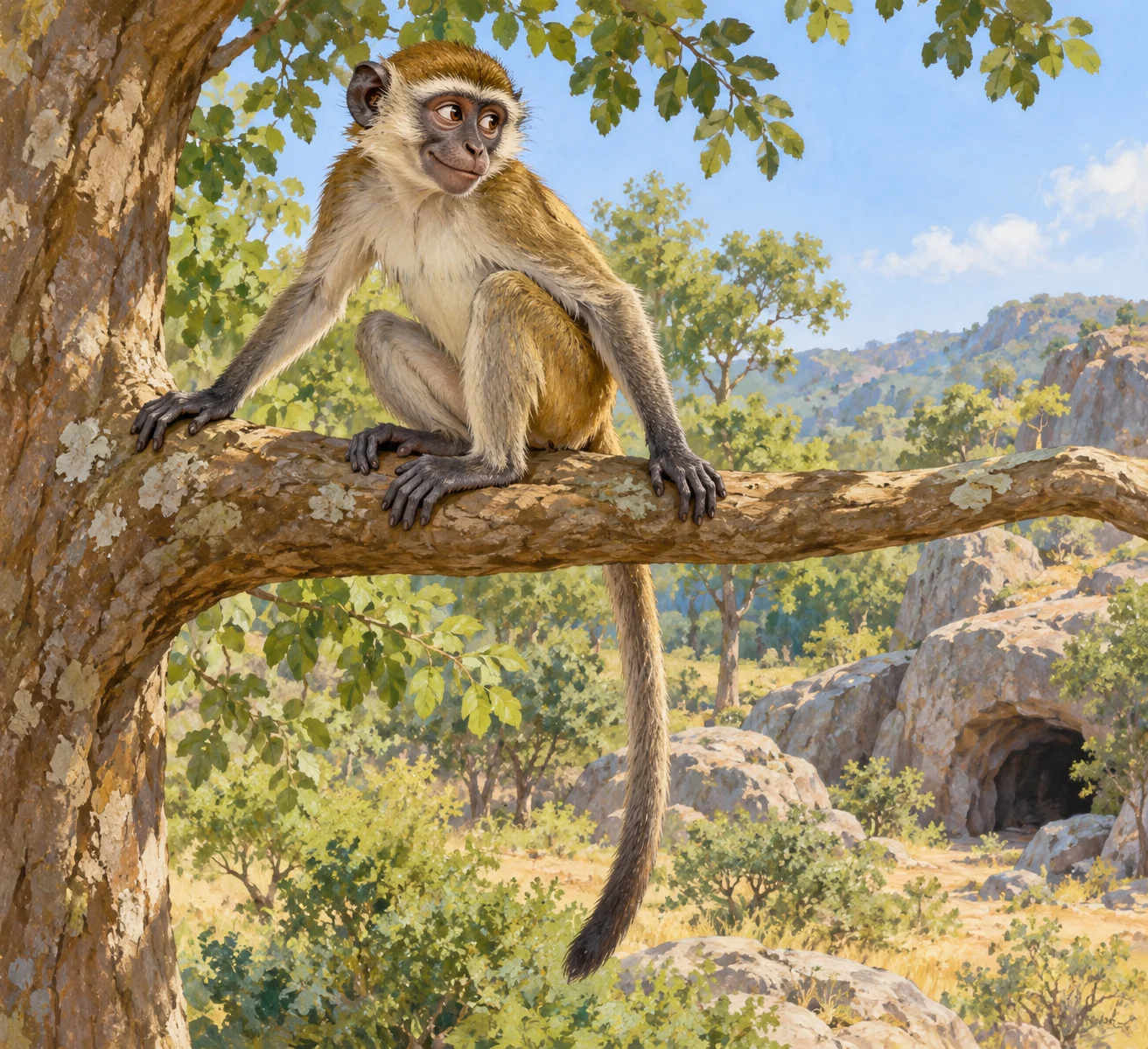
The escaped monkey back in the tree; species, colouring, tail form and woodland detail imagined.
Original narrative illustration; species, colour and detailed setting interpreted, not authenticated natural history or ethnography.
Overview
The unnamed monkey in Bérenger-Féraud’s seventh tale of Part I begins by mocking a lion. From a branch he copies the larger animal’s movements and continues even after being threatened with death. His grimaces and acrobatics make him lose his balance, and he falls into the lion’s grasp. Rather than eat him immediately, the lion puts him in a hole, seals the entrance with a large stone and goes to fetch a companion for the meal. The monkey cannot push the stone away. His opportunity comes when a wolf, with whom he has previously quarrelled, hears his cries and asks why he is weeping.
The monkey claims that he is singing while digesting a feast and waiting for a hare to bring more meat. He says there is plenty left for his old friend. Tempted by this invented abundance, the wolf shifts the stone and enters cautiously. The monkey slips between his legs and escapes, leaving him trapped. When the lion returns with his companion, the pair simply substitutes the wolf for their intended meal. The monkey is already back in the tree, celebrating his escape from both enemies. The compiler then compares the deception with La Fontaine’s Le Loup et le Renard and quotes that separate fox-and-well fable. The comparison belongs to the book’s editorial voice; the monkey is not silently turned into La Fontaine’s fox, and no historical line of borrowing is established.
Origins & earliest records
Part I, VII, La finesse du singe et la naïveté du loup, in the 1885 Recueil. No personal name, species, village, individual narrator or specific language community is supplied for this monkey.
Records & interpretation
Complete narrative and the compiler’s ensuing comparison, printed pp. 51–56, with actual text-page images for the opening and escape. Complete introduction and Part I appreciation retained.
Selected bibliography
Documented works and useful reading. This is not a list of every appearance.
- 01
Recueil de contes populaires de la Sénégambie
Part I, VII, La finesse du singe et la naïveté du loup, printed pp. 51–56; complete tale and relevant commentary retained.
Family & connections
A source-supported family tree or inspiration record has not yet been compiled for this profile. Related reading below indicates a connection in subject matter, not a proven lineage or creative influence.
References
Sources supporting this profile. Linked pages have their own scope and editorial standards.
- Historical French collected-tale publicationBérenger-Féraud 1885: complete La finesse du singe et la naïveté du loupResearch access: 2026-10-18
Image credits
AI-generatedThe escaped monkey back in the tree; species, colouring, tail form and woodland detail imagined.
Original narrative illustration; species, colour and detailed setting interpreted, not authenticated natural history or ethnography.