
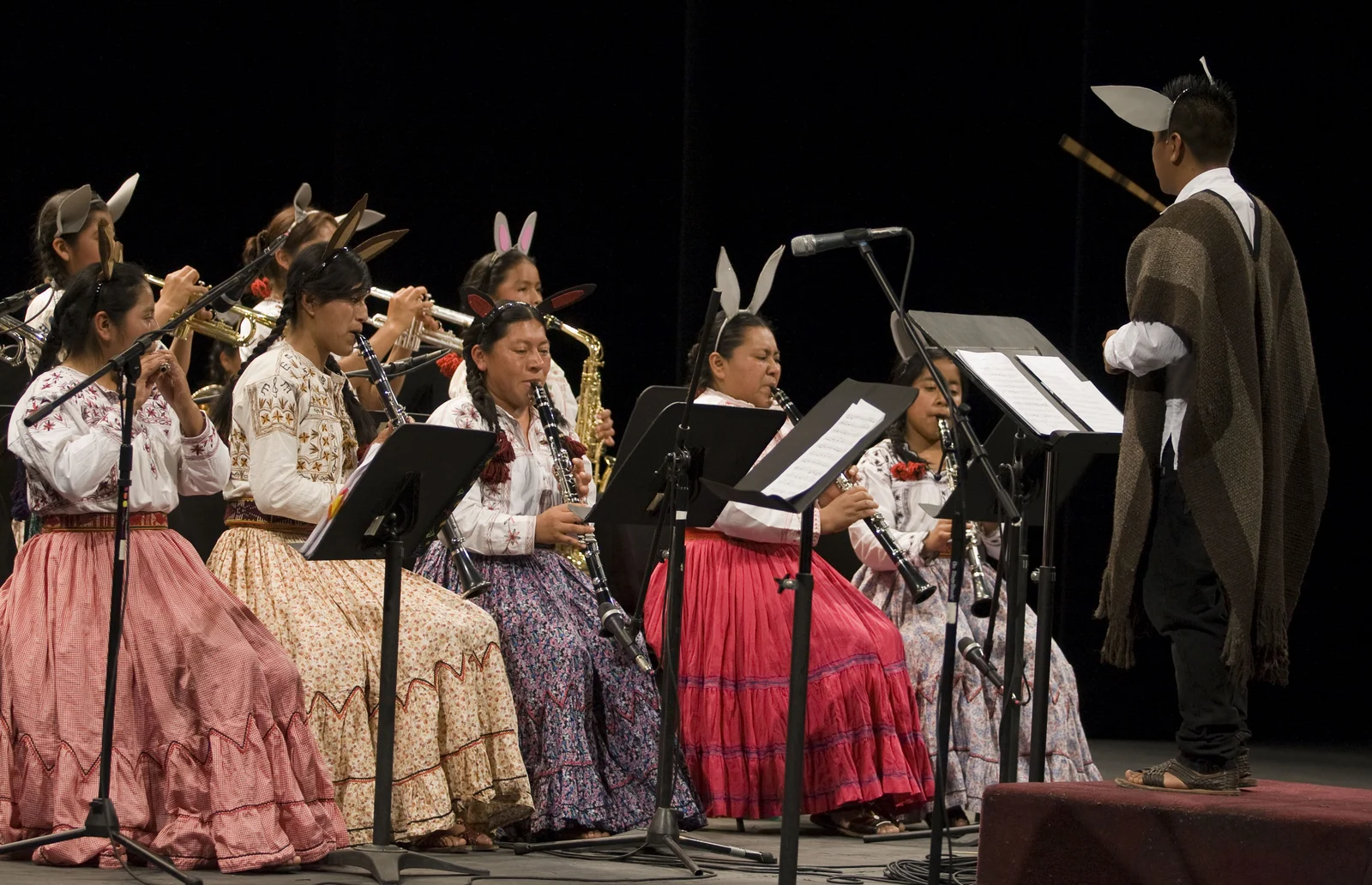
Musicians of Mujeres del Viento Florido play clarinets, flute and brass on stage while a conductor faces them; several wear theatrical animal-ear headbands.
Mujeres del Viento Florido, the women’s band from Santa María Tlahuitoltepec, performs at Mexico City’s Esperanza Iris theatre on17August2014. The stage costume and ensemble document this performance rather than a uniform appearance or practice of Mixe communities.
Overview
Mixe communities are associated with northeastern Oaxaca, where a mountainous region extends through markedly different elevations and environments. INPI describes high, middle and low zones rather than one uniform landscape. Its language atlas places Mixe within the Mixe-Zoque family and distinguishes six variants, with forms including ayöök, ayuujk, ayuuk, eyuk and ayuk. These are language classifications and local naming distinctions. They should not be mistaken for biological divisions, six separate governments or a requirement that every person have the same linguistic proficiency. Nor is Mixe another name for the neighbouring Mixtec peoples.
Colmix, an interdisciplinary network from the Mixe region, presents writing as work undertaken by communities, teachers, cultural promoters and individual authors. Its public book list describes collaborative efforts toward an alphabet in the 1980s and continuing gatherings devoted to life and language. It brings together monolingual and bilingual publications from schools, government institutions, independent publishers and organizations. The range includes theatre, recipes, poetry, environmental writing and science communication. This is a selective catalogue, not a closed canon: its invitation to readers asks what other books belong in school and community libraries.
Music education has its own institutions. The Centro de Capacitación Musical y Desarrollo de la Cultura Mixe, or CECAM, traces its school to 1977. Its current educational offer includes introductory work with children, an induction programme for young people and a professional technical programme in traditional Oaxacan music coordinated with INBAL for certification. Band participation appears alongside these courses. The institution connects learning with continuing musical practice; its public educational offer is evidence of organized training rather than a claim that musical talent is an inherited characteristic of all Mixe people.
A June 2023 account by Julio César Gallardo and Tajëëw Díaz describes the circulation of Juan Rulfo’s Luvina in the Mixe of Tlahuitoltepec. The 2017 translation was associated with Colmix and teacher Raquel Diego Díaz. The authors recall teacher Félix Hernández saying that he first read the story in Mixe. They also report a February 2023 delivery of 550 books and accompanying discs to community authorities for local libraries and schools. Literary translation here involves teachers, readers, recordings and public distribution. The report documents that process; neither the translated story nor the recordings have been used here as a directly inspected account of community history.
History & identity
Northeastern Oaxacan community histories are not reduced to the dates of modern schools or publishing projects.
Sources & representation
Complete INPI geography and language introductions, full Colmix catalogue, CECAM written educational offer and complete June2023 Gallardo/Díaz article read. Linked books and recordings were not inspected.
Selected bibliography
Documented works and useful reading. This is not a list of every appearance.
- 01
“Luvina” en Xaamkëjxp
Complete June2023 report read; distinguishes the 2017 translation and 2023 distribution. Includes a named teacher’s recollection.
- 02
Más de 20 libros en lengua mixe
Undated selective catalogue, read as bibliography and an account of publishing; linked volumes not read.
Language & cultural connections
These connections link languages or specific cultural works and institutions; they do not establish biological ancestry or ethnic identity.
CECAM
CECAM advertises children’s and introductory music education, band formation and professional certification coordinated with INBAL. This documents institutional teaching, not an inherited musical trait or a uniform practice of every Mixe community.
References
Sources supporting this profile. Linked pages have their own scope and editorial standards.
- Official Indigenous-affairs referenceINPI: Mixe regional geographyResearch access: 2026-10-05
- Official language referenceINPI: Mixe language introductionResearch access: 2026-10-05
- Community cultural networkColmix: writing and bibliographyResearch access: 2026-10-05
- Community music education institutionCECAM: educational offerResearch access: 2026-10-05
- Named community-authored cultural reportFAHHO: Gallardo and Díaz on LuvinaResearch access: 2026-10-05
Image credits
Documentary photograph of a named community ensemble at a dated public concertMusicians of Mujeres del Viento Florido play clarinets, flute and brass on stage while a conductor faces them; several wear theatrical animal-ear headbands.
Mujeres del Viento Florido, the women’s band from Santa María Tlahuitoltepec, performs at Mexico City’s Esperanza Iris theatre on17August2014. The stage costume and ensemble document this performance rather than a uniform appearance or practice of Mixe communities.