
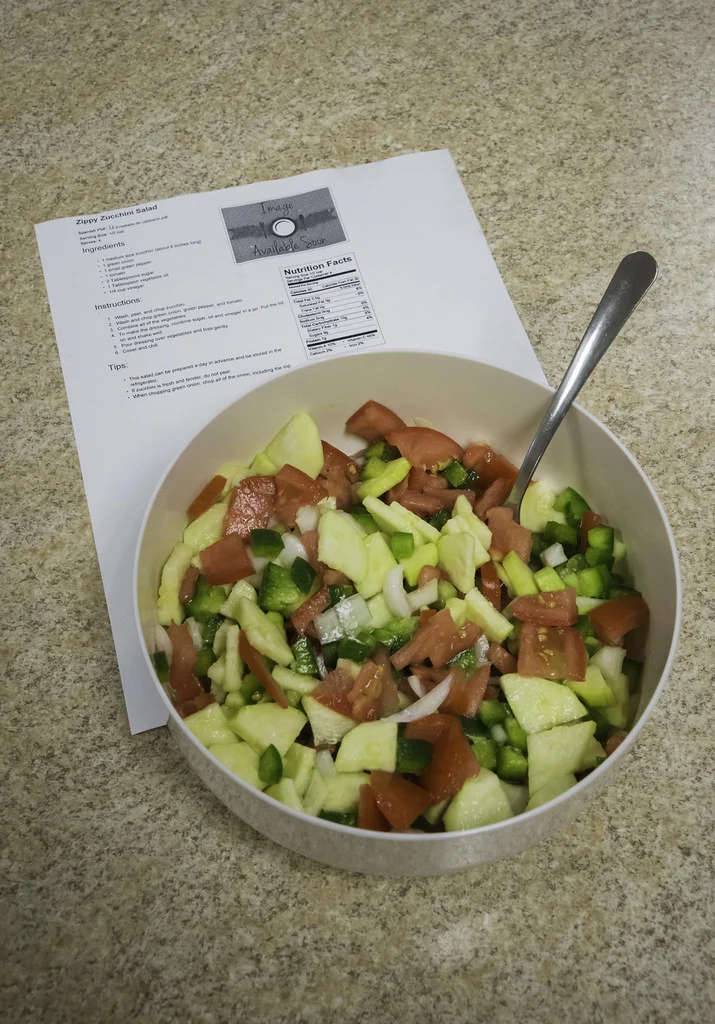
Zucchini salad and recipe sheet prepared during a Menominee Nation nutrition-education class in Keshena on 10 September 2014, photographed by USDA’s Bob Nichols
This zucchini salad was prepared during a nutrition-education class at the Food Distribution Center in Keshena on 10 September 2014. The original USDA caption connects the class with the College of Menominee Nation and University of Wisconsin Extension. The photograph records a particular educational activity; it is not presented as traditional Menominee cuisine or a portrait of the community.
Overview
The Menominee Indian Tribe of Wisconsin locates its origin account at the mouth of the Menominee River and names Bear, Eagle, Wolf, Moose and Crane as its five ancestral clans. The community's own presentation places this account alongside continuing language, religion and political independence. It should be read as a statement of collective history and responsibility, rather than converted into a biological classification or a requirement that every individual practise identically.
The tribal government's brief history identifies Keshena as its governmental seat and lists Neopit, Middle Village, Zoar and South Branch among the reservation's principal communities. Its account of federal termination and the grassroots struggle for restoration culminates in the act signed on 22 December 1973. That date concerns federal recognition, not the beginning of the people. Tribal membership and living on the reservation also remain different matters; the same account discusses members unable to reside there because of housing and employment constraints.
Cultural preservation has its own institutional history. The legislature established the Historic Preservation Department in 1991, and it received Tribal Historic Preservation Office designation in 1999. Its public account connects protection of cultural resources and repatriation with language teaching. A specifically dated example is an August 2005 immersion camp, where fifteen young participants used Menominee during activities including basket making, pottery and nature walks. This is evidence of a particular educational undertaking, not a current timetable for every program.
A College of Menominee Nation announcement dated 25 April 2024 describes collaboration between its Teacher Education Department and the tribal Language and Culture Commission. It links early-childhood immersion with a charter school established in 2023 for children progressing from that program. Lead immersion teacher Luke Besaw explains the value of teachers learning cultural activities through participation. The proposed professional development and involvement of community knowledge holders are stated aims; the announcement alone does not establish later completion or measured results.
Community educational publishing also includes The Menominee Clans Story, introduced by the College as a resource combining art, language, maps and music with classroom materials. Its public introduction addresses teachers as users of a community-produced curriculum. That introduction documents an educational resource; it does not substitute for reading every linked narrative, studying the complete lesson plans or listening to the recordings.
History & identity
The Nation situates its origin account within its ancestral river homeland; institutional and federal-recognition dates are separate.
Sources & representation
Tribal self-description and historical overview, complete preservation-department body, complete 2024 college announcement and bounded Clans Story introduction. Linked laws, lessons and recordings were not examined.
Selected bibliography
Documented works and useful reading. This is not a list of every appearance.
- 01
The Menominee Clans Story
Community educational resource; public introductory description inspected, not all linked contents.
- 02
3 Questions for...Alumna Ada Deer
Columbia School of Social Work,5March2021; explicitly edited and condensed interview.
Language & cultural connections
These connections link languages or specific cultural works and institutions; they do not establish biological ancestry or ethnic identity.
College of Menominee Nation–Language and Culture Commission partnership
The College’s April 2024 announcement describes collaboration supporting immersion-teacher development. This records a language-reclamation initiative, not inherited identity.
Algonquian language family
UW–Madison’s account of linguist Monica Macaulay’s fieldwork identifies Menominee as an Algonquian language. This concerns linguistic affiliation, not biological ancestry or Nation citizenship.
Located primary passages
Specific passages supporting details in this entry, grouped by their published witness.
3 Questions for...Alumna Ada Deer
Columbia School of Social Work,5March2021; explicitly edited and condensed interview.
- Deer connects her political work with family influences, education and responsibilities to Menominee people. She describes restoration as collective work involving community members and legal allies, alongside her own leadership. This is a named participant’s retrospectively edited account, rather than an anonymous cultural portrait, a complete memoir or an independent verification of every historical detail.
Related memoir and linked legislation unread. Metaphorical references to inherited activism are not biological claims about identity.
References
Sources supporting this profile. Linked pages have their own scope and editorial standards.
- Community-authoredWho We AreResearch access: 2026-10-05
- Community-authoredBrief HistoryResearch access: 2026-10-05
- Community-authoredHistoric Preservation DepartmentResearch access: 2026-10-05
- Community-authoredLanguage-reclamation partnership, 25 April 2024Research access: 2026-10-05
- Community-authoredThe Menominee Clans Story introductionResearch access: 2026-10-05
Image credits
Contextual community nutrition-program photographZucchini salad and recipe sheet prepared during a Menominee Nation nutrition-education class in Keshena on 10 September 2014, photographed by USDA’s Bob Nichols
This zucchini salad was prepared during a nutrition-education class at the Food Distribution Center in Keshena on 10 September 2014. The original USDA caption connects the class with the College of Menominee Nation and University of Wisconsin Extension. The photograph records a particular educational activity; it is not presented as traditional Menominee cuisine or a portrait of the community.