
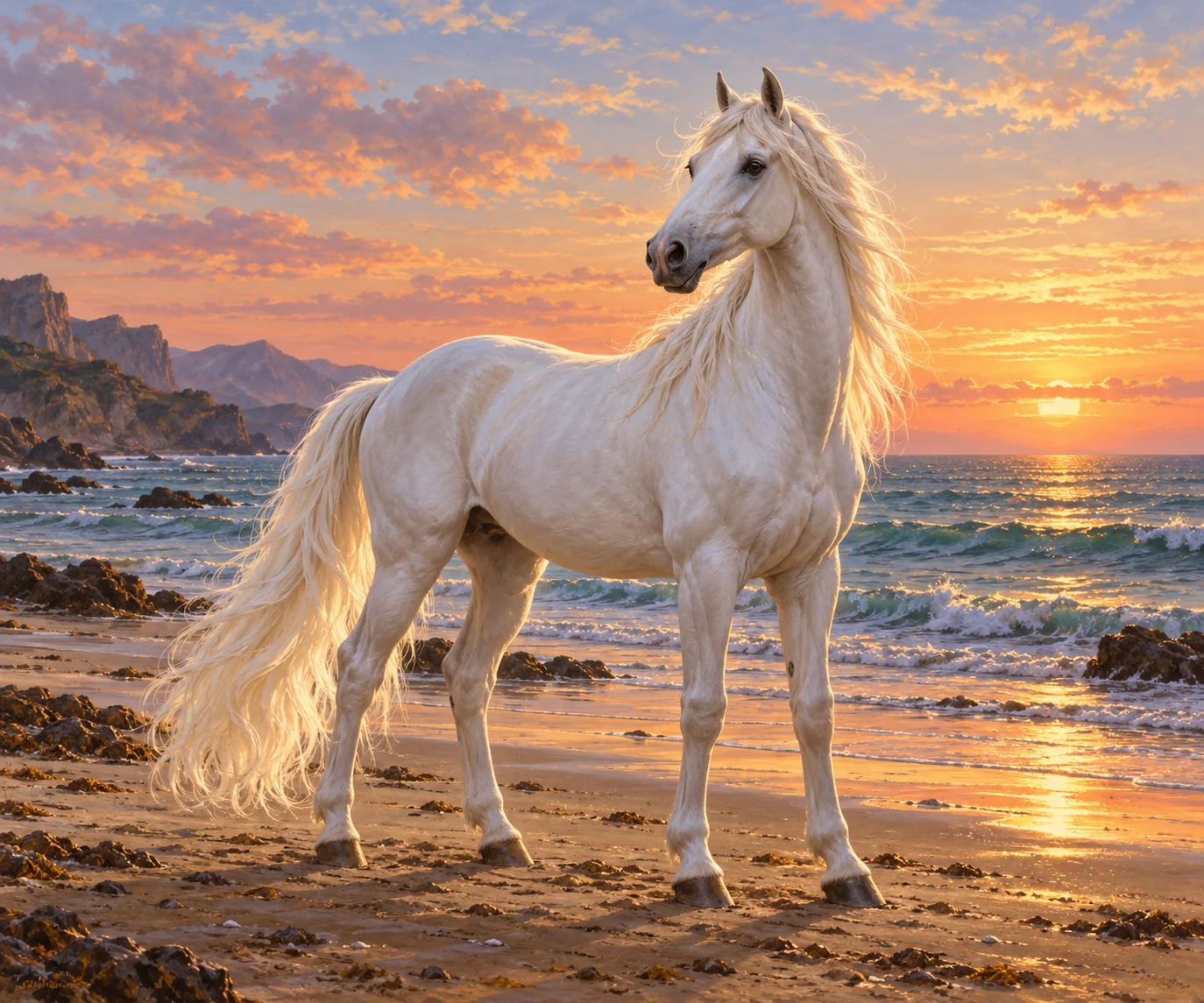
The snow-white Meerross at the sea shore; horse anatomy and coastal staging interpreted from the tale.
Original narrative illustration; invented visual particulars are not authenticated ethnography or a historical portrait.
Overview
A king dreams of a snow-white horse springing from the sea at sunrise, circling the world three times in an instant and returning beneath the water. His three sons set out to find it, and the youngest takes the dangerous middle road. After a long wandering he receives shelter from the mother of seven Narts. Her youngest son explains the horse’s daily passage, its bath in a milk lake and the golden saddle and silver bit kept in a nearby plane tree. The prince waits by the shore, seizes the horse’s neck and holds on through its violent leaps. It acknowledges his victory, speaks to him and allows him to ride.
The horse then acts as an adviser rather than merely a means of travel. When the prince finds a shining golden down-feather, it warns that either taking or leaving it will bring regret. A king demands the feather’s owner, and the horse explains how the sea king’s daughters arrive as doves and remove their skins to bathe. Its advice enables the prince to take the youngest daughter’s skin, compelling her to follow him. Later, after she has escaped the unwanted royal marriage and joined the prince, his jealous brothers send him into a dry well. The horse evades capture, returns to the captive princess and explains how to rescue him. She cuts and twists her own hair into a long rope; the horse takes it to the well and draws him out. The brothers flee, and the prince’s marriage closes the story.
Origins & earliest records
Schiefner prints The Meerross as the first tale in his 1873 Avar collection, with a German rendering beneath the Avar text. The retained foreword describes a linguistic research purpose and introduces Reinhold Köhler’s comparisons. Neither an exact storyteller nor a collection village is established by the available prefatory pages.
Records & interpretation
Complete German tale I, printed pp.1–12, including the sea emergence, capture, advice and final well rescue. The retained parts of Köhler’s note I are incomplete because printed prefatory pp.VI–VII are missing from this scan.
Selected bibliography
Documented works and useful reading. This is not a list of every appearance.
- 01
Awarische Texte
St Petersburg: Imperial Academy of Sciences, Mémoires, seventh series, XIX, no.6. Avar texts with German renderings; consulted scan has prefatory gaps.
Family & connections
A source-supported family tree or inspiration record has not yet been compiled for this profile. Related reading below indicates a connection in subject matter, not a proven lineage or creative influence.
References
Sources supporting this profile. Linked pages have their own scope and editorial standards.
- Historical Avar tale collection with German renderings and comparative notesSchiefner, Awarische Texte, original 1873 editionResearch access: 2026-10-18
Image credits
AI-generatedThe snow-white Meerross at the sea shore; horse anatomy and coastal staging interpreted from the tale.
Original narrative illustration; invented visual particulars are not authenticated ethnography or a historical portrait.