
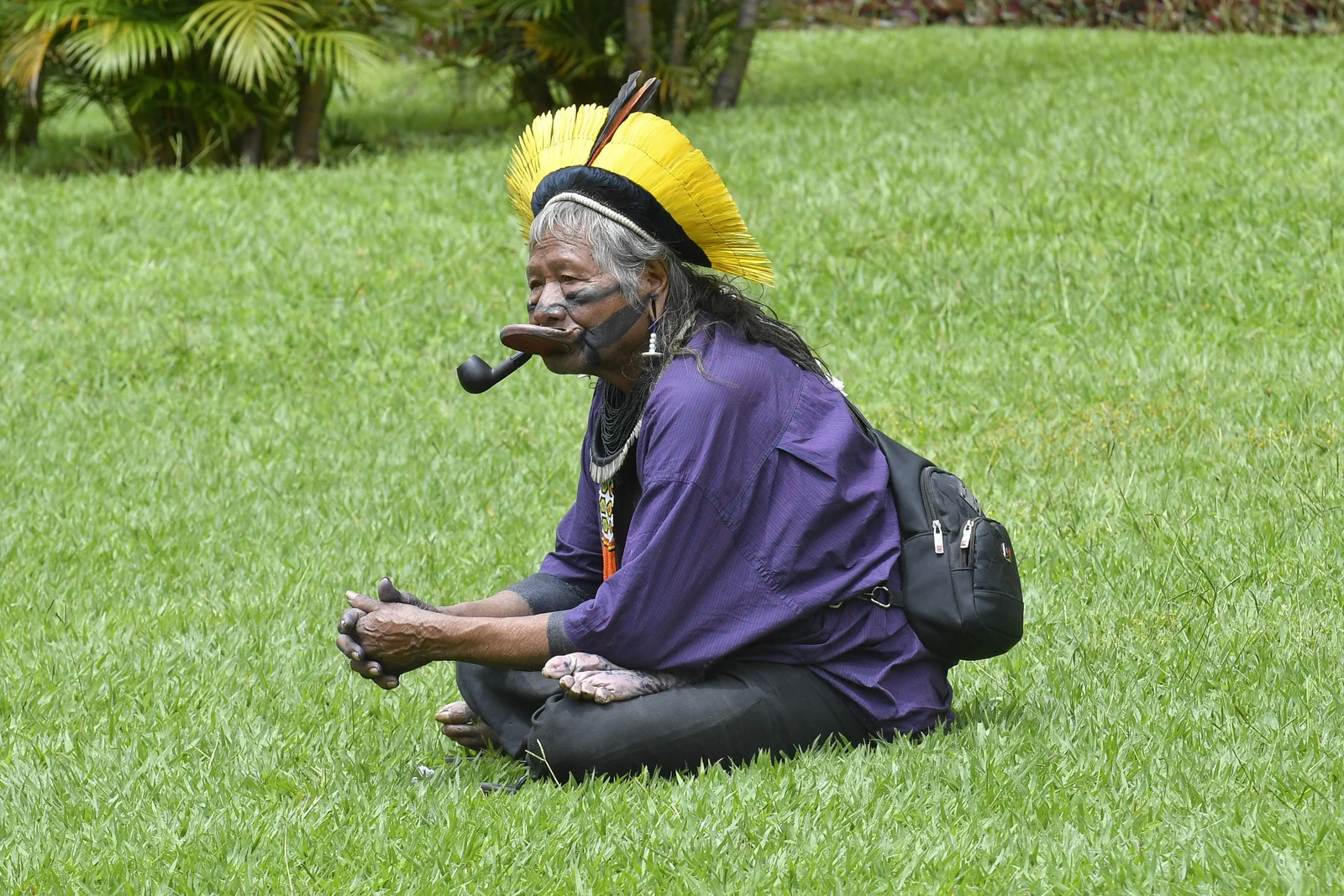
Raoni Metuktire sits cross-legged on grass during a2019 Senate visit, wearing a purple shirt and yellow feather headdress, with a black backpack and pipe.
Raoni Metuktire during his visit to Brazil’s Senate on 27 March 2019, photographed by Geraldo Magela. This is a particular public figure and occasion, not a representative appearance or shared political position of all Mẽbêngôkre people.
Overview
Mẽbengôkre, widely known as Kayapó, are a living Indigenous people with communities in Pará and Mato Grosso. Instituto Socioambiental’s account locates villages across the upper Iriri, Bacajá, Fresco and other Xingu tributaries. It identifies Mebengôkre as a self-designation and places the language in the Jê family. Its language section notes differences among community varieties and differing knowledge of Portuguese. These linguistic relationships and experiences do not describe a biological classification or a single uniform community.
One regional institution is Instituto Kabu, founded on 27 March 2008 by the villages of Baú, Pukany and Kubemkokre. Its own history explains that it was established to implement the Indigenous component of the BR-163 environmental plan under Funai supervision. It describes work to reduce road-related impacts while defending Kayapó Mekrãgnotí rights and forest integrity. The institution’s founding is a modern organizational milestone, not the origin of the communities it serves.
Kabu’s description of its activities identifies Indigenous leadership supported by a small professional team and emphasizes training as well as representation. Its four program areas cover territorial monitoring and management, economic alternatives and food security, environmental education and cultural documentation, and project administration. Its affiliations extend into the Baú, Menkragnoti and Panará Indigenous lands. Organizational participation therefore should not be equated automatically with one people’s identity, nor should Kabu be presented as the sole voice of all Mẽbengôkre communities.
A November 2022 report names Tomejkwa Bepakati, Doto Takak ire and Mydjere Kayapó in meetings about future work with partner institutions. It describes workshops with children, young people and women undertaken since 2021, together with preparation of territorial planning and educational materials. Agroforestry and teacher training were among the activities discussed for 2023. Those forward-looking plans remain distinct from the workshops already reported, and the named offices belong to the report’s historical moment.
Kabu’s publications catalogue makes documentary and political communication visible alongside these programs. It lists Menire Bê Kayapó Djapêj, subtitled The Kayapó Woman and Her Work, a Kayapó-Menkragnoti consultation protocol, and statements addressing mining and collective land rights. These are identified resources rather than fully examined books or legal documents. Their presence shows that public community expression includes written institutional materials as well as the oral traditions mentioned in Kabu’s founding account.
History & identity
Selected Indigenous-peoples documentation and complete public accounts from a regional Indigenous organization.
Sources & representation
ISA opening identity, name and language sections; complete Kabu history, activities, November2022 report and publication catalogue. Education subpage failed to load and was not used. Linked PDFs and films not read.
Selected bibliography
Documented works and useful reading. This is not a list of every appearance.
- 01
Menire Bê Kayapó Djapêj: The Kayapó Woman and Her Work
Undated catalogue entry only, PDF not inspected.
Language & cultural connections
Source-supported language and cultural connections have not yet been compiled for this profile.
References
Sources supporting this profile. Linked pages have their own scope and editorial standards.
- Indigenous organization or specialist documentationISA Mẽbengôkre profileResearch access: 2026-10-05
- Indigenous organization or specialist documentationKabu historyResearch access: 2026-10-05
- Indigenous organization or specialist documentationKabu activitiesResearch access: 2026-10-05
- Indigenous organization or specialist documentationKabu November2022 reportResearch access: 2026-10-05
- Indigenous organization or specialist documentationKabu publicationsResearch access: 2026-10-05
Image credits
Dated documentary photograph of source-identified Kayapó leader Raoni MetuktireRaoni Metuktire sits cross-legged on grass during a2019 Senate visit, wearing a purple shirt and yellow feather headdress, with a black backpack and pipe.
Raoni Metuktire during his visit to Brazil’s Senate on 27 March 2019, photographed by Geraldo Magela. This is a particular public figure and occasion, not a representative appearance or shared political position of all Mẽbêngôkre people.