
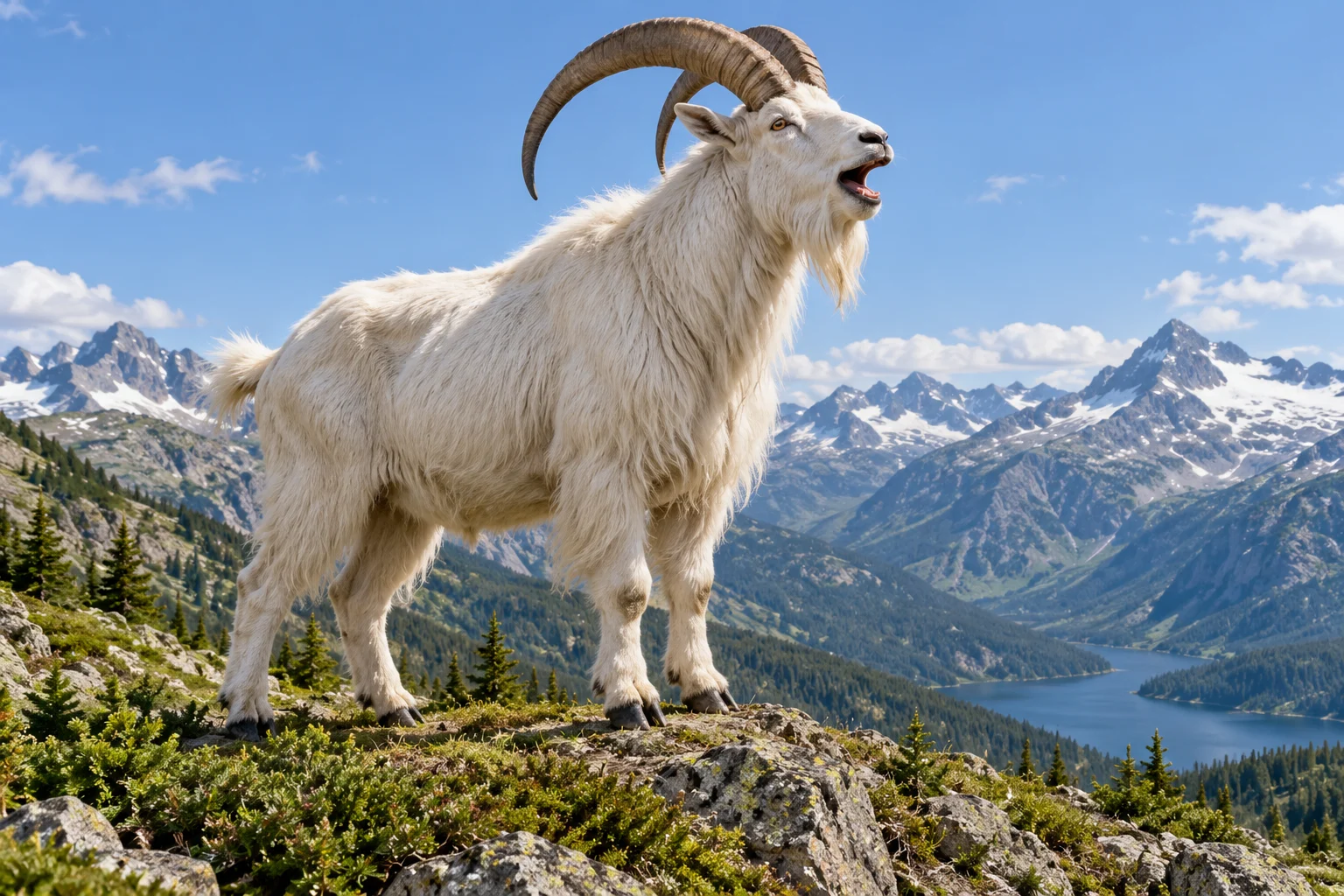
AI-generated giant-goat interpretation.
Coat, horns, pose and scale staging imagined.
Overview
Nassau’s Mpongwe marriage tale places an enormous goat among the mountains. The other animals obtain meat by entering his open mouth and cutting portions from an interior described as a house full of flesh. His heart alone must remain untouched. They conceal this resource from Leopard, fearing his appetite for that organ. Tortoise deliberately reveals it after Leopard has taken his wife and possessions, turning access to the goat into a revenge plan.
Inside the goat, Leopard disregards repeated warnings and cuts the heart. The goat dies and his mouth closes, trapping the visitors. Leopard appropriates the stomach as a hiding place, leaving Tortoise to conceal himself in the gall-bladder. When the other animals divide the carcass, the discarded sac carries Tortoise into the bushes. He pretends to have arrived innocently, then directs the assembled animals to pierce the stomach containing Leopard. The goat’s death therefore enables Tortoise to recover his marriage and goods, but destroys the shared source of meat.
The separately collected Bapuku/Benga tale begins with Tortoise and Leopard sharing a town troubled by a lack of meat. Tortoise finds the enormous goat tied in the forest. Identified as a gift of Njambe, the Creator, it speaks and opens an aperture in its body on request. Tortoise initially keeps the location secret; Leopard discovers it by following ashes leaking from a deliberately pierced travelling-bag. Here Tortoise protests when Leopard reaches for the heart, rather than first plotting the goat’s death as revenge for a stolen marriage.
When the Bapuku/Benga goat dies, Tortoise escapes in its urinary bladder, not the Mpongwe tale’s gall-bladder. Leopard again dies in the retained stomach. This version continues into conflict between their children, ending with Tortoise’s family fleeing into water. The narratives share an enormous, vulnerable meat-giving animal, but differ in entry, motives and aftermath. Neither describes how removed portions regenerate or supplies a measured body size. These are related attributed witnesses, not a single continuous biography.
Origins & earliest records
Mpongwe telling recorded at Libreville and a separate Bapuku/Benga telling recorded at Batanga.
Records & interpretation
Complete Part First tale4 and Part Second tale32, together with both collection forewords and general preface.
Selected bibliography
Documented works and useful reading. This is not a list of every appearance.
- 01
Where Animals Talk: West African Folk Lore Tales
Part First, Mpongwe tale4, Tasks Done for a Wife, pp.30–37
- 02
Where Animals Talk: West African Folk Lore Tales
Part Second, Benga tale32, The Giant Goat, pp.202–207
Family & connections
A source-supported family tree or inspiration record has not yet been compiled for this profile. Related reading below indicates a connection in subject matter, not a proven lineage or creative influence.
References
Sources supporting this profile. Linked pages have their own scope and editorial standards.
- Historical collected narrativeNassau1912, Part First, Mpongwe tale4, Tasks Done for a Wife, pp.30–37Research access: 2026-10-18
- Historical collected narrativeNassau1912, Part Second, Benga tale32, The Giant Goat, pp.202–207Research access: 2026-10-18
Image credits
AI-generatedAI-generated giant-goat interpretation.
Coat, horns, pose and scale staging imagined.