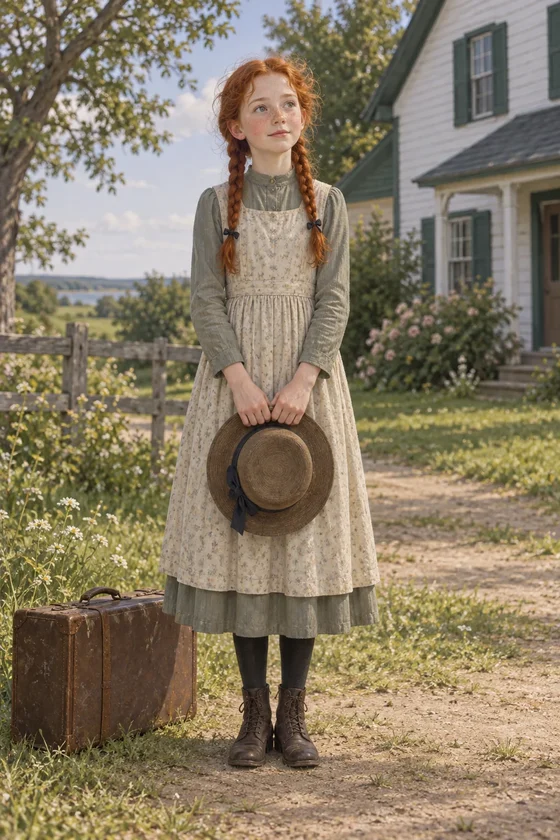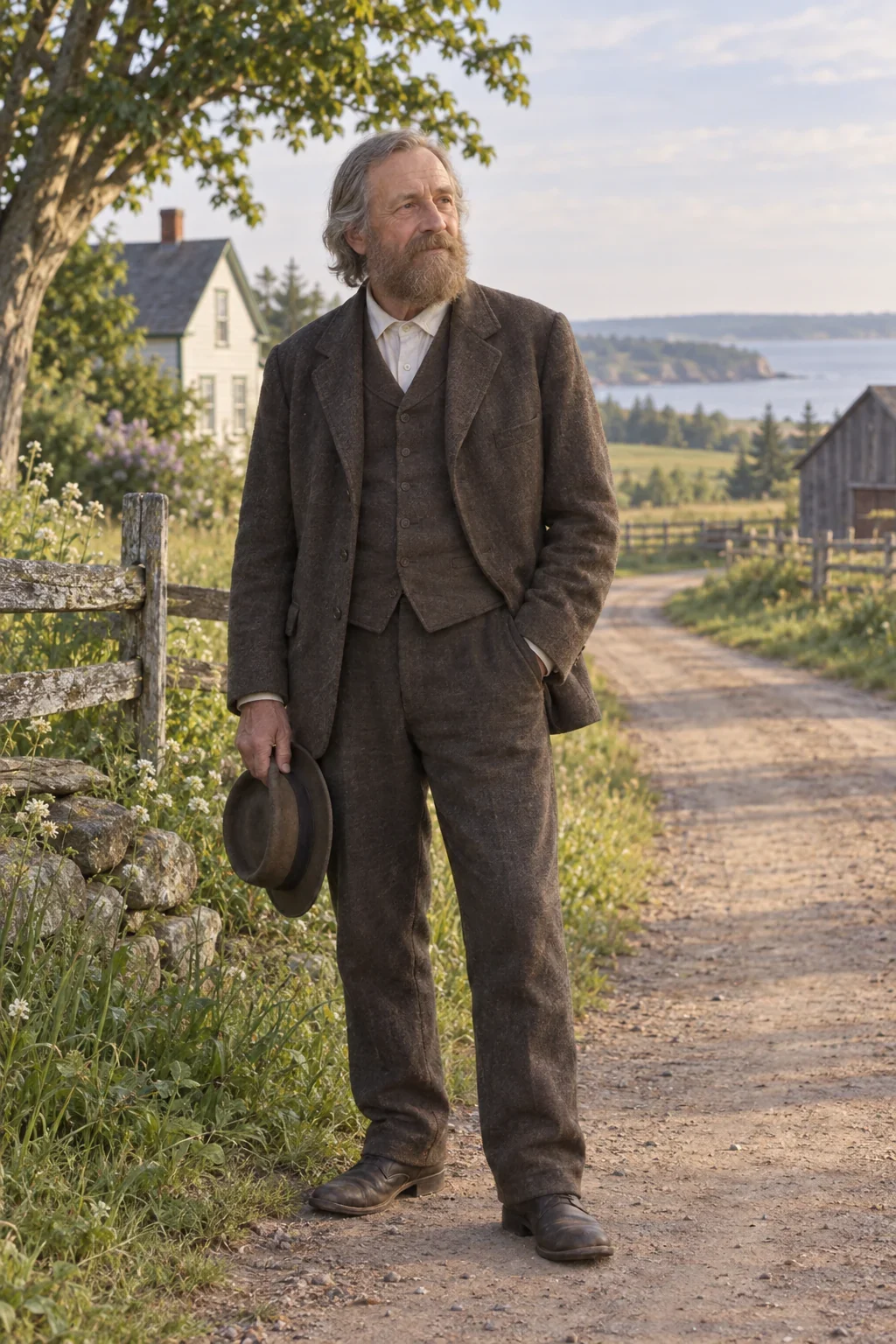
Imagined Matthew Cuthbert in a quiet original-novel portrait.
Unofficial AI interpretation. Matthew pauses beside the farm lane. Selected object or posture follows the original novel; exact portrait, unmentioned clothing and scene arrangement are imagined, without an adaptation likeness claim. Full-frame display derivative; no upscaling.
Overview
Matthew Cuthbert is the shy farmer whose immediate sympathy for Anne Shirley makes her arrival at Green Gables more hopeful. He lives with his sister Marilla in Avonlea and is about sixty when the novel begins. The narrator describes his stooping shoulders, long iron-grey hair and full soft brown beard. He dislikes encounters in which he must talk to strangers, especially women, and seldom ventures far from his familiar work. His journey to Bright River is therefore unusual enough to attract Rachel Lynde’s attention. He expects to collect a boy who may help with chores, not a talkative orphan girl.
Anne’s conversation on the drive home surprises him, but he enjoys listening rather than wishing to silence her. Her pleasure in the landscape and eagerness for a home reach him before the misunderstanding has been resolved. He does not tell her at the station that she is unwanted, and her distress on hearing Marilla’s plan makes him reluctant to return her. Matthew argues for keeping Anne even though she cannot fulfil the original expectation of a farm helper. His support is sometimes hesitant in speech, but the decision has substantial consequences for the household. It should not be reduced to a passive kindness that changes nothing.
Once Anne remains, Matthew often supplies encouragement alongside Marilla’s instruction. He allows the child to feel that someone at Green Gables takes delight in her thoughts and achievements. His concern over her plain clothes leads to the Christmas dress with puffed sleeves, a gift that answers a wish Marilla has resisted. Obtaining it is difficult for a man so uncomfortable in shops and conversation; Rachel Lynde’s assistance helps turn his intention into a practical result. The episode connects generosity with an ordinary social limitation. It does not require him to become outspoken or to manage the household in the same manner as his sister.
Matthew follows Anne’s education and takes pride in her success, increasingly seeing her as his own rather than as a substitute for the boy they requested. His health and the family’s financial worries form a darker thread beneath the domestic comedy. News of the bank failure precedes his sudden collapse and death, leaving Anne and Marilla to face grief and uncertainty at Green Gables. The book gives Anne time to recognise and express the loss, while its final decisions address how life may continue without him. This profile retains the first novel’s limits: Matthew’s kindness, vulnerability and chosen attachment are grounded in its scenes, while imagined precise clothing, dramatic death imagery and invented later appearances are excluded.
First appearances & development
Lucy Maud Montgomery’s Anne of Green Gables establishes this character through Anne’s arrival, schooling and household relationships. This profile follows the selected original narrative and does not combine adaptation continuity with it.
Canon & continuity
Original narrative.
Selected bibliography
Documented works and useful reading. This is not a list of every appearance.
- 01
Anne of Green Gables
Original.
Family & connections
A source-supported family tree or inspiration record has not yet been compiled for this profile. Related reading below indicates a connection in subject matter, not a proven lineage or creative influence.
References
Sources supporting this profile. Linked pages have their own scope and editorial standards.
- PrimaryAnne of Green GablesResearch access: 2026-10-12
Image credits
Unofficial modern AI interpretationImagined Matthew Cuthbert in a quiet original-novel portrait.
Unofficial AI interpretation. Matthew pauses beside the farm lane. Selected object or posture follows the original novel; exact portrait, unmentioned clothing and scene arrangement are imagined, without an adaptation likeness claim. Full-frame display derivative; no upscaling.