
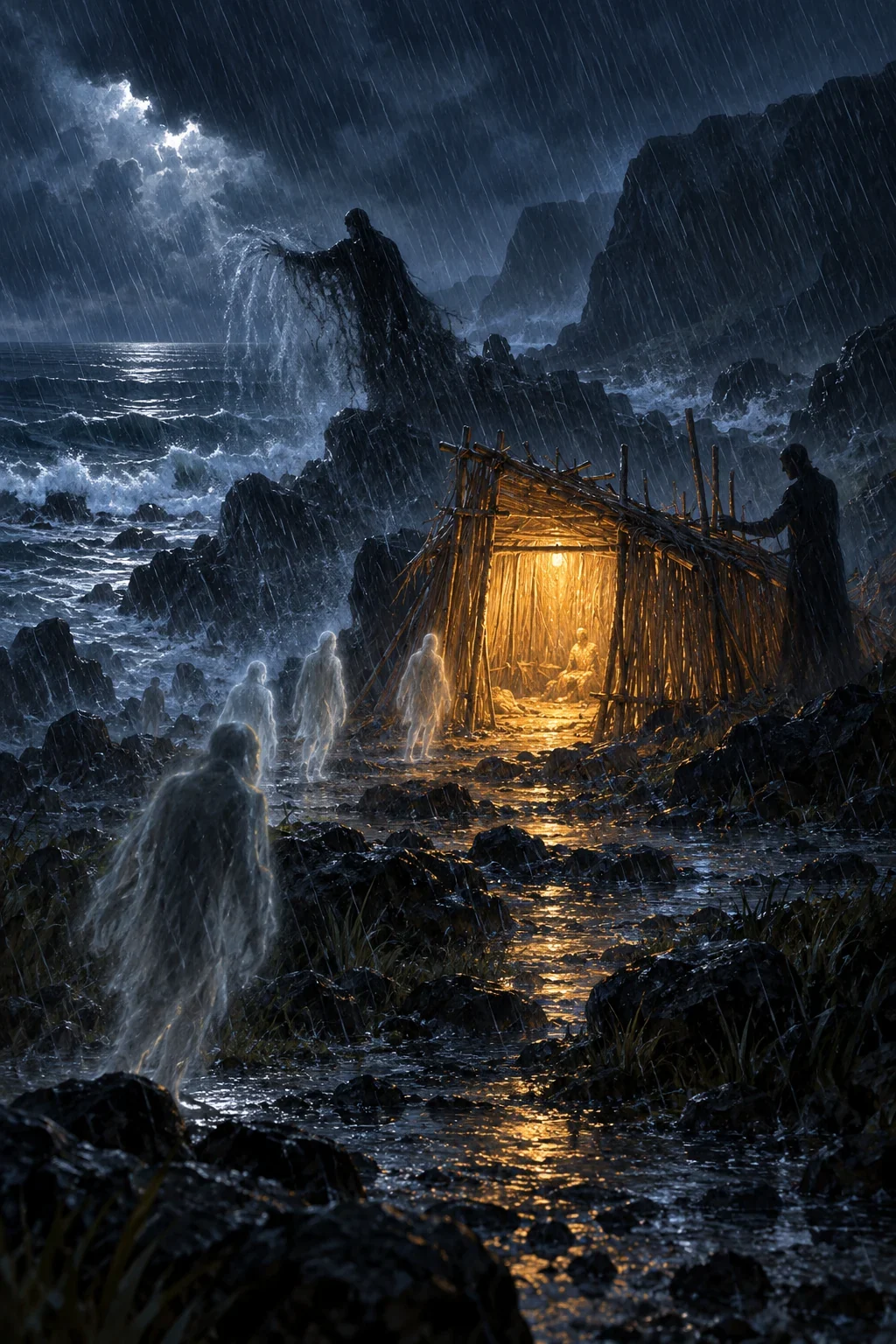
AI-generated contextual interpretation of Mata-wara-wara and Papai-a-taki-vera’s rain-and-reed-house trap in Routledge’s recorded Rapa Nui account. Rain, night shelter and wandering souls follow the narrative. Figures, faces, draped shapes, light, building geometry, exact coast and terrain are imagined; no ethnographic or historic reconstruction is claimed.
AI-generated contextual interpretation of Mata-wara-wara and Papai-a-taki-vera’s rain-and-reed-house trap in Routledge’s recorded Rapa Nui account. Rain, night shelter and wandering souls follow the narrative. Figures, faces, draped shapes, light, building geometry, exact coast and terrain are imagined; no ethnographic or historic reconstruction is claimed.
Overview
Mata-wara-wara and Papai-a-taki-vera act together in a short complete account recorded by Katherine Routledge. The first name is glossed as Strong-Rain. A rough structure of slabs on an ahu is described as his house, but the place is not named in this passage. His partner builds a different shelter: a house of reeds which exists only at night. The story joins a particular pair and their division of work, rather than describing every aku-aku as a rain-maker or a builder.
The trap depends on the souls of sleeping people wandering outside their bodies. Mata-wara-wara brings rain; Papai-a-taki-vera constructs the reed house. Cold and wet, the wandering souls enter the apparent refuge, where the spirits kill them. The sleeper nevertheless wakes the next morning. Feeling unwell, the person lingers for two or three days and then dies. That delayed ending is part of the account: the shelter does not rescue the wanderers, and the attack is not described as an immediately visible assault on a sleeping body.
Routledge places this narrative beside reports that the soul visits places present to a dreamer’s thought. Her attached note51 says that aku-aku could name spirits of both living and dead people, with varua given as an equivalent. Those reported terms help explain the distinction between the wandering victims and their supernatural attackers. They do not establish that all beings so named share one identity. The account gives neither attackers a fixed anatomy or costume, and it supplies no named victim, counter-charm or eventual defeat. Its complete ending is the sleeper’s decline and death, conveyed through a historical English recorder rather than an identified narrator’s surviving transcript.
Origins & earliest records
Complete paired rain-and-reed-house account, pp238–239 of Katherine Routledge’s The Mystery of Easter Island. Work first published1919; the retained hosted text includes an April1920 second-edition preface. No body collation of the first and second print editions is claimed.
Records & interpretation
Historical collected narrative and surrounding terminology, not verified disease causation, a supernatural encounter or current community-wide belief. The source does not identify the individual teller of this account. Colonial-era generalizations about religion elsewhere in the chapter are not adopted.
Selected bibliography
Documented works and useful reading. This is not a list of every appearance.
- 01
The Mystery of Easter Island: The Story of an Expedition
Complete religion framing pp236–240, paired account pp238–239, notes49–51; complete first and second prefaces read.
Family & connections
A source-supported family tree or inspiration record has not yet been compiled for this profile. Related reading below indicates a connection in subject matter, not a proven lineage or creative influence.
References
Sources supporting this profile. Linked pages have their own scope and editorial standards.
- Primary historical collectionRoutledge, Chapter XVI, paired spirit account pp238–239 and note51Research access: 2026-10-27
Image credits
AI-generated illustrationAI-generated contextual interpretation of Mata-wara-wara and Papai-a-taki-vera’s rain-and-reed-house trap in Routledge’s recorded Rapa Nui account. Rain, night shelter and wandering souls follow the narrative. Figures, faces, draped shapes, light, building geometry, exact coast and terrain are imagined; no ethnographic or historic reconstruction is claimed.
AI-generated contextual interpretation of Mata-wara-wara and Papai-a-taki-vera’s rain-and-reed-house trap in Routledge’s recorded Rapa Nui account. Rain, night shelter and wandering souls follow the narrative. Figures, faces, draped shapes, light, building geometry, exact coast and terrain are imagined; no ethnographic or historic reconstruction is claimed.