
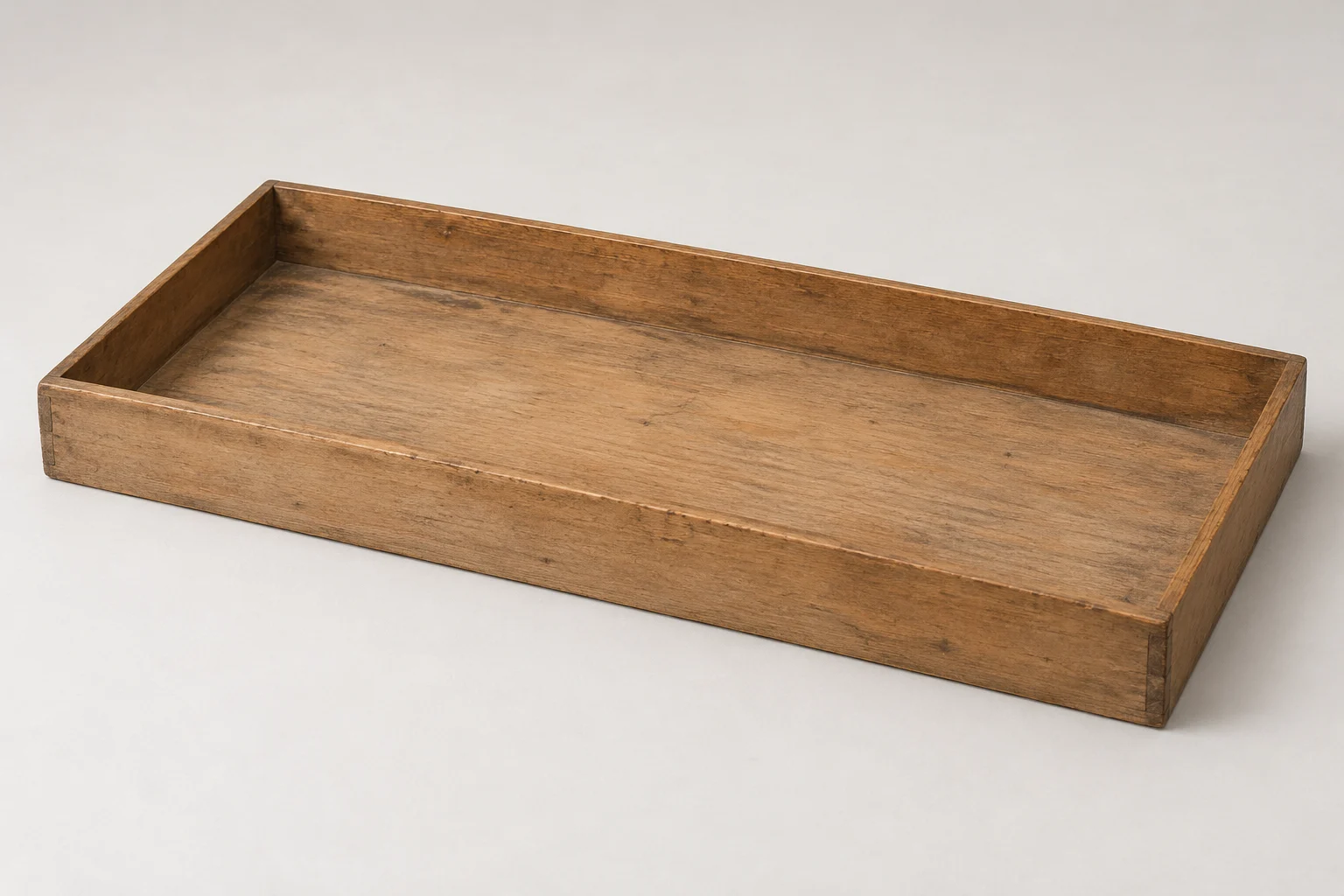
Generated interpretation of a published tool form; not an authenticated specimen or exact replica. An unlabelled end feature in the engraving is omitted.
Overview
Zaehnsdorf’s account of marbled book edges begins with a long, shallow trough made of wood or zinc. He suggests a depth of about two inches and makes its length and width dependent on the work, giving a range rather than one compulsory size. The trough holds the prepared size on which colours float. Brushes distribute the colours, and drawn sticks or combs disturb the surface to form patterns. Paper is laid against this prepared surface, while the edges of a book are pressed onto it and lifted away. The captioned engraving shows the low rectangular vessel, open from above, with straight walls around the working area.
The trough belongs to a wider division of workshop labour. Zaehnsdorf says that few London binders marble their own work, normally sending it to specialist marblers, but still explains the process for readers wishing to attempt it. He emphasizes consistency in colour order and proportion when several books or sheets must match. These are observations and instructions from the 1890 manual, not current prices or a universal account of book production. The engraving also contains an unlabelled feature near one end; the selected text does not explain its attachment or function. A contextual study of the basic vessel therefore omits that feature and discloses the omission, without presenting itself as an exact reconstruction of the engraved apparatus.
History & identity
Joseph W. Zaehnsdorf’s revised second edition was issued by George Bell and Sons in London in 1890. The retained original title and imprint are transcribed in the HTML edition; no separate physical title-page photograph was acquired. His preface distinguishes hand processes from machine illustrations and addresses amateurs and members of the trade.
Sources & representation
Complete Chapters XVI and XVII, full preface and introduction, transcribed edition imprint, and the native Marbling Trough engraving. The unlabelled end feature remains unresolved and is explicitly excluded from the proposed contextual depiction.
Selected bibliography
Documented works and useful reading. This is not a list of every appearance.
- 01
The Art of Bookbinding: A Practical Treatise
Second edition, revised and enlarged. London: George Bell and Sons. Chapters XVI, Colouring the Edges, and XVII, Gilt Edges; original captioned illustrations.
Language & cultural connections
Source-supported language and cultural connections have not yet been compiled for this profile.
References
Sources supporting this profile. Linked pages have their own scope and editorial standards.
- Historical practitioner manualThe Art of Bookbinding, original practitioner manualResearch access: 2026-10-18
Image credits
AI-generatedGenerated interpretation of a published tool form; not an authenticated specimen or exact replica. An unlabelled end feature in the engraving is omitted.