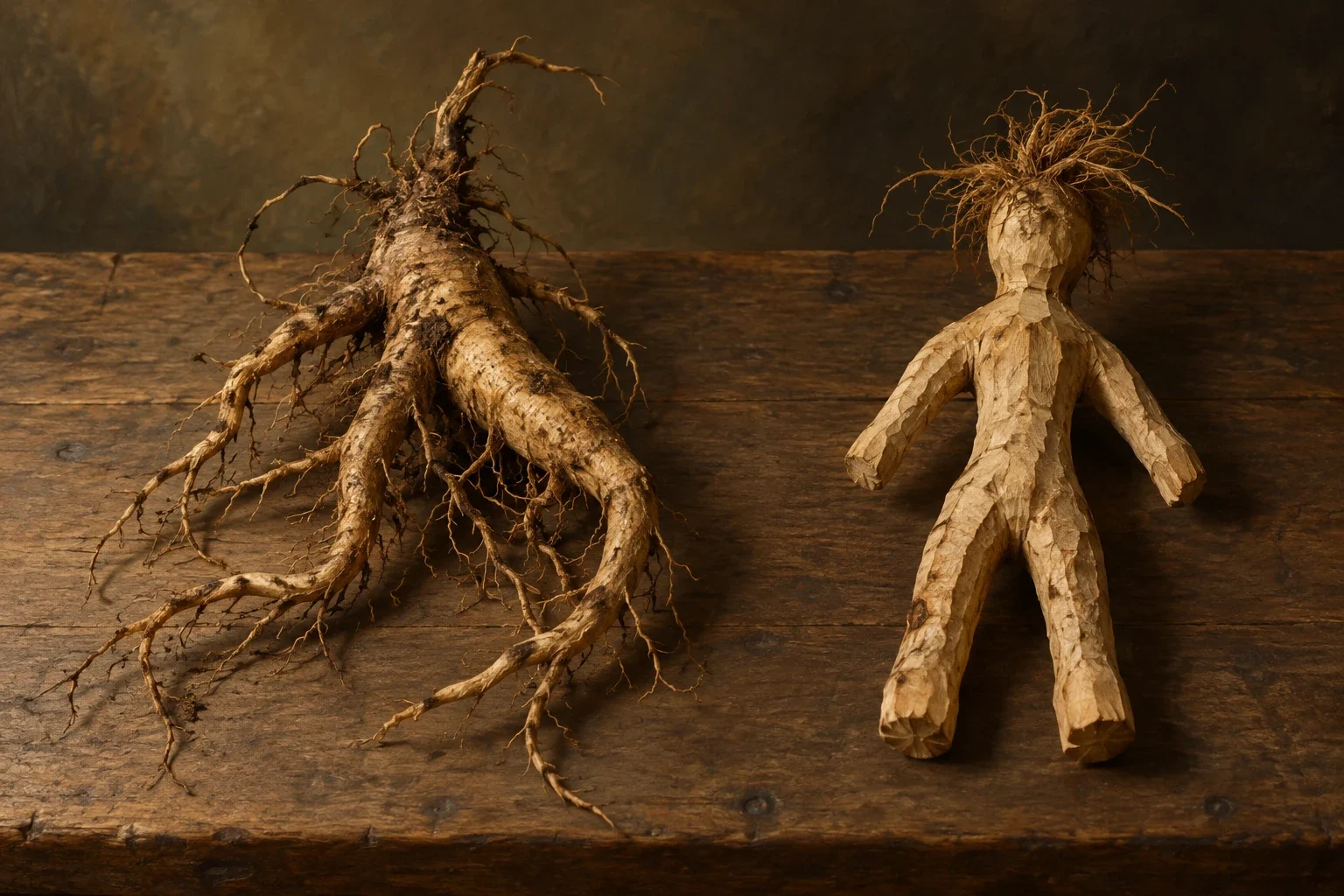
AI-generated interpretation of Browne’s distinction between irregular roots and fashioned humanlike objects; forms and setting imagined.
The right-hand object is a visibly carved representation, not a living humanoid plant. The left-hand root is an imagined irregular form, not an authenticated botanical specimen. Exact root shapes, fibres, carving marks and table are artistic interpretation.
Overview
Thomas Browne's Pseudodoxia Epidemica treats the mandrake as a plant surrounded by disputed stories about human shape, dangerous uprooting and extraordinary birthplaces. The selected seventeenth-century account is a criticism of those beliefs, rather than an endorsement of a little person living underground. Browne begins with the supposed resemblance of the root to a human body. A divided root can suggest legs, he argues, but its branches need not form a regular pair and comparable shapes occur in other vegetables. He also challenges the inference that herbalists' male and female labels establish humanlike reproductive sexes. His argument concerns how names, resemblance and inherited classifications encourage a belief; it is not a present-day botanical description of the genus.
Visible objects sold as proof receive particular attention. Browne says that itinerant sellers carried roots shaped as men or women, and cites Mathiolus for their artificial manufacture from other plants. The apparent hair, in the reported deception, comes from sprouting seeds. These manufactured figures are evidence for the practices and accusations described in his compilation, not authenticated specimens of naturally human-shaped mandrakes. Browne distinguishes deliberate fabrication from the occasional suggestiveness of an ordinary root. His criticism also extends to the story that mandrakes arise beneath gallows from material falling from the dead. That origin belongs to the belief he disputes, rather than the life history accepted by this profile.
The same subsection rejects the uprooted root's alleged shriek and the fatal consequences assigned to whoever pulls it from the ground. Browne proposes that a slight noise caused by tearing a firmly embedded plant could become an exaggerated story. He reports an elaborate gathering ritual on Pliny's authority, but questions the danger it assumes. Circe's reputed use of the plant and comparisons with other difficult or dangerous roots help explain, in his argument, why such claims acquired authority. His references to Baaras and Moly remain comparisons with other named plants, not proof that all the names denote mandrake. He finally observes that a belief promising death to anyone who tests it can discourage its own examination. The text therefore preserves supernatural motifs alongside an early modern attempt to dismantle them.
Origins & earliest records
Thomas Browne, Pseudodoxia Epidemica, II.vi, subsection 1 on mandrakes. The work first appeared in 1646; the inspected electronic witness identifies the sixth edition of 1672. This dates a selected critical account, not the beginnings of the folklore or a botanical species.
Records & interpretation
Complete selected mandrake subsection read from its opening through the transition to the separate discussion of cinnamon and other spices. Ancient authors and Mathiolus are mediated through Browne, not independently read here. Modern editorial footnotes and unrelated botanical subsections are excluded from the creature account.
Selected bibliography
Documented works and useful reading. This is not a list of every appearance.
- 01
Pseudodoxia Epidemica, II.vi, subsection 1: mandrakes
Work first published 1646; electronic witness identifies sixth edition 1672. Complete selected mandrake subsection, within chapter pp. 101–109; exact subsection page-span not established.
Family, evolution & connections
Mandragora (Final Fantasy)
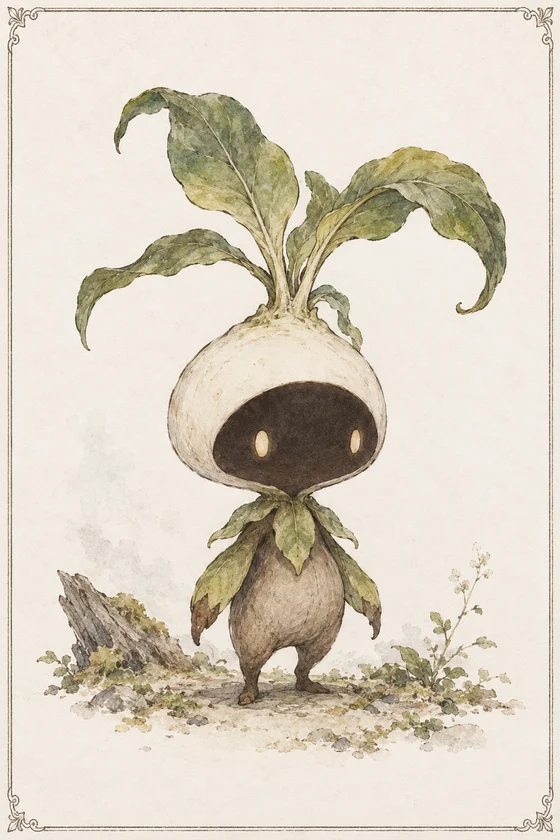
A plant of historical folklore whose supposedly human-shaped root, shriek and fatal uprooting are examined and disputed in Thomas Browne’s seventeenth-century account. Final Fantasy XI's mandragora are small, mobile plants with their own culture, solar nourishment and a repertoire of disruptive attacks. Later stories also give particular mandragora speaking roles rather than treating the entire family as anonymous enemies.
References
Sources supporting this profile. Linked pages have their own scope and editorial standards.
- Historical English primary text in scholarly transcriptionThomas Browne, Pseudodoxia Epidemica II.vi: mandrake subsectionResearch access: 2026-10-24
Image credits
AI-generated historical interpretationAI-generated interpretation of Browne’s distinction between irregular roots and fashioned humanlike objects; forms and setting imagined.
The right-hand object is a visibly carved representation, not a living humanoid plant. The left-hand root is an imagined irregular form, not an authenticated botanical specimen. Exact root shapes, fibres, carving marks and table are artistic interpretation.