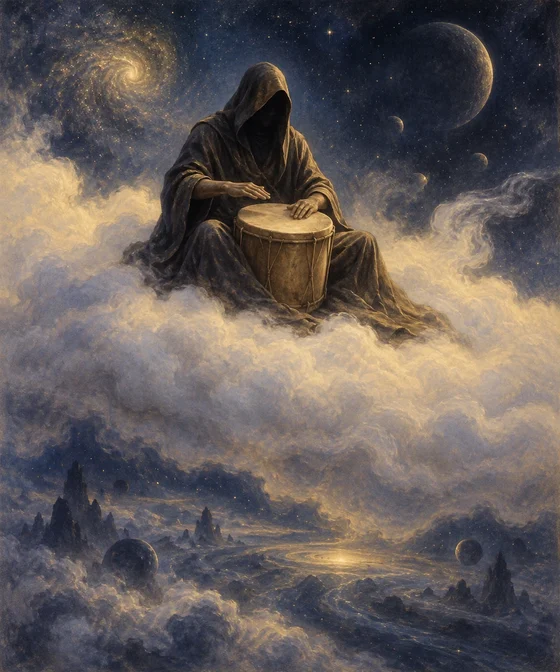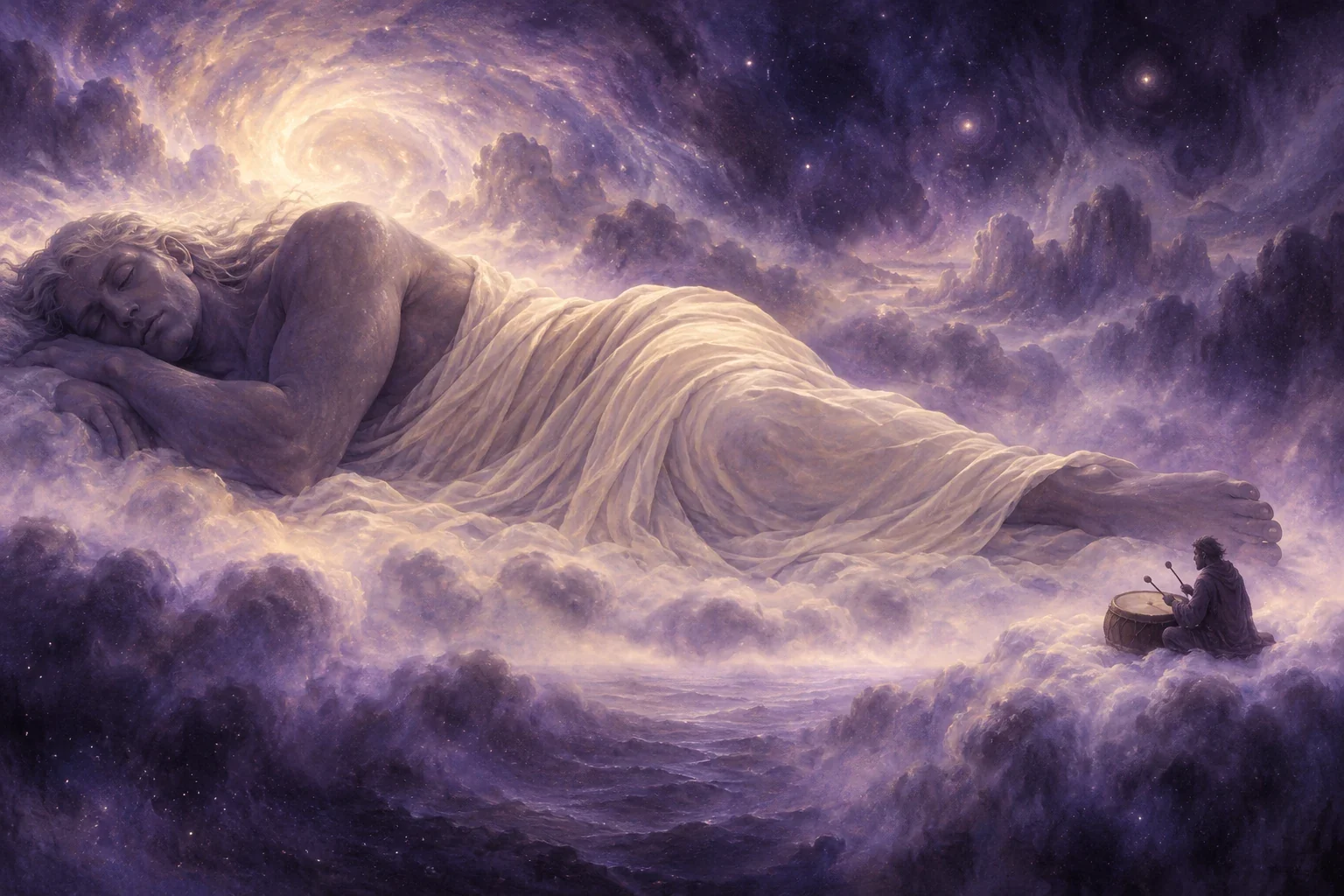
Modern AI interpretation of sleeping Mana-Yood-Sushai with Skarl drumming near his feet. Bodies, clothing, scale, colours and setting are imagined; this depicts authored fiction, not a historical religious portrait.
Modern AI interpretation of sleeping Mana-Yood-Sushai with Skarl drumming near his feet. Bodies, clothing, scale, colours and setting are imagined; this depicts authored fiction, not a historical religious portrait. Full-frame display derivative; no upscaling.
Overview
Mana-Yood-Sushai is the resting creator at the centre of Lord Dunsany’s fictional Pegana cosmos. The opening places Fate and Chance before the Beginning, casting lots to decide which should direct him to make gods for a game. The narrator does not identify the winner. Mana-Yood-Sushai then makes the gods and Skarl the drummer. The story distinguishes this creation from the making of the worlds, which is subsequently undertaken by the lesser gods.
Weariness and music establish his sleep. After making the gods, he grows drowsy as Skarl beats his newly made drum. Skarl sits upon mist before his feet, continuing the rhythm above the gods. While the creator rests, those gods make worlds, suns, life and death. The early account depicts them communicating by gestures to avoid disturbing him, although a later episode introduces Kib’s voice and the end of that silence.
The relationship between sleep and existence remains partly conjectural within the narration. Some say that the worlds and suns echo the drum; others call them dreams in Mana-Yood-Sushai’s mind. The narrator preserves ignorance rather than choosing either explanation. He also sets a limit on worship: none may pray directly to Mana-Yood-Sushai, but only to the gods he has made. This is a rule of an authored imaginary pantheon, not a claim about a historical community’s practices.
Awakening is represented as a cosmic ending and renewal. When the creator forgets to rest, he will make new gods and other worlds, destroy the old gods, and bring their worlds to departure. In the Game of the Gods episode, his eventual rising also brings a rebuke to the gods for playing with worlds, suns, people, life and death. Skarl’s final silence is another narrated trigger for the end of rest. The retained text describes sleep and feet without establishing a fixed bodily form. A reclining figure in a modern illustration is therefore imaginative casting, not a verified canonical portrait.
First appearances & development
Lord Dunsany presents this being in The Gods of Pegana. The retained witness is the Library of Congress copy of the Boston John W. Luce edition dated 1916 in its institutional catalogue.
Canon & continuity
Retained original-print OCR supports the selected narrative claims; uncertain cosmological explanations remain attributed alternatives. This is authored fiction, not testimony about an actual religious community.
Selected bibliography
Documented works and useful reading. This is not a list of every appearance.
- 01
The Gods of Pegana
Selected original narrative: opening, Of Skarl the Drummer, Of the Making of the Worlds, and Of the Game of the Gods.
Family & connections
A source-supported family tree or inspiration record has not yet been compiled for this profile. Related reading below indicates a connection in subject matter, not a proven lineage or creative influence.
References
Sources supporting this profile. Linked pages have their own scope and editorial standards.
- PrimaryThe Gods of Pegana — original-print OCRResearch access: 2026-10-11
- CustodialLibrary of Congress copy — Internet Archive catalogueResearch access: 2026-10-11
Image credits
Unofficial modern AI interpretationModern AI interpretation of sleeping Mana-Yood-Sushai with Skarl drumming near his feet. Bodies, clothing, scale, colours and setting are imagined; this depicts authored fiction, not a historical religious portrait.
Modern AI interpretation of sleeping Mana-Yood-Sushai with Skarl drumming near his feet. Bodies, clothing, scale, colours and setting are imagined; this depicts authored fiction, not a historical religious portrait. Full-frame display derivative; no upscaling.