
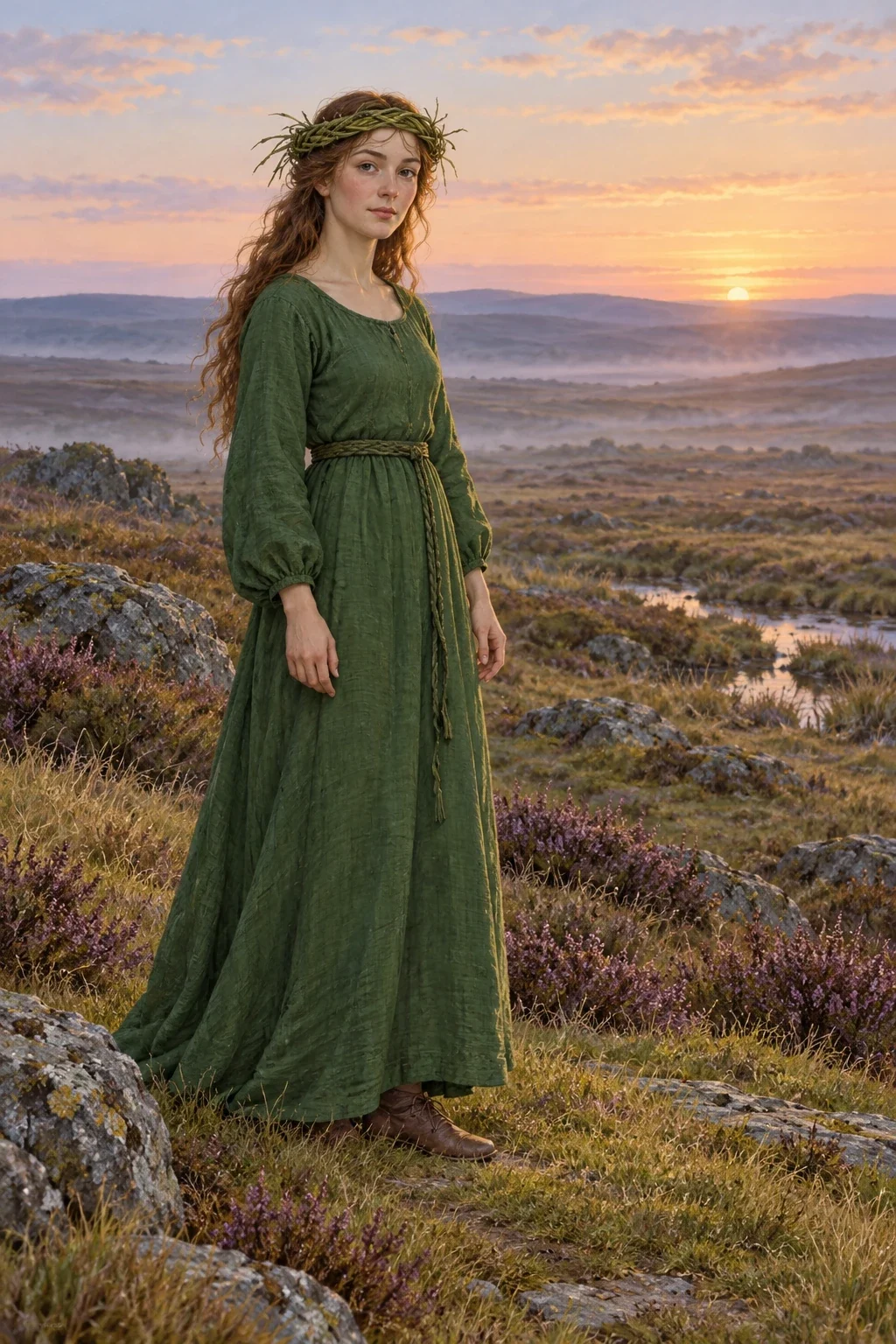
AI narrative interpretation of Maid Væ in Keightley’s The Fairy Mythology (1892).
Adult casting, face, dress construction, footwear, plaited headgear construction and pose are AI interpretation of Keightley’s short narrative, not an authenticated historical portrait or costume.
Overview
After a wedding entertainment at Østerhæsinge, the guests prepare their horses and carriages at daybreak and boast about their bridal presents. A maiden comes from a neighboring moor, wearing green and plaited rushes on her head. She asks the loudest guest what he will give Maid Væ. The man, affected by drink, takes up a whip and answers that he will give her ten cuts. At that moment he falls dead.
Keightley places this short account among Elle-maid narratives. Note 142 locates the scene on Funen and labels Thiele’s source “communicated,” explaining that this means material received through friends rather than directly collected oral testimony. The tale gives no further biography, precise mechanism for the death, wings, weapon or fixed stature for the maiden. This profile covers that brief printed narrative, without extending it into a general account of Danish fairy powers.
Origins & earliest records
“Maid Vae,” pp. 89–90, with note 142, in Thomas Keightley’s The Fairy Mythology (George Bell & Sons, 1892); Keightley cites Thiele, volume I, p. 109.
Records & interpretation
Complete “Maid Vae,” pp.89–90, note142 and surrounding Elle-folk commentary inspected. Keightley cites Thiele I109 as communicated through friends, without naming the individual teller here.
Selected bibliography
Documented works and useful reading. This is not a list of every appearance.
- 01
The Fairy Mythology
Complete “Maid Vae,” pp.89–90, note142 and surrounding Elle-folk commentary inspected. Keightley cites Thiele I109 as communicated through friends, without naming the individual teller here.
Family & connections
A source-supported family tree or inspiration record has not yet been compiled for this profile. Related reading below indicates a connection in subject matter, not a proven lineage or creative influence.
References
Sources supporting this profile. Linked pages have their own scope and editorial standards.
- Primary historical compilationKeightley, The Fairy Mythology: complete historical narrativeResearch access: 2026-10-21
- Primary historical commentaryKeightley: complete selected notes and source attributionResearch access: 2026-10-21
Image credits
AI-generatedAI narrative interpretation of Maid Væ in Keightley’s The Fairy Mythology (1892).
Adult casting, face, dress construction, footwear, plaited headgear construction and pose are AI interpretation of Keightley’s short narrative, not an authenticated historical portrait or costume.