
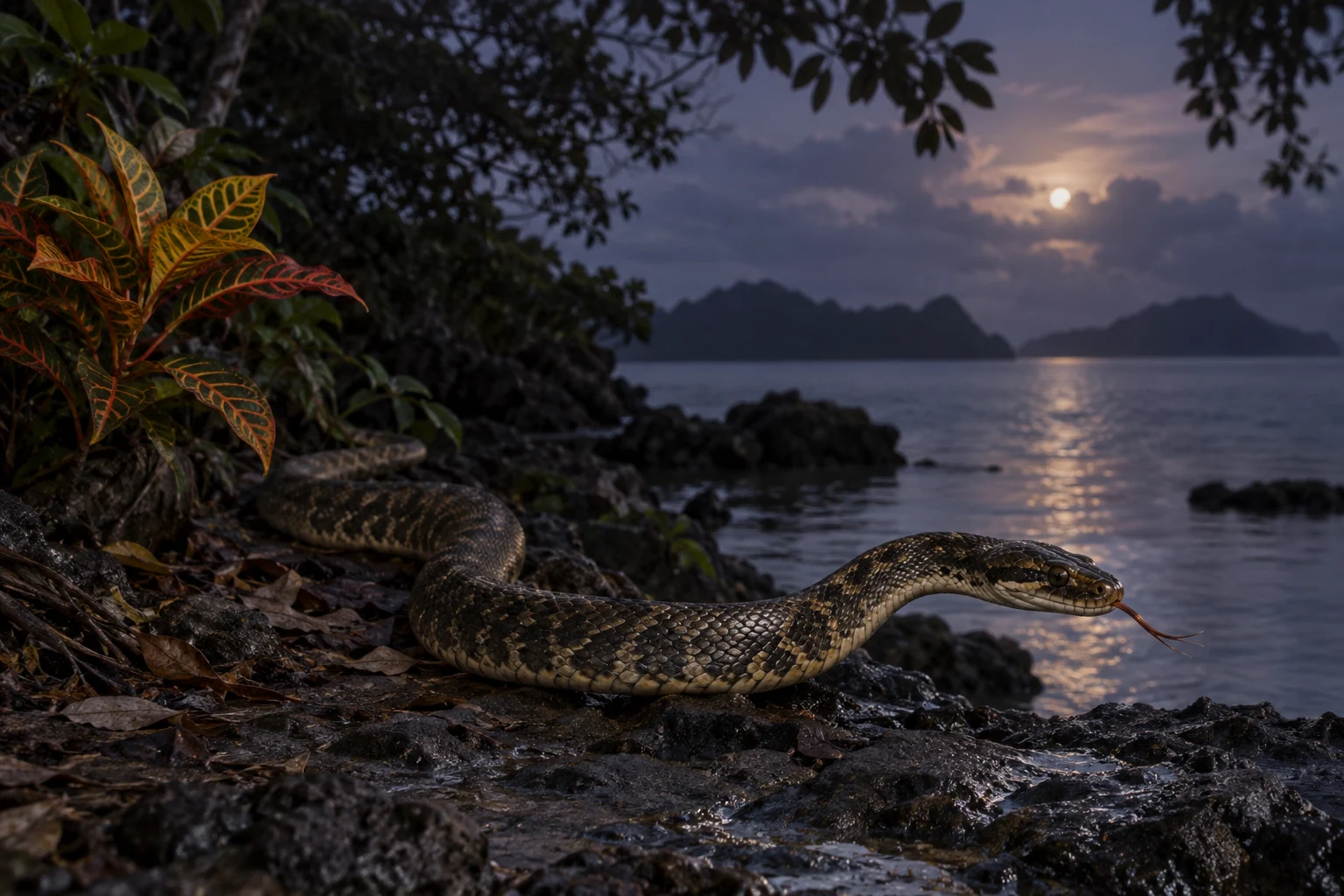
AI interpretation of Mae in snake form beside croton near water.
AI-generated unofficial original narrative interpretation. Selected source-specific scene; unspecified appearance and setting imagined. Not a historical reconstruction or community portrait.
Overview
Coombe describes Mae as an amphibious snake able to take the appearance of a young man or woman. It is generally seen in dim light; her example involves a man returning from fishing or garden work. Accepting its invitation is associated with fatal illness, while company is said to prevent encounters.
The tests for recognising Mae vary between islands. Reported signs include snake-skin at the neck, a scarlet tongue, joints that bend backward, immunity to the nettle tree, and drinking a coconut upside down. These are separate local tests, not one fixed anatomy.
Croton and white amaranth are named as protections. Striking the figure with croton is said to expose its tail. Coombe offers a speculative explanation of the belief's origin, but that explanation is her interpretation and is not adopted here.
Origins & earliest records
Recorded from Raga (Pentecost) and neighbouring islands in Florence Coombe, Islands of Enchantment (1911), Part I ch. I, pp. 14–16. This is the earliest source inspected for this profile, an attestation rather than a date of oral origin.
Records & interpretation
Selected passages verified in the compilation's cached OCR. Island-specific tests remain separate; present-day belief and practice are unverified.
In the literature
“The mae never appears to those who walk in company. Only the man or woman who is alone need fear its approach, and the possession of a croton leaf, or the white flower of an amaranth, spells absolute safety.”
Part I, ch.I, Raga (Pentecost), p.15; mae safeguards
Coombe reports protective beliefs about mae in her Raga chapter. The passage is her historical description, not confirmation of a supernatural danger or a statement of contemporary practice.
Selected bibliography
Documented works and useful reading. This is not a list of every appearance.
- 01
Islands of Enchantment: many-sided Melanesia seen through many eyes
Selected bibliography; source account, Part I ch. I pp. 14–16.
Family & connections
A source-supported family tree or inspiration record has not yet been compiled for this profile. Related reading below indicates a connection in subject matter, not a proven lineage or creative influence.
References
Sources supporting this profile. Linked pages have their own scope and editorial standards.
- Historical book (digitised full text)Islands of Enchantment: many-sided Melanesia seen through many eyes (full OCR text)Research access: 2026-10-07
- Catalogue recordIslands of Enchantment: many-sided Melanesia seen through many eyes (catalogue record)Research access: 2026-10-07
Image credits
AI-generated interpretationAI interpretation of Mae in snake form beside croton near water.
AI-generated unofficial original narrative interpretation. Selected source-specific scene; unspecified appearance and setting imagined. Not a historical reconstruction or community portrait.