
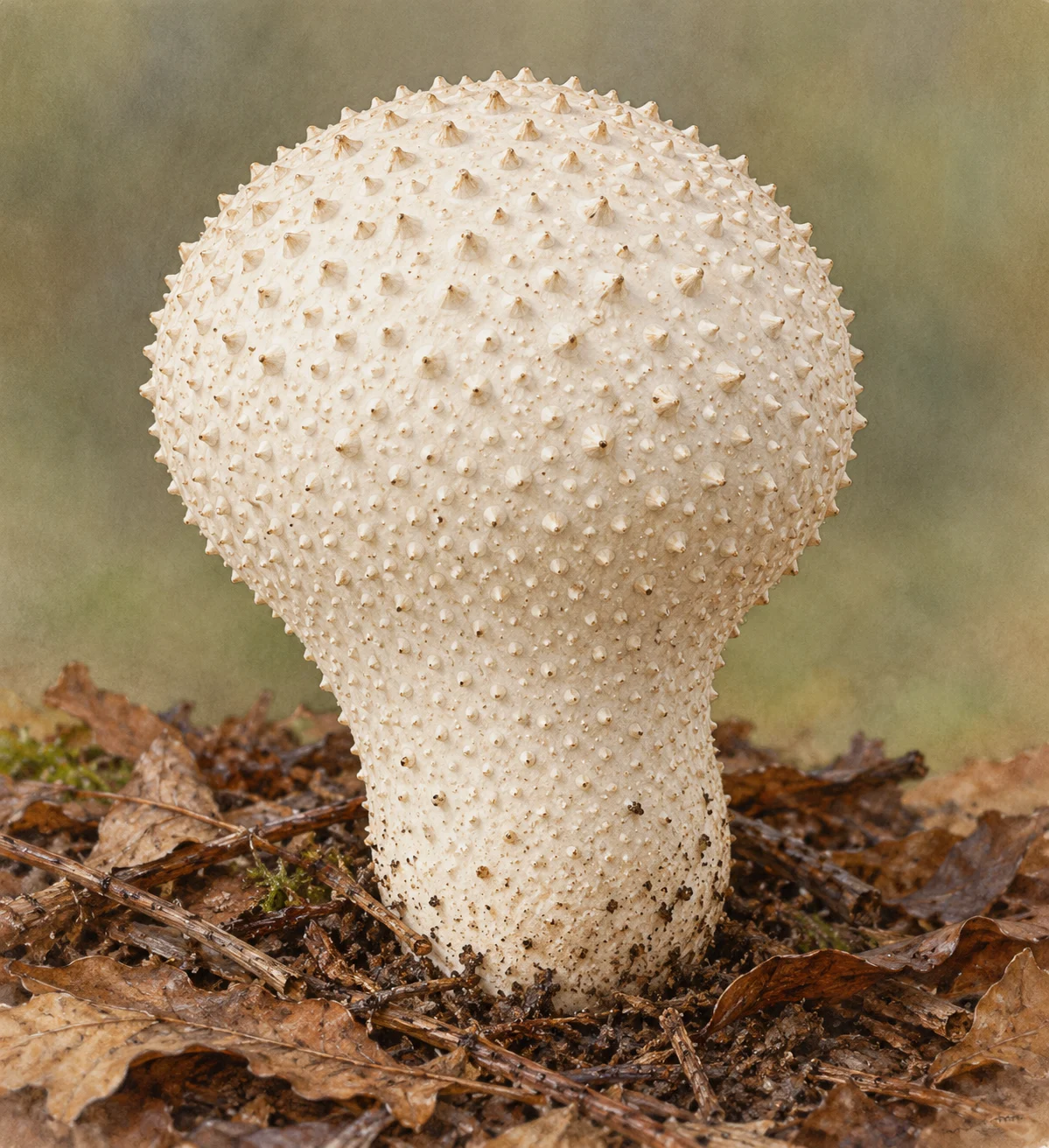
AI-generated fresh fruiting-body study.
Interpretation; underground mycelium is not reconstructed.
Overview
Common puffballs are pear-shaped fruiting bodies with tapering bases. Fresh pale surfaces carry short, blunt conical warts of different sizes. As the fungus ages, those warts wear away, leaving a net-like pattern; the body darkens and develops a small opening at its summit through which brown spores escape.
The visible puffball is the reproductive structure of a larger fungal network in the soil. Missouri’s conservation account describes that mycelium digesting decaying organic material and returning nutrients to the soil. Inside a developing puffball, solid tissue becomes a powdery spore mass before dispersal through the upper opening.
Origins & earliest records
Regional species accounts
Evidence & interpretation
Published accounts.
Selected bibliography
Documented works and useful reading. This is not a list of every appearance.
- 01
- 02
Family & connections
A source-supported family tree or inspiration record has not yet been compiled for this profile. Related reading below indicates a connection in subject matter, not a proven lineage or creative influence.
Look for a taxonomic record and classified relativesReferences
Sources supporting this profile. Linked pages have their own scope and editorial standards.
- Community species accountCommon PuffballResearch access: 2026-10-18
- Conservation agency accountGem-Studded PuffballResearch access: 2026-10-18
Image credits
AI-generated illustrationAI-generated fresh fruiting-body study.
Interpretation; underground mycelium is not reconstructed.