
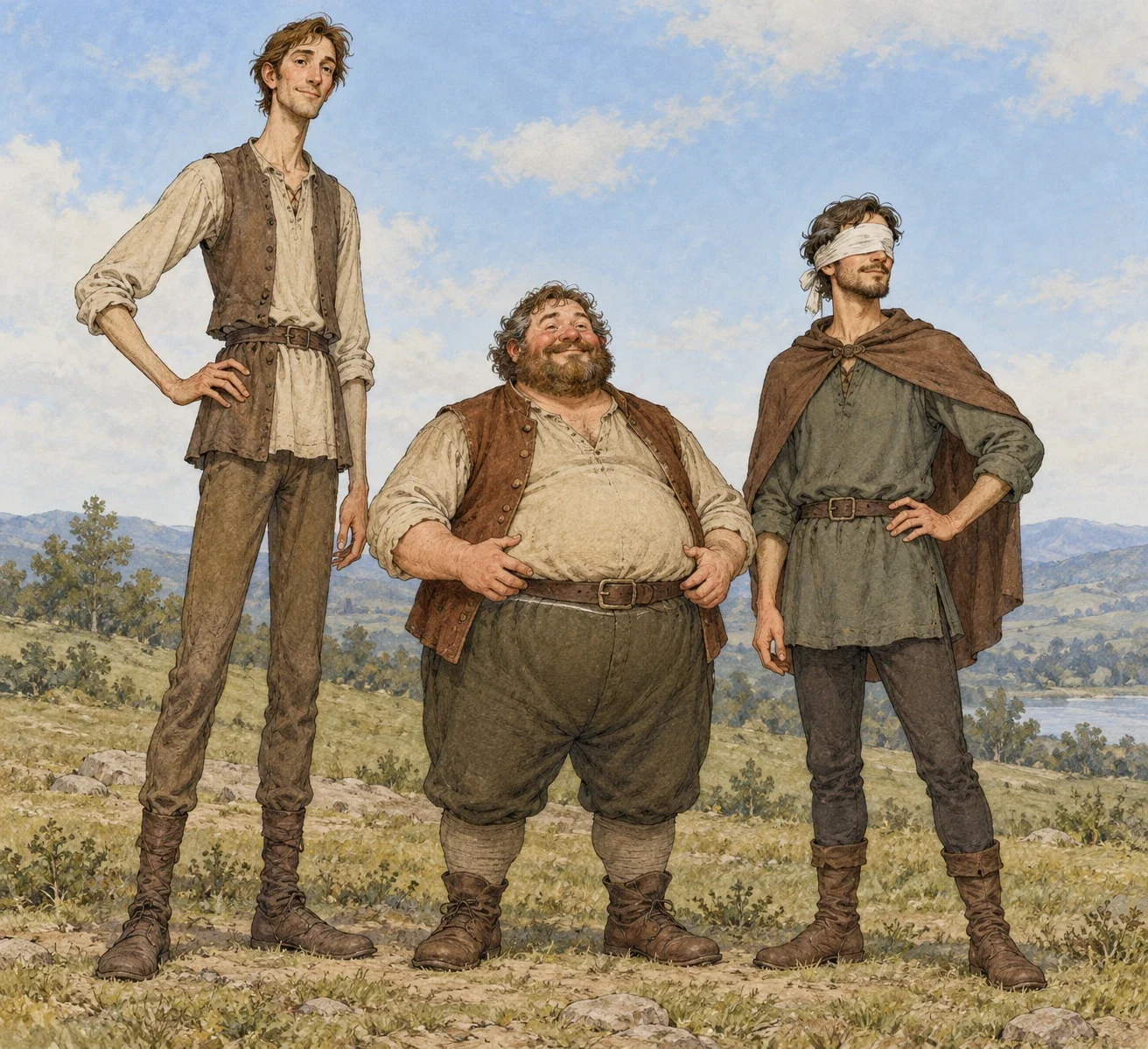
AI-generated literary interpretation of Long, Broad, and Sharpsight in Wratislaw’s telling.
The contrasting bodies and Sharpsight’s handkerchief follow the text. Faces, clothes, colouring, pose and exact proportions are imagined; the translator’s weather allegory is not presented as literal anatomy.
Overview
Long, Broad, and Sharpsight enter the story as companions whom a travelling prince takes into service. Long first appears as a tall man who can lengthen his whole body and then contract it. He retrieves a nest without climbing its tree, rises above the forest to find a route and subsequently takes enormous strides while carrying his companions. Broad is initially short and thick-set, with an exceptionally large paunch. He demonstrates the power to expand until he fills the surrounding space, then contracts with a wind strong enough to bend the trees. Sharpsight wears a handkerchief over his eyes because ordinary uncovered sight would be excessively powerful. He can see through the covering; when he deliberately uncovers his eyes and fixes them on a rock, it breaks apart. These demonstrations give the three helpers distinct capacities before the rescue begins, rather than making them interchangeable giants.
The prince seeks a woman held in an iron castle by a wizard. Keeping her in sight for three nights is the condition of release, but the prince and helpers repeatedly fall asleep under enchantment. Their extraordinary bodies do not make them immune to that difficulty. Instead, Sharpsight discovers the missing woman each morning in a different form: an acorn high in an oak, a precious stone within a mountain, and a golden ring inside a shell at the bottom of a distant sea. Long carries Sharpsight to the first two hiding places, and the latter breaks the mountain apart with his gaze. The recovered acorn and precious stone become the princess when the prince drops them. The object transformations belong to the captive woman, not to the helpers. Each successful recovery breaks one of the iron hoops around the wizard’s waist.
The final journey requires all three companions. Long cannot reach the shell while the sea remains full, so Broad drinks enough water to expose its bed. Carrying a companion filled with seawater proves difficult even for Long, who leaves Broad in a valley; the released water turns it into a lake. Sharpsight then sees the approaching deadline at the castle, and Long throws the recovered ring through its window just in time. The princess reappears, the wizard’s last hoop breaks, and he escapes in raven form. The people and landscape held motionless around the castle regain life. The prince credits his servants rather than claiming the rescue for himself, and Broad rejoins the party on the homeward journey. After the wedding the three decline a comfortable permanent place at court and return to travelling in search of work. Their cooperation, limitations and final independence remain part of this selected account.
Origins & earliest records
This entry follows chapter I of A. H. Wratislaw’s Sixty Folk-Tales from Exclusively Slavonic Sources, published in London in 1889. Its contents attribute the tale to K. J. Erben, and the preface identifies Erben’s 1865 reading-book as the collection from which Wratislaw translated his selection. The chapter appears under Bohemian Stories, whose introduction explicitly identifies the language as Czech. This documents a mediated historical telling, not the first invention of the three figures. The underlying Czech witness has not been independently collated here, and the English names and descriptions retain the scope of this translation.
Records & interpretation
The complete historical English chapter, including its ending and appended commentary, distinguishes the three bodies, their cooperative recoveries and their departure after the wedding. Wratislaw then proposes that Long represents a rainbow, Broad a cloud and Sharpsight lightning, with the princess as drought-bound earth; he also offers a solar reading of the prince. These are the translator’s interpretations. The tale’s text and his comparative argument do not establish a proven meteorological origin or a universal explanation shared by storytellers.
Selected bibliography
Documented works and useful reading. This is not a list of every appearance.
- 01
Sixty Folk-Tales from Exclusively Slavonic Sources
London: Elliot Stock. Chapter I, Long, Broad, and Sharpsight, printed pp.4–16, including the translator’s commentary; preface, contents and Bohemian introduction retained.
Family & connections
A source-supported family tree or inspiration record has not yet been compiled for this profile. Related reading below indicates a connection in subject matter, not a proven lineage or creative influence.
References
Sources supporting this profile. Linked pages have their own scope and editorial standards.
- Historical translated primary narrative with attributed comparative commentaryWratislaw 1889, complete chapter I and compiler framingResearch access: 2026-10-21
Image credits
AI-generatedAI-generated literary interpretation of Long, Broad, and Sharpsight in Wratislaw’s telling.
The contrasting bodies and Sharpsight’s handkerchief follow the text. Faces, clothes, colouring, pose and exact proportions are imagined; the translator’s weather allegory is not presented as literal anatomy.