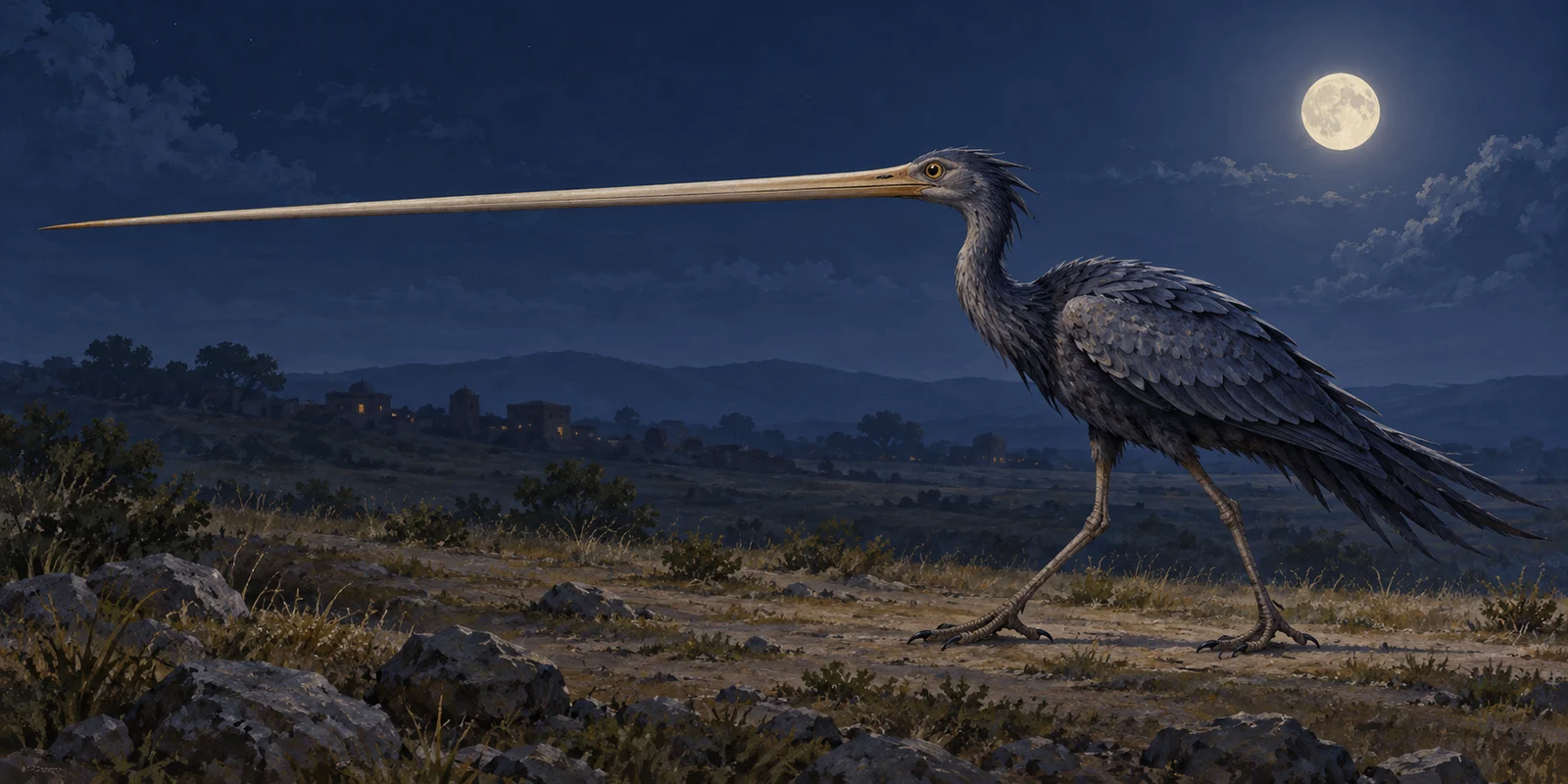
The unnamed bird with its extraordinary beak; species, colours and relative proportions imagined.
Original narrative illustration; appearance, colours, proportions and setting interpreted, not authenticated Ewe iconography or modern national origin.
Overview
The unnamed bird threatens the city where Yiyisa lives in the eighth fable of Spieth’s Ho literature section. During famine, the spider sends himself hidden in a bundle carried by God’s children to his daughter Yiyisa. She welcomes her father but warns him that the inhabitants eat in the city and sleep elsewhere. A bird will devour them, she says, and its beak reaches from Ho to Tsibü. The spider refuses to leave. He invokes his own drinking names, translated as the little gun and the little gourd bottle, and sharpens a knife while waiting in his room.
The bird travels towards the city singing that it eats human flesh. Its song also boasts that other birds fall silent and grass dies when it cries. The narration says its beak precedes its body by seven hours of travel. The spider cuts away the advancing beak until he kills the bird, then adapts its song into a boast about spiders. The relieved townspeople explain that a wounded person is another reason they cannot sleep there. The spider dances to that person’s song, receives the wounds and spreads them among humanity. Thus the complete ending qualifies the apparent rescue. A closing storyteller’s formula presents the performance as a tale passed on to listeners; the bird is not an independently documented animal.
Origins & earliest records
Ho section, Die Literatur, A. Fabeln, no. 8, Die Spinne und ihre Tochter Yiyisa. The bird is unnamed; Yiyisa names the spider’s daughter, not the bird.
Records & interpretation
Complete bilingual fable, printed pp. 584–589, including ending; original PDF text pages checked. Complete preface and relevant cross-reference retained.
Selected bibliography
Documented works and useful reading. This is not a list of every appearance.
- 01
Die Ewe-Stämme: Material zur Kunde des Ewe-Volkes in Deutsch-Togo
Ho section, Die Literatur, A. Fabeln, pp. 584–589.
Family & connections
A source-supported family tree or inspiration record has not yet been compiled for this profile. Related reading below indicates a connection in subject matter, not a proven lineage or creative influence.
References
Sources supporting this profile. Linked pages have their own scope and editorial standards.
- Historical bilingual Ewe/German collected narrativeSpieth 1906: complete fable, pp. 584–589Research access: 2026-10-18
Image credits
AI-generatedThe unnamed bird with its extraordinary beak; species, colours and relative proportions imagined.
Original narrative illustration; appearance, colours, proportions and setting interpreted, not authenticated Ewe iconography or modern national origin.