
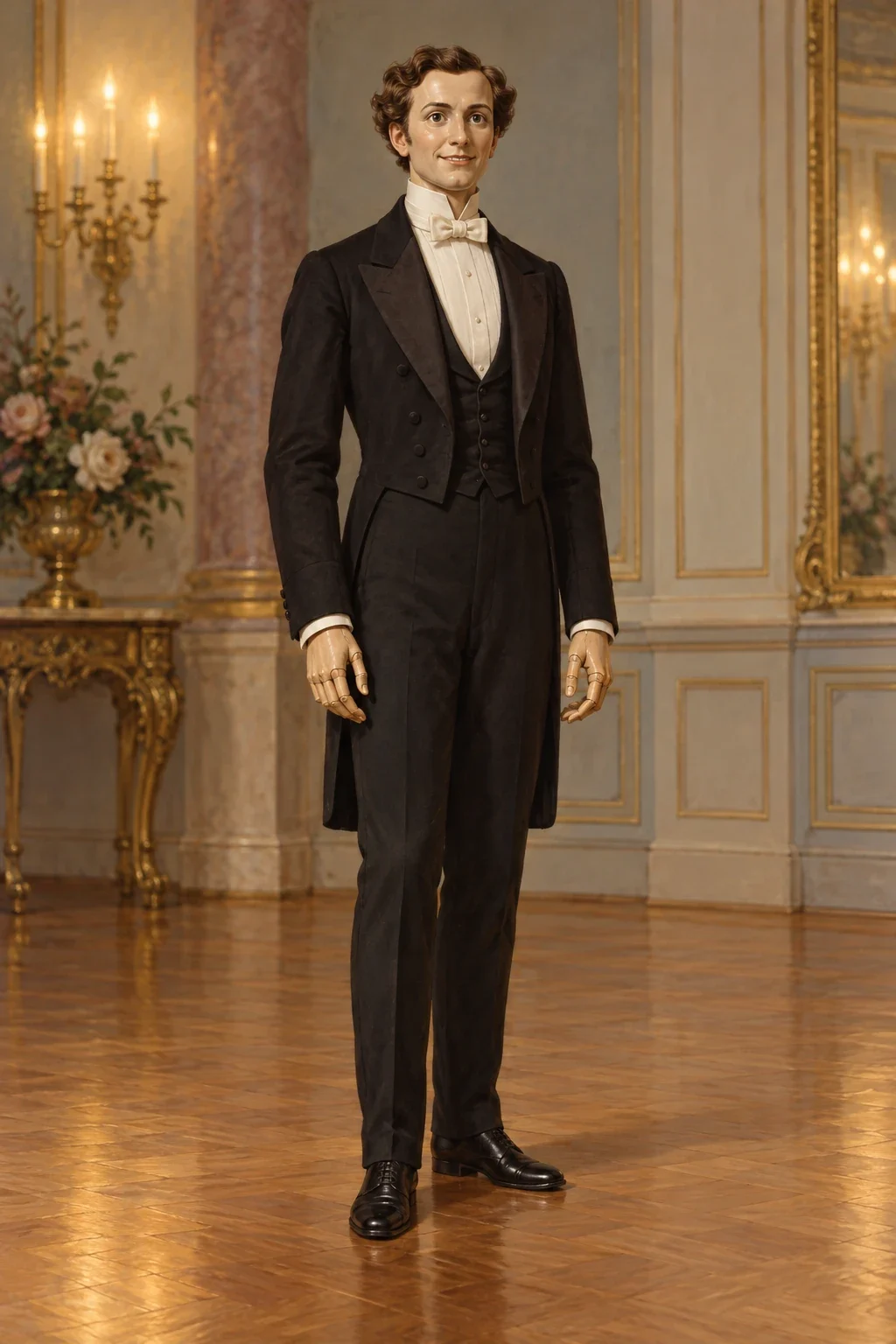
Lieutenant Fritz at his introduction, before the waltz.
AI-generated literary interpretation. Facial particulars, hair, formal clothing design and room are imagined; no historical machine or original-edition artwork is reproduced.
Overview
Lieutenant Fritz is the artificial man introduced by the toymaker Nicholaus Geibel in a story told by MacShaughnassy in chapter XI of Jerome K. Jerome's Novel Notes. Geibel hears his daughter Olga's friends complain about human dance partners and develops their suggestion of an electric substitute. At a later betrothal ball he presents Fritz as a young acquaintance, but the guests recognise an uncanny mechanism. Its waxen face has staring eyes and a fixed smile; it walks stiffly, bows with a harsh clicking sound and speaks in thin tones from the back of its head. The title lieutenant is part of this introduction, not evidence that the figure has a military career.
Fritz is made for the waltz. A coat button operates its speech, while controls let its partner regulate speed, stop it and release herself. Its right arm is screwed around Annette's waist and its delicately jointed left hand fastens to her right. Geibel warns that the pair will circle and that a collision can change their course. Initially the device keeps perfect time while repeating polite ballroom remarks. These are programmed conversational formulas within the story, rather than evidence that Fritz understands its partner or has the feelings of a human suitor.
After Geibel leaves the room, Annette increases the speed until the other couples drop out and even the musicians stop. Her failure to answer alarms the guests. Attempts to seize the dancer fail; its steel-cased feet injure a man, and a further rush diverts it into walls and furniture while it continues holding her. The narrator points to the guests' panic and missed opportunities to halt the mechanism, rather than demonstrating a conscious decision by Fritz to harm. Geibel eventually returns and enters the room with the host; the final intervention is kept behind closed doors. Only the inventor's retreat to simpler mechanical animals is reported afterwards.
First appearances & development
Authored English fiction embedded in a conversation among would-be novelists; not a reported historical machine or collected folk tradition.
Canon & continuity
Complete chapter XI, all 164 paragraphs, including the whole embedded dancing-man narrative and its enclosing debate; complete 19-paragraph original prologue and retained edition declaration read.
Selected bibliography
Documented works and useful reading. This is not a list of every appearance.
- 01
Novel Notes - chapter XI
Retained electronic witness identifies the 1893 Leadenhall Press Ltd. edition; no physical title page or original illustration inspected.
Family & connections
A source-supported family tree or inspiration record has not yet been compiled for this profile. Related reading below indicates a connection in subject matter, not a proven lineage or creative influence.
References
Sources supporting this profile. Linked pages have their own scope and editorial standards.
- Primary authored literary text in a historical-edition transcriptionNovel Notes - complete chapter XI and prologueResearch access: 2026-10-21
Image credits
AI-generatedLieutenant Fritz at his introduction, before the waltz.
AI-generated literary interpretation. Facial particulars, hair, formal clothing design and room are imagined; no historical machine or original-edition artwork is reproduced.