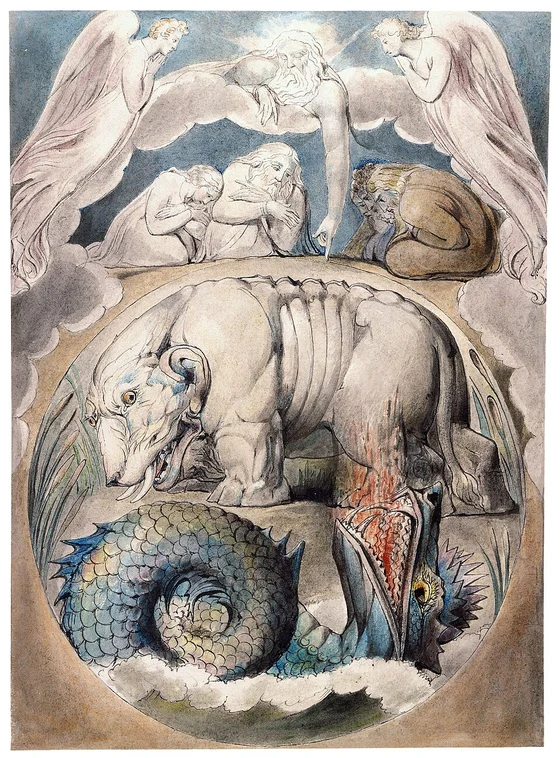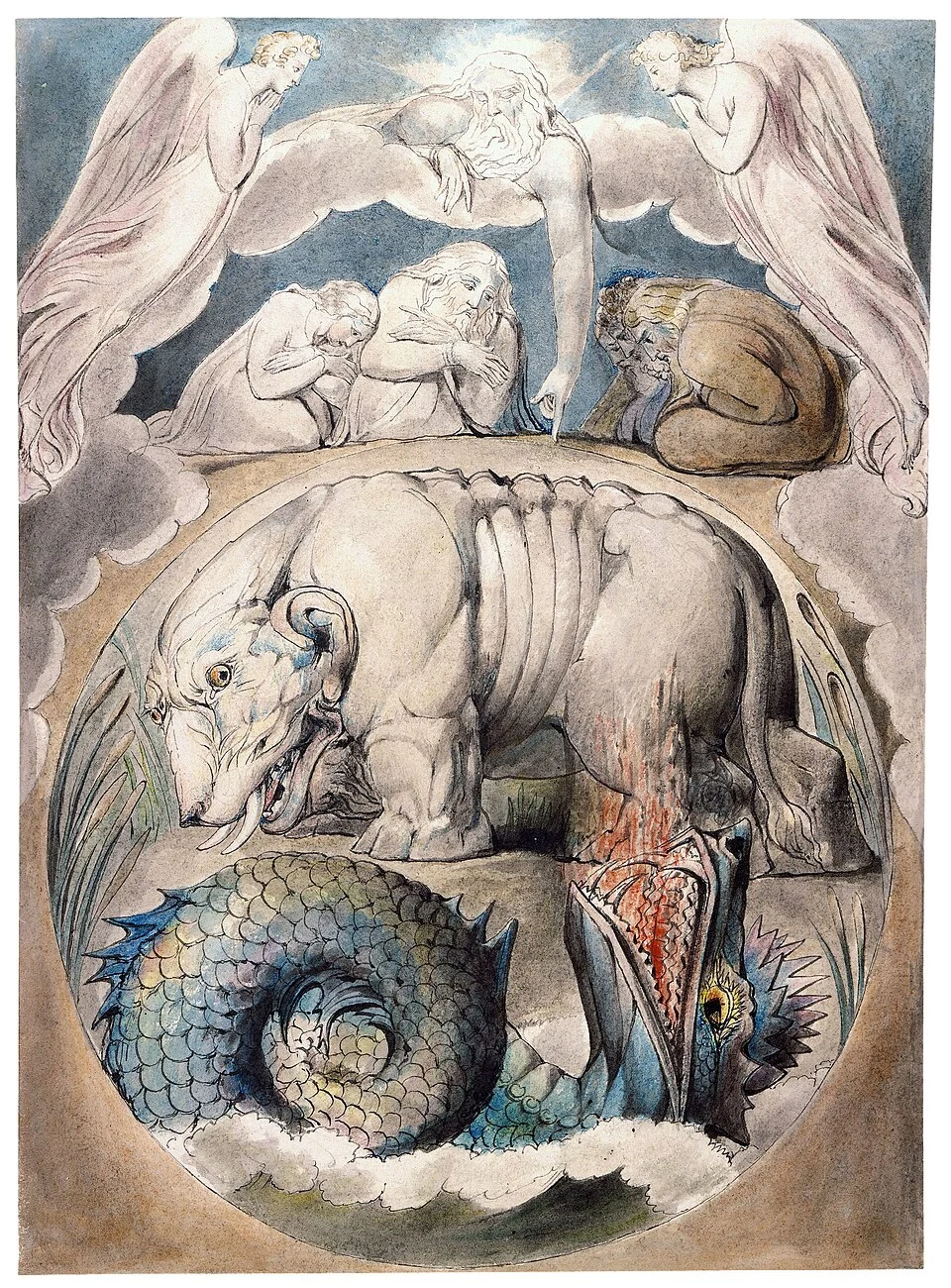
William Blake illustration of biblical Behemoth and Leviathan
Biblical subject; contextual only for Final Fantasy summon.
Overview
Leviathan appears in Job 41 as a creature that resists hooks, cords, spears and the ordinary ways humans capture or domesticate animals. The description emphasizes tightly joined scales, fearsome teeth and exceptional strength. Smoke, sparks and flame form part of its poetic imagery, while its movement disturbs the deep. The questions make human vulnerability central to the passage rather than presenting a practical hunting manual or a zoological identification.
Blake’s 1825–26 engraving represents Leviathan as a long, coiled, scaled creature in water below the terrestrial Behemoth. An enormous toothed mouth turns upward, and the body fills the lower half of a circular scene beneath the divine speaker. This supplies a precise later visual interpretation of the text, not a universally prescribed shape. The biblical being is kept separate from Final Fantasy’s namesake, and unresolved comparisons with living animals are not treated as settled taxonomy.
Origins & earliest records
Primary scriptural witness: Book of Job, Job 41:1–34. The work’s composition and authorship are not precisely dated here. KJV first published 1611; selected hosted transcription is later.
Records & interpretation
The specified Job passage directly read, and Met object 383509, accession 17.17.1–15, individually inspected. Scriptural poetry and Blake’s later iconography are distinguished; animal identification is unresolved.
In the literature
“Canst thou draw out leviathan with an hook? or his tongue with a cord which thou lettest down?”
Job 41:1 · King James Version translators
A rhetorical question in the divine description of leviathan. Identification and symbolism require separate commentary.
Selected bibliography
Documented works and useful reading. This is not a list of every appearance.
- 01
Book of Job
Job 41:1–34; paraphrased here rather than reproducing extended translation wording.
- 02
Behemoth and Leviathan, Illustrations of the Book of Job
Engraving; Met accession 17.17.1–15. Public-domain image confirmed in museum API.
Family & connections
A source-supported family tree or inspiration record has not yet been compiled for this profile. Related reading below indicates a connection in subject matter, not a proven lineage or creative influence.
Primary records and illustrations
Book of Job; William Blake’s Illustrations of the Book of Job
KJV English translation first published 1611; Blake engraving 1825–26. Job 41:1–34; Blake plate 15, Met accession 17.17.1–15
Primary passage directly read. A coiled scaled aquatic body fills the lower half of the circular creature scene, with an upward-facing mouth and rows of teeth. This is Blake’s later interpretation of Job. Museum image public-domain status checked; KJV rights labels vary by jurisdiction, so the profile uses original paraphrase.
References
Sources supporting this profile. Linked pages have their own scope and editorial standards.
- Primary religious text / selected English translationBook of Job — Job 41:1–34, KJV transcriptionResearch access: 2026-10-05
- Museum object record / primary religious iconographyBehemoth and Leviathan — Met object 383509Research access: 2026-10-05
- Primary illustrated interpretationBlake engraving — individually inspected public-domain imageResearch access: 2026-10-05
Image credits
Historical illustrationWilliam Blake illustration of biblical Behemoth and Leviathan
Biblical subject; contextual only for Final Fantasy summon.