
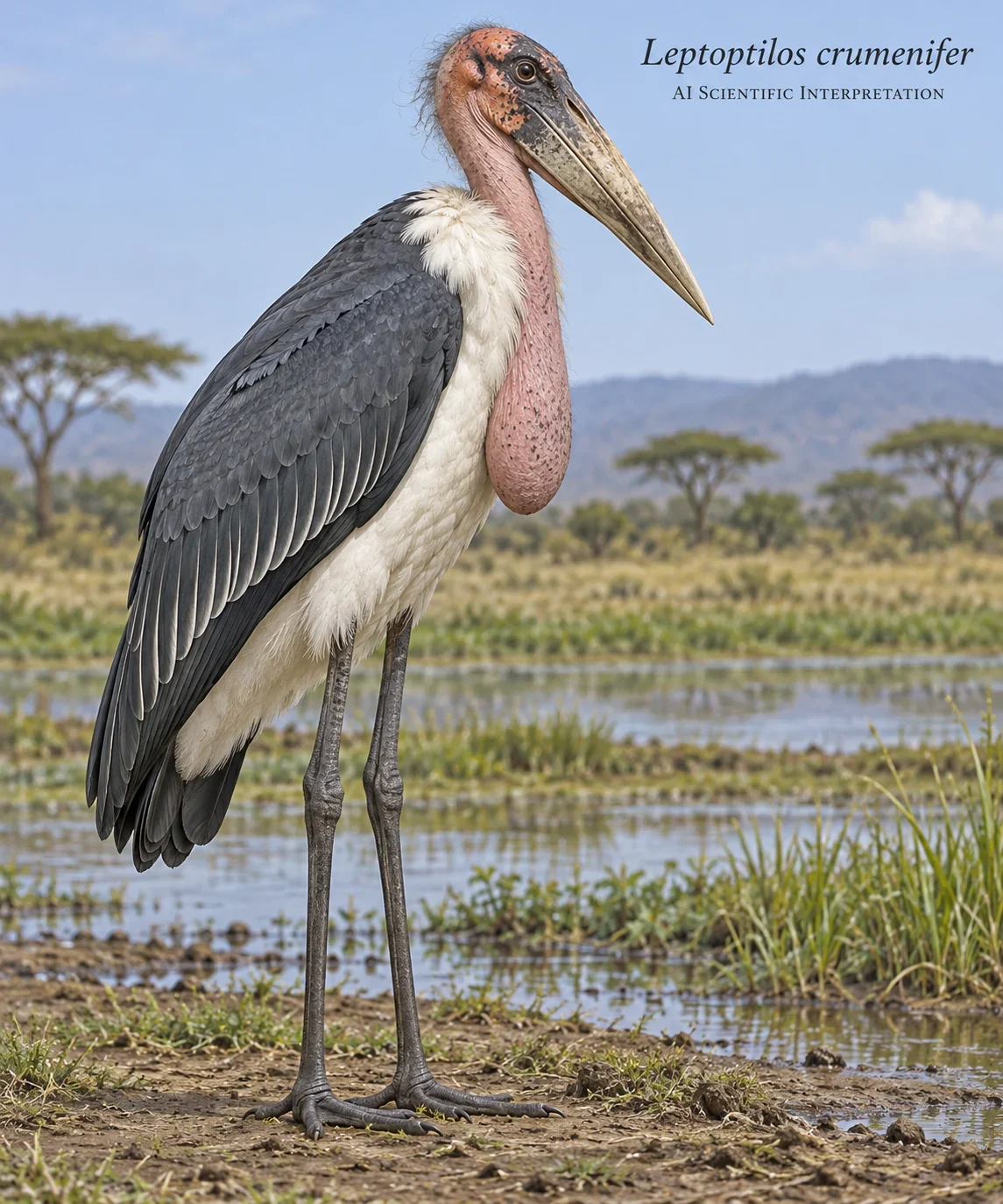
AI scientific interpretation of Leptoptilos crumenifer.
AI scientific interpretation of an imagined Leptoptilos crumenifer.
Overview
Toronto Zoo describes pink to orange-red head and neck skin with sparse hairlike feathers, a pendulous gular sac and an outsized horn-coloured to greenish-yellow bill. Slate-grey upperparts contrast with off-white underparts. Long legs are dark grey, sometimes appearing white from excrement associated with evaporative cooling.
Tsuchida and colleagues’ 2023 study compared marabou storks using a slaughterhouse and a landfill near Kampala. Faecal chemistry and bacterial sequencing distinguished the two feeding environments. The landfill flock had a more diverse gut microbiome and more Lactobacilli; predicted microbial functions were enriched for carbohydrate metabolism.
Garuma’s 2018 thesis followed marabous around Ethiopia’s Lake Hawassa in wet and dry seasons of 2017–18. Point counts recorded 289 and 366 birds respectively. Nests were predominantly in town on acacia trees; both parents guarded and incubated eggs. These counts and nesting observations describe the study area, not every population.
Origins & earliest records
A zoo diagnosis complements primary microbial and field-ecology studies.
Evidence & interpretation
Predicted microbial functions and site associations are not universal causal outcomes.
Selected bibliography
Documented works and useful reading. This is not a list of every appearance.
- 01
- 02
- 03
Family, evolution & connections
Taxonomic classification
A hierarchy of classified groups, not a chain of direct ancestors.
Source note: The primary paper uses crumenifer; the zoo’s crumeniferus spelling is retained as a searchable alternative.
- FamilyCiconiidae
References
Sources supporting this profile. Linked pages have their own scope and editorial standards.
- Institutional zoologyMarabou storkResearch access: 2026-10-11
- Primary research abstractThe fecal microbiomes analysis of Marabou storks (Leptoptilos crumenifer) reveals their acclimatization to the feeding environment in the Kampala urban areas, UgandaResearch access: 2026-10-11
- Primary thesis abstractEcological Studies of Marabou Stork (Leptoptilos Crumeniferus) Around Hawassa Lake, Southern Ethiopia.Research access: 2026-10-11
Image credits
AI-generated interpretationAI scientific interpretation of Leptoptilos crumenifer.
AI scientific interpretation of an imagined Leptoptilos crumenifer.