
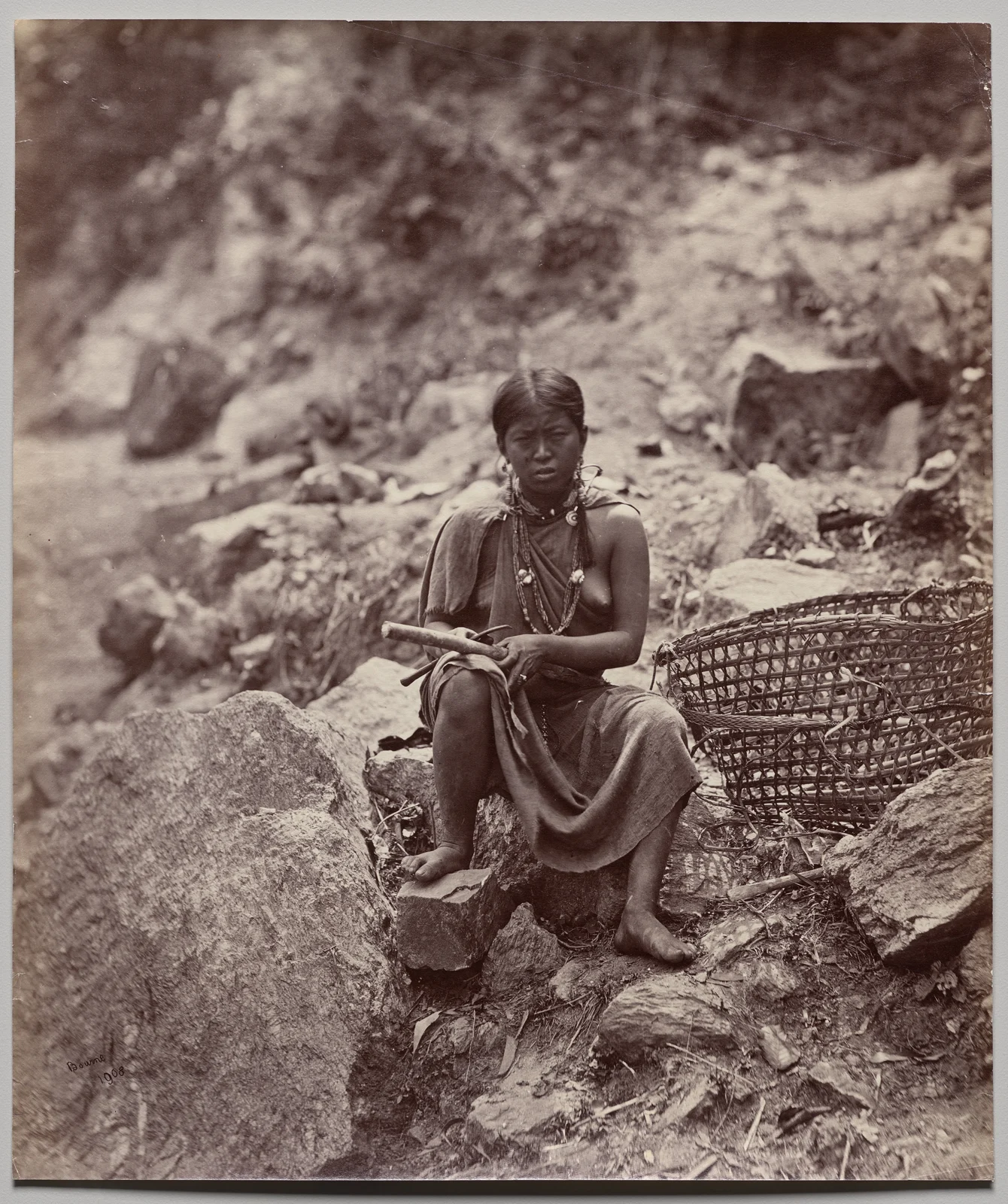
Historical sepia photograph of a seated woman on rocks, holding a cylindrical object beside a large openwork basket.
Samuel Bourne’s photograph titled Lepcha Woman (number 1908), c. 1863–70. The museum supplies the Lepcha identification; the sitter is unnamed. This colonial-era photograph is a particular historical portrayal, not a representation of all Lepcha people or contemporary life.
Overview
Sikkim’s institute records the self-name Mutanchi Rong Kup Rum Kup. Lepcha and Rong name people and language; religious communities share cultural connections.
It documents literary genres including songs, narratives, prayers and cultural writing. Official recognition of the language in 1977 is a political milestone, not the beginning of Lepcha culture.
The Kalimpong-based Rongring society records registration in June 2021. Its learning platform offers language and folktale courses in support of cultural preservation.
Nepal’s foundation identifies Ilam as a Lepcha homeland. Didityom addresses community rules, disputes and collective work. Appointed and elected outside administration narrowed its role, which continues mainly in religious and cultural life.
History & identity
Nepal’s foundation reports no written evidence establishing Lepcha origins.
Sources & representation
Selected institutional accounts.
Selected bibliography
Documented works and useful reading. This is not a list of every appearance.
- 01
Tribal Research Institute & Training Centre – Government of Sikkim
Selected bibliography.
- 02
Home – RLCWS LMS
Selected bibliography.
- 03
लेप्चा | National Foundation For Development of Indigenous Nationalities, Lalitpur
Selected bibliography.
Language & cultural connections
Source-supported language and cultural connections have not yet been compiled for this profile.
References
Sources supporting this profile. Linked pages have their own scope and editorial standards.
- Institutional heritage accountTribal Research Institute & Training Centre – Government of SikkimResearch access: 2026-10-07
- Community institutionHome – RLCWS LMSResearch access: 2026-10-07
- National indigenous institution; Nepal-focused accountलेप्चा | National Foundation For Development of Indigenous Nationalities, LalitpurResearch access: 2026-10-07
Image credits
Historical photograph, c. 1863–70Historical sepia photograph of a seated woman on rocks, holding a cylindrical object beside a large openwork basket.
Samuel Bourne’s photograph titled Lepcha Woman (number 1908), c. 1863–70. The museum supplies the Lepcha identification; the sitter is unnamed. This colonial-era photograph is a particular historical portrayal, not a representation of all Lepcha people or contemporary life.