
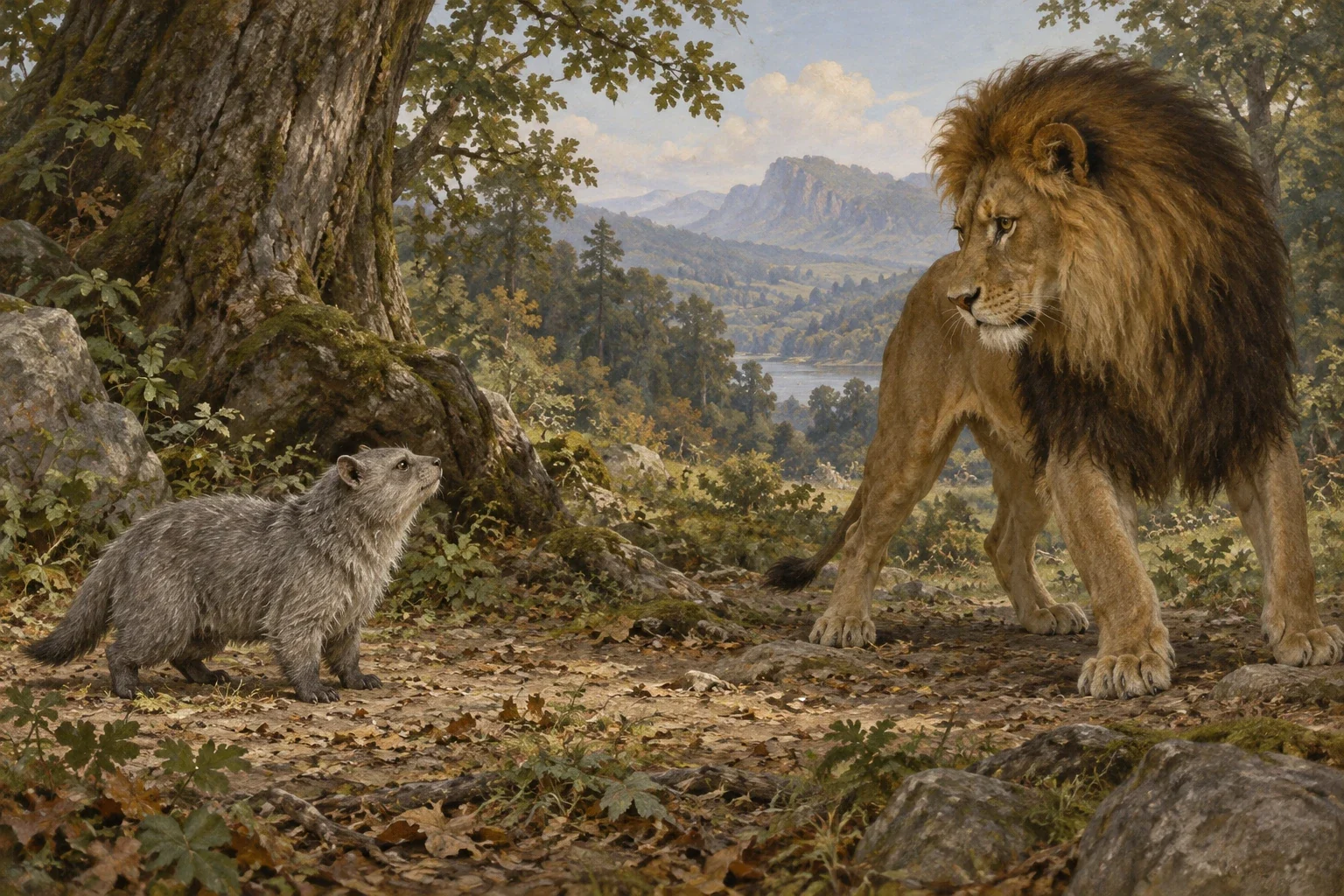
Leontophonus - AI-generated imagined folklore illustration.
AI-generated imagined Leontophonus facing a wary lion. Pliny supplies the small size and hostile relationship; the gray furry body is invented because the selected text does not establish its anatomy.
Overview
Pliny’s account, in Philemon Holland’s translation, describes a small animal occurring in countries that produce lions. Its dangerous quality reverses the expected hierarchy between a powerful predator and a much smaller creature: a lion tasting its flesh is said to die. The passage also attributes lethal power to its urine. These are reported ancient marvels, not verified toxicological observations.
The narrative explains an enemy relationship through mutual avoidance and attack. Lions are said to recognize the danger and crush the creature with their paws rather than bite it. The account further describes hunters using the animal’s remains against lions. This records an attributed historical claim; it is not a recommended method or evidence that the practice worked.
Aberdeen MS24, folio8r, retains the small lion-killer and the poisoned-remains motif within the lion account. Its surviving passage also repeats the lion’s refusal to bite. Neither inspected witness defines a unique external anatomy. A bear-like, boar-like or rodent-like drawing is consequently an artistic interpretation, not a settled species identification.
Origins & earliest records
Pliny supplies a first-century Roman textual witness; Aberdeen MS24 supplies a medieval continuation. No universal earliest-origin claim is made.
Records & interpretation
Complete Holland leontophone paragraph; complete relevant folio8r translation and Latin transcription inspected.
Selected bibliography
Documented works and useful reading. This is not a list of every appearance.
- 01
Natural History, Book VIII, chapter57
Complete chapter38 in Holland’s numbering, Of the Leontophone, read; corresponds to modern BookVIII chapter57.
- 02
Aberdeen Bestiary, folio8r
Lion account: full leontophone passage and corresponding transcription inspected; manuscript around1200.
Family & connections
A source-supported family tree or inspiration record has not yet been compiled for this profile. Related reading below indicates a connection in subject matter, not a proven lineage or creative influence.
References
Sources supporting this profile. Linked pages have their own scope and editorial standards.
- Primary text or custodial scholarly editionNatural History, Book VIII, chapter57Research access: 2026-10-10
- Primary text or custodial scholarly editionAberdeen Bestiary, folio8rResearch access: 2026-10-10
Image credits
AI-generated imagined folklore illustrationLeontophonus - AI-generated imagined folklore illustration.
AI-generated imagined Leontophonus facing a wary lion. Pliny supplies the small size and hostile relationship; the gray furry body is invented because the selected text does not establish its anatomy.