
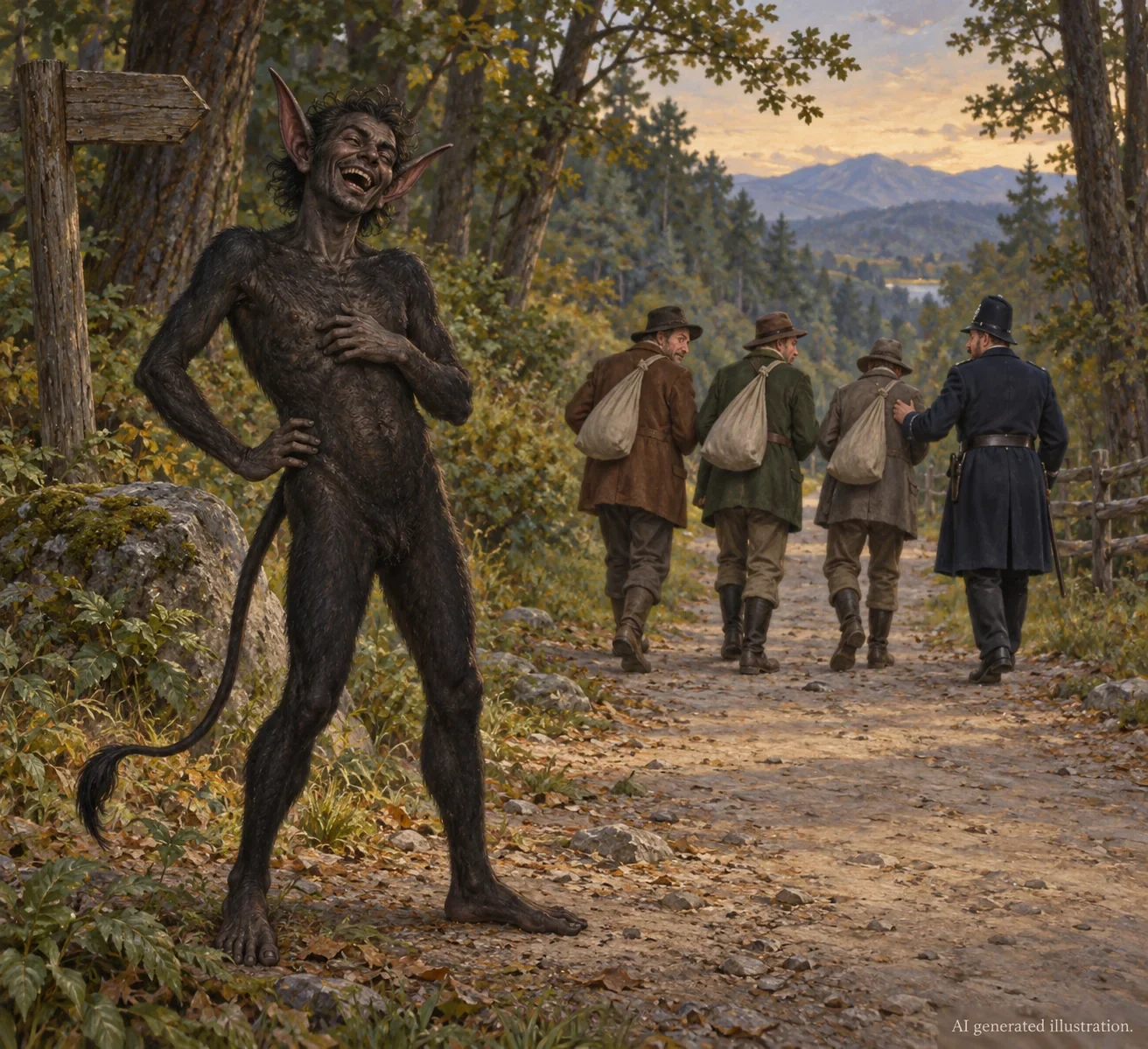
Long-eared tailed deceiver laughing while three travelers leave under escort.
Unofficial AI interpretation of the Magyar anthology’s deceiver. Long ears and tail follow the text; proportions, clothes and setting imagined, not national-costume evidence.
Overview
Three brothers enter Hungary intending to learn Hungarian. A supposed teacher offers a three-day course; each pupil learns only one answer: “we three,” “for a cheese,” or “that’s right.” Later they find their teacher apparently dead beside a forest road. Their memorized replies convince an arriving policeman that they killed him, and he leads them away.
Once they leave, the apparent corpse rises and reveals a sooty devil with long ears and a tail, laughing at the deception. The title identifies the lads as Slovak, while the opening names Slavonia. That unresolved geographic wording is preserved without converting it into modern Slovakia or Croatia. The narrative’s linguistic caricature is not an assessment of Slovak speakers.
Origins & earliest records
TaleXXIII in the 1889 Magyar collection; Hungary is an explicit destination, not proof of exclusive national ownership.
Records & interpretation
Complete retained short tale read through the final disguise reveal. Individual narrator and collection locality unidentified.
Selected bibliography
Documented works and useful reading. This is not a list of every appearance.
- 01
The Folk-Tales of the Magyars
TaleXXIII, p126; original title has character damage in retained text.
Family & connections
A source-supported family tree or inspiration record has not yet been compiled for this profile. Related reading below indicates a connection in subject matter, not a proven lineage or creative influence.
References
Sources supporting this profile. Linked pages have their own scope and editorial standards.
- Historical English translated anthologyJones and Kropf, The Folk-Tales of the Magyars
Image credits
Unofficial modern AI interpretationLong-eared tailed deceiver laughing while three travelers leave under escort.
Unofficial AI interpretation of the Magyar anthology’s deceiver. Long ears and tail follow the text; proportions, clothes and setting imagined, not national-costume evidence.