
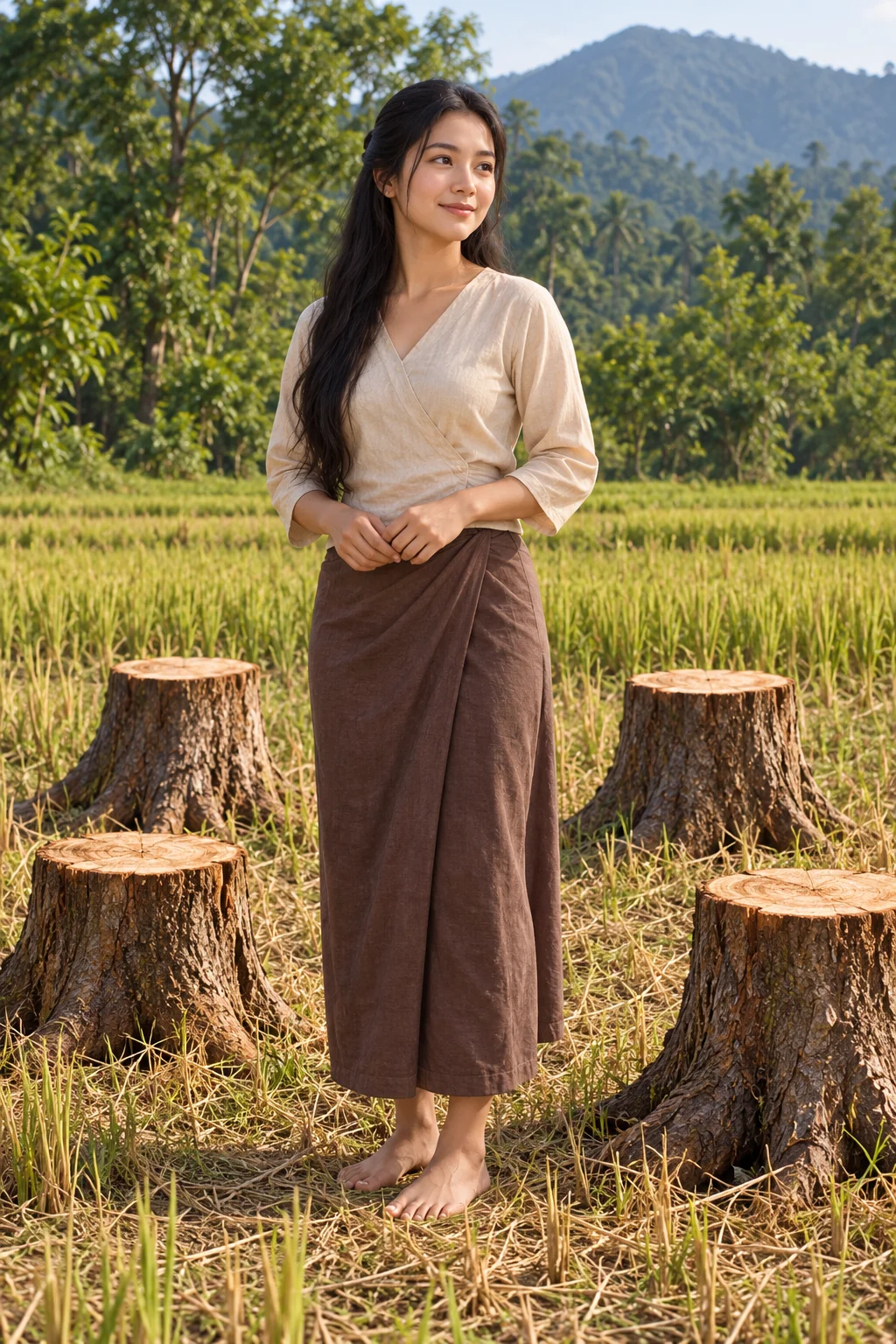
Langaon’s wife in human form; appearance, clothing and setting imagined.
Original narrative illustration; appearance and setting interpreted, not an authenticated ethnographic record.
Overview
In Sirinan of Piasau’s story, Langaon repeatedly harvests little rice and moves away to make new clearings. He finds monkeys damaging one crop and taking the ripe grain from another. At a further clearing, the monkeys attack him when he tries to drive them away. After he fetches a spear and wounds one, the largest continues fighting. Langaon backs between four tree-stumps, where the fight stops and the monkey becomes a beautiful woman. She explains that her mother sent her, that she and her companions reaped his missing rice, and that her family pitied his unmarried state. At her nearby house, she gives him the stored rice and becomes his wife. Evans’s footnote identifies the story’s Maragang as proboscis monkeys.
After they have a child, Langaon insists on visiting a neighboring village. She asks him not to stay overnight, but he joins a feast, remains seven days and becomes involved with another woman. On his return, his wife knows what happened. Calling herself the village’s Kinharingan tumanah, she shows him his own image with the other woman in a looking-glass. He admits the truth. She rejects his offers of customary compensation and says she will leave with their child. Even when he binds her hands and feet to his at night, she and the child are gone by morning.
Langaon searches for them but flees attacking deer and wild pigs. A dream figure tells him that his wife will ride a rhinoceros marked by bells. He confronts a herd, grasps the bell-bearing animal and struggles with it for three days; the other animals vanish. He finally falls beside his own house and loses his grip, whereupon the rhinoceros disappears. He then hears a child indoors and finds his wife and child returned. The text says she rides the animal; it does not explicitly say that she becomes it. Evans’s concluding note distinguishes the Kinharingan above from the Kinharingan tumanah associated with the earth in a local oath. This profile preserves the wife’s particular narrative identity rather than merging her with every use of the divine name.
Origins & earliest records
Sirinan of Piasau, Tempassuk District, identified as the narrator by Evans; The Story of Langaon, pp. 55–61, including the concluding note.
Records & interpretation
Complete seven-page narrative and endnote; human and monkey phases are explicit, while rhinoceros transformation is not.
Selected bibliography
Documented works and useful reading. This is not a list of every appearance.
- 01
Studies in Religion, Folk-Lore, & Custom in British North Borneo and the Malay Peninsula
Original historical English collection; pp. 55–61.
Family & connections
A source-supported family tree or inspiration record has not yet been compiled for this profile. Related reading below indicates a connection in subject matter, not a proven lineage or creative influence.
References
Sources supporting this profile. Linked pages have their own scope and editorial standards.
- Primary collected narrativeStudies in Religion, Folk-Lore, & Custom in British North Borneo and the Malay PeninsulaResearch access: 2026-10-18
Image credits
AI-generatedLangaon’s wife in human form; appearance, clothing and setting imagined.
Original narrative illustration; appearance and setting interpreted, not an authenticated ethnographic record.