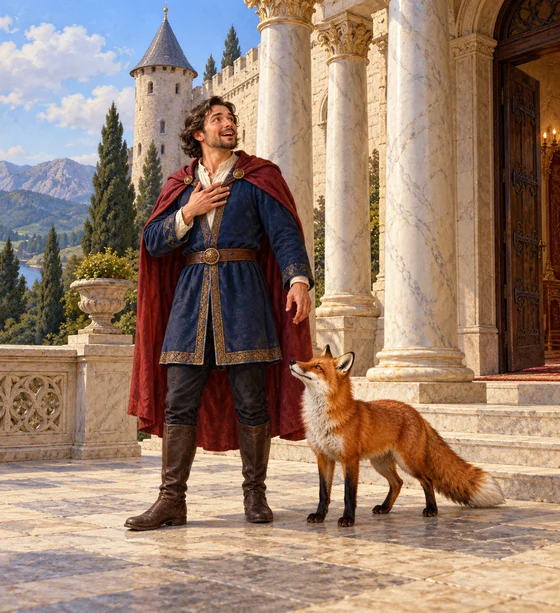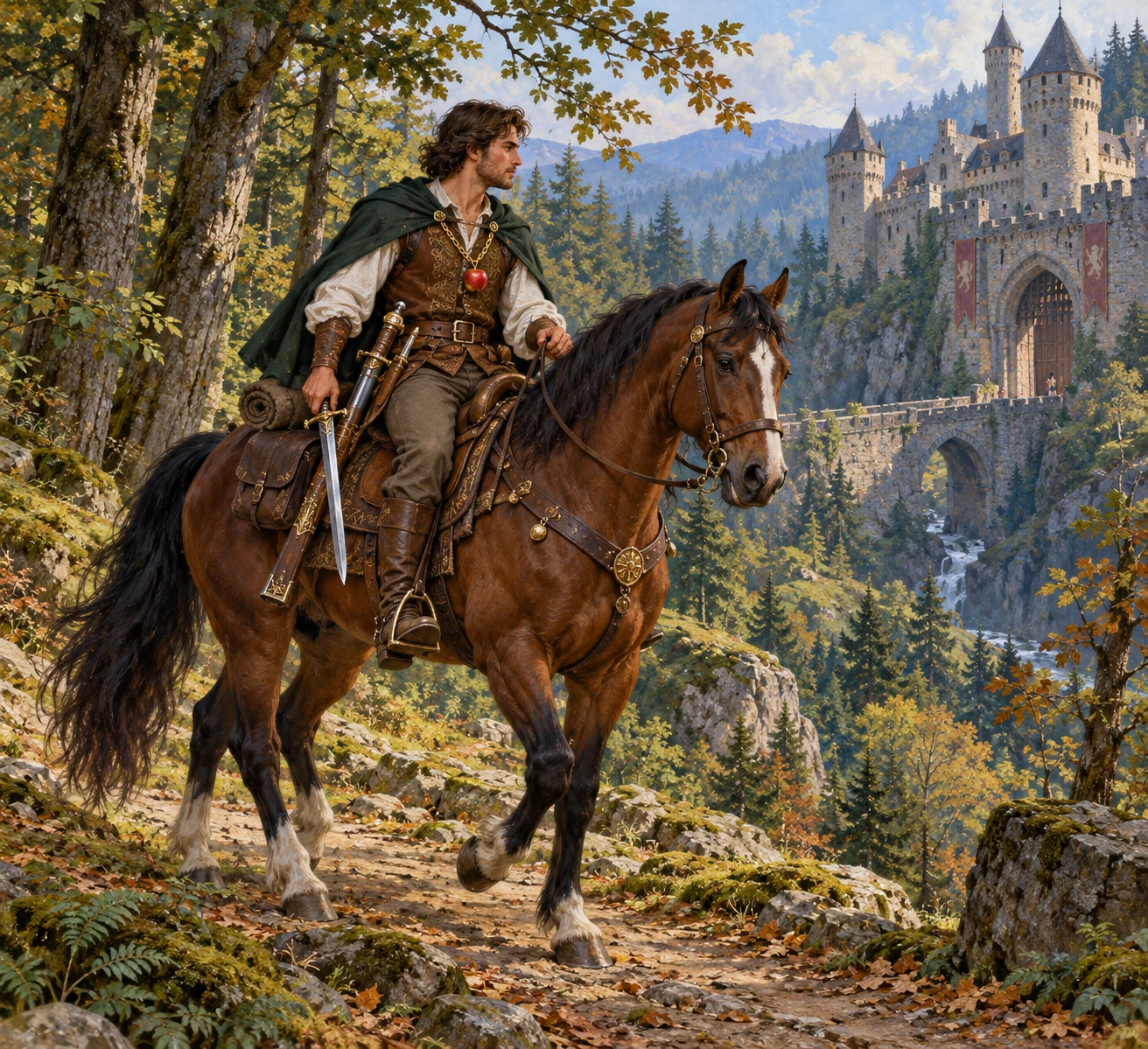
Lacko approaches the castle on the Vile’s horse, wearing the apple on its golden chain; detailed staging imagined.
Original narrative illustration; detailed appearance and staging imagined, not an authenticated cultural record.
Overview
Twelve brothers grow up under the guidance of the Vile, who teach them and encourage helpful, devout conduct. Their neighbour and companion Lacko shares their work and is likewise favoured by these divine women. After the brothers’ father dies, the story depicts their mother as increasingly hostile under the influence of visitors who consume what her sons earn. The brothers confront the guests, but continue showing respect toward her. Eventually she curses all twelve to the devils. A whirlwind enters the house and carries them away. Lacko challenges her account until she admits what happened, then calls upon the Vile for help. They locate the brothers in an enchanted forest castle guarded by a devil and two great black hounds.
The Vile equip Lacko with a gun, a sword, a knife and an apple, as well as their own powerful horse and a further long, double-edged sword. One Vila accompanies him to guide and assist him. At the castle he wears the apple on a golden chain around his neck. Horse and rider overcome the devil and the hounds, with Lacko using both gun and sword, and find the weeping brothers in the fifth room. They return home together. The Vile then announce that God has empowered them to turn rescuer and rescued into stars as a lasting warning against a parent’s curse. A luminous cloud carries all thirteen upward, and thirteen new stars appear that evening under the name Laskari. Krauss’s separate preface associates that name with the seven-star group and calls the tale’s count a confusion of names; that editorial interpretation does not erase the thirteen figures narrated in the ending.
Origins & earliest records
Krauss assigns tale28, “Laskari”, to Jamladinec in the manuscript collection supplied by Matija Kračmanov Valjavec. The preface describes Valjavec’s collecting and teaching around Varaždin, but supplies no individual narrator for this tale. The retained witness is Krauss’s complete German version. Its village of Pusto selo belongs to the story and is not identified with the collecting locality.
Records & interpretation
Complete tale28, printed pp.98–108, including the equipment, rescue and thirteen-star ending; preface pp.XXIII–XXIV supplies the Valjavec/Jamladinec binding, and p.XXVIII supplies Krauss’s separate numerical comment. Native pages verify the name Lacko, equipment and ending.
Selected bibliography
Documented works and useful reading. This is not a list of every appearance.
- 01
Sagen und Märchen der Südslaven, volume I
Original Leipzig: Wilhelm Friedrich edition; complete tales24 and28 with the original preface.
Family & connections
A source-supported family tree or inspiration record has not yet been compiled for this profile. Related reading below indicates a connection in subject matter, not a proven lineage or creative influence.
References
Sources supporting this profile. Linked pages have their own scope and editorial standards.
- Original historical German collection and translationKrauss1883: original title, complete preface and selected complete German narrativesResearch access: 2026-10-18
Image credits
AI-generatedLacko approaches the castle on the Vile’s horse, wearing the apple on its golden chain; detailed staging imagined.
Original narrative illustration; detailed appearance and staging imagined, not an authenticated cultural record.