
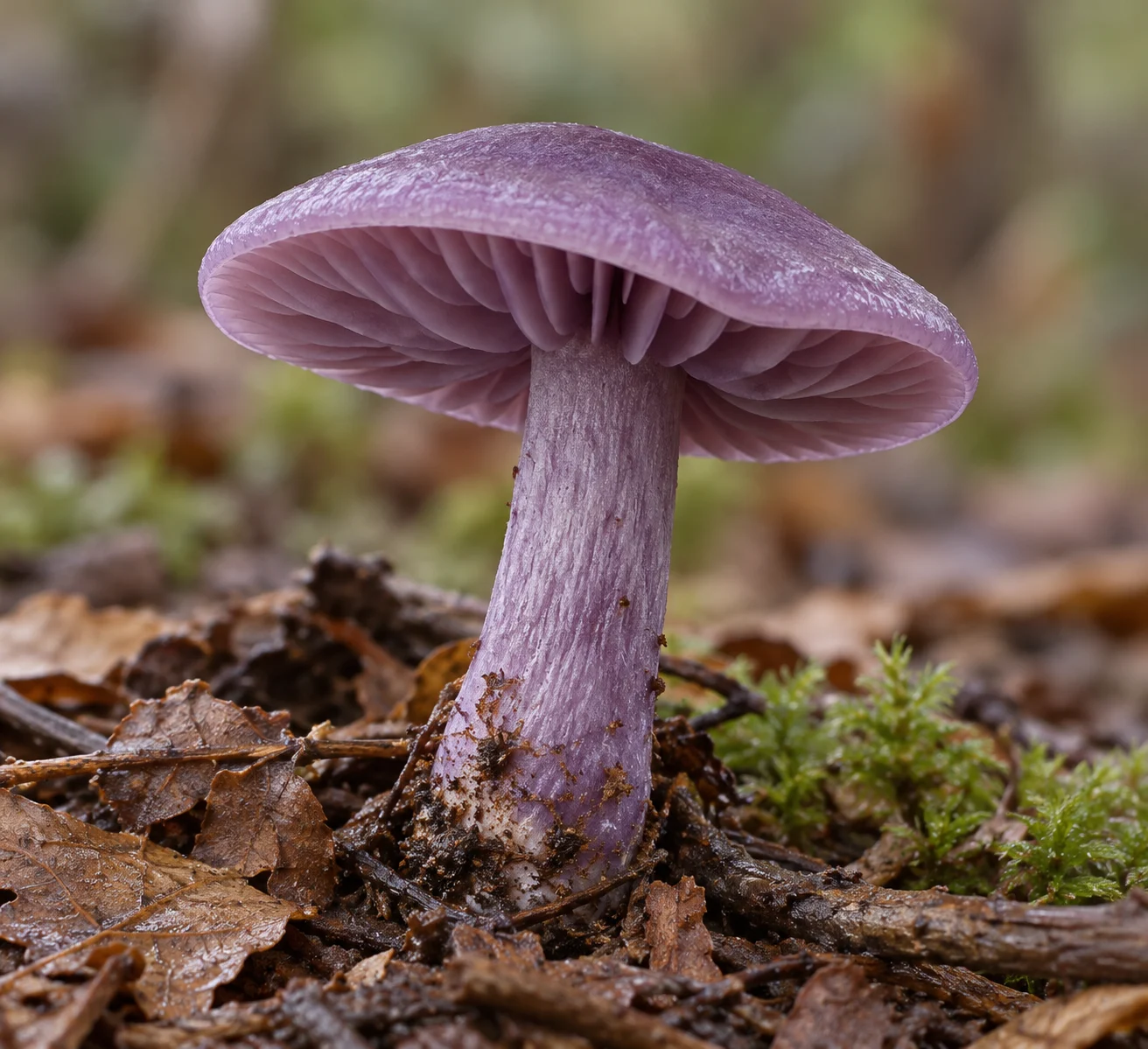
AI-generated fruiting-body study.
Independent interpretation; underground tissues are not reconstructed.
Overview
The amethyst deceiver has a purple or lilac cap, gills and stem when moist. Its thick, widely spaced gills are distinctive. As it dries, the colour fades towards pale lilac or buff, producing markedly different appearances within the species.
It occurs in coniferous and deciduous woodland, often with beech. NatureSpot gives late summer to early winter as its usual season and documents records from Martinshaw Wood and Burbage Common. Dry specimens may resemble the common deceiver, Laccaria laccata.
Origins & earliest records
British woodland records.
Evidence & interpretation
Community species account.
Selected bibliography
Documented works and useful reading. This is not a list of every appearance.
- 01
Family & connections
A source-supported family tree or inspiration record has not yet been compiled for this profile. Related reading below indicates a connection in subject matter, not a proven lineage or creative influence.
Look for a taxonomic record and classified relativesReferences
Sources supporting this profile. Linked pages have their own scope and editorial standards.
- Community species accountAmethyst DeceiverResearch access: 2026-10-18
Image credits
AI-generated illustrationAI-generated fruiting-body study.
Independent interpretation; underground tissues are not reconstructed.