
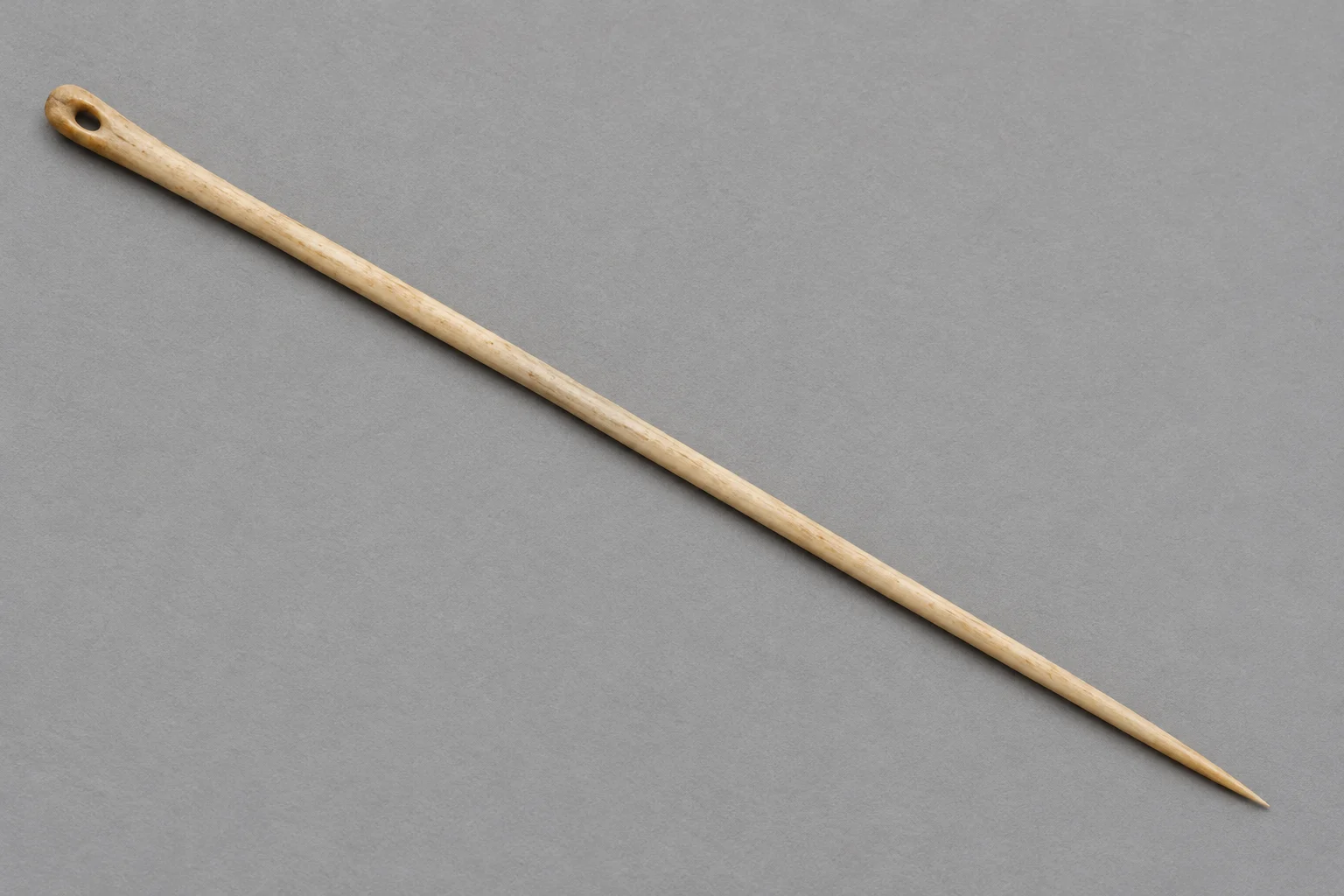
Generated interpretation of a published archaeological form; not a photographed specimen or authenticated replica.
Overview
Dawkins illustrates a bone needle from La Madelaine while discussing the tools found in the caves and rock-shelters of Périgord. The drawing presents a long narrow shaft, a sharp lower point and a small pierced eye near the rounded upper end. His accompanying account describes needles sawn from the compact metacarpal and tarsal bones of reindeer and horse, then rounded and smoothed on grooved sandstone. Pointed flakes found with them were used to make the eyes, a process that he says Lartet demonstrated experimentally. These manufacturing observations concern the needles as a class; the passage does not assign the illustrated specimen to a particular animal or give its maker a name.
The needle sits within a wider assemblage of flint flakes, bone implements, worked antler, animal remains and hearth traces. Dawkins uses the combination to describe life in the occupied shelters rather than treating the needle as an isolated curiosity. He interprets the eyed form as evidence of sewing and proposes skin garments joined with reindeer tendon. That proposed thread and use are historical inferences, not material shown attached to Figure 110. The present profile therefore keeps the needle unthreaded and distinguishes the pictured object from the surrounding reconstruction. It also retains the credit to Lartet and Christy instead of presenting Dawkins as the original discoverer or treating his later comparisons with Arctic peoples as an established ancestry finding.
History & identity
Dawkins’s 1874 synthesis draws here on the discoveries of Édouard Lartet and Henry Christy and credits their illustrations. His preface and note 223 acknowledge permission from the editors of Reliquiæ Aquitanicæ to use letterpress and engravings. The retained title and imprint are transcribed evidence, not a newly acquired physical title-page image.
Sources & representation
Figure 110 and the complete Périgord discussion, especially the manufacturing paragraph; full preface and note 223 establish the reused research and illustration context. The complete native needle image was viewed. No individual bone species, present repository or current chronological date is established here.
Selected bibliography
Documented works and useful reading. This is not a list of every appearance.
- 01
Cave Hunting: Researches on the Evidence of Caves Respecting the Early Inhabitants of Europe
London: Macmillan and Co. Complete Périgord section, printed pages 337–347; illustrations credited to Lartet and Christy. Preface and note 223 identify borrowed letterpress and engravings from Reliquiæ Aquitanicæ.
Language & cultural connections
Source-supported language and cultural connections have not yet been compiled for this profile.
References
Sources supporting this profile. Linked pages have their own scope and editorial standards.
- Historical archaeological synthesisCave Hunting, historical archaeological synthesisResearch access: 2026-10-18
Image credits
AI-generatedGenerated interpretation of a published archaeological form; not a photographed specimen or authenticated replica.