
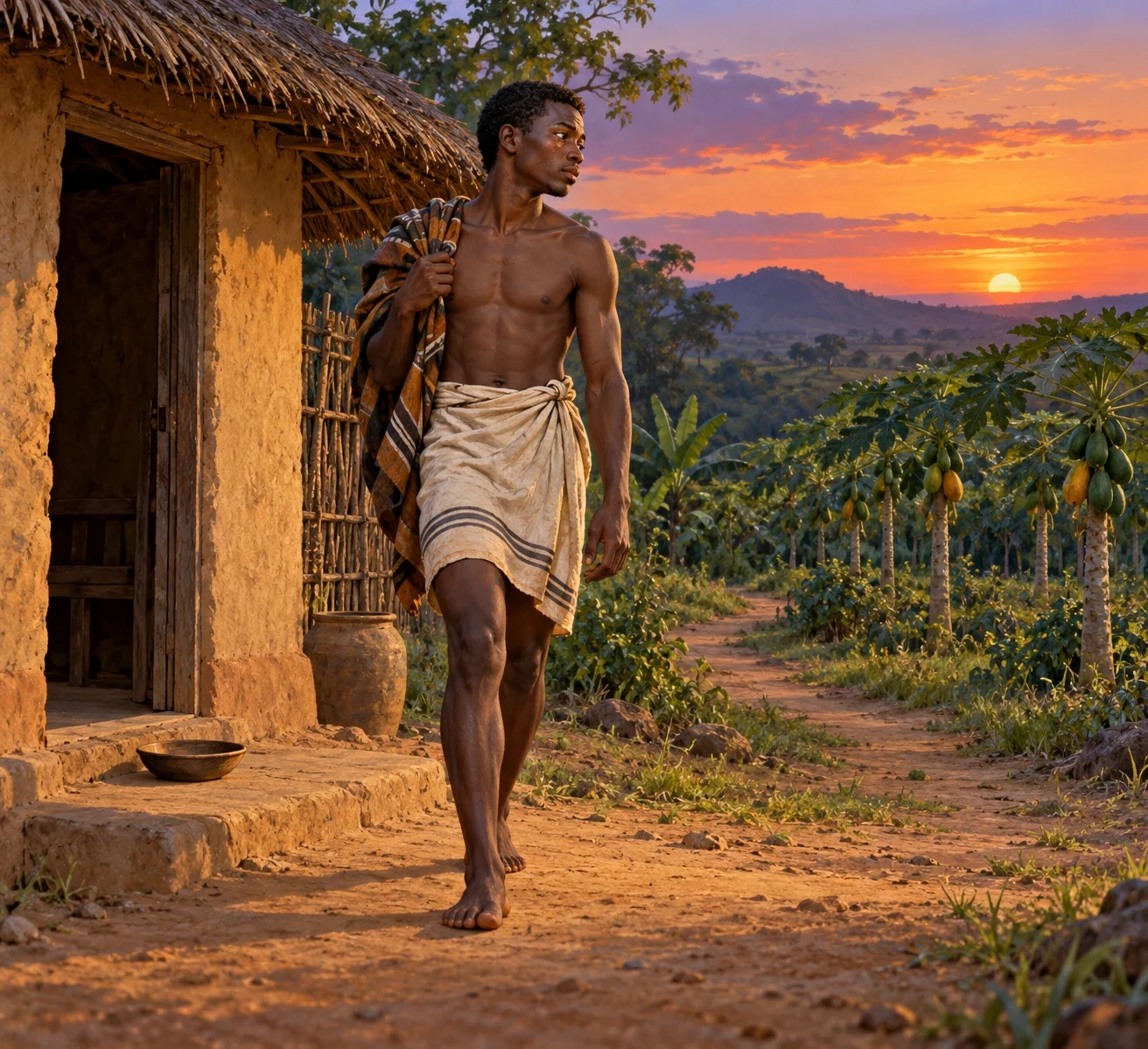
AI-generated interpretation of Kwofi preparing to leave for the paw-paw field after being denied a meal, before the divine visitor arrives in Barker and Sinclair’s selected 1917 retelling. Face, exact age, clothing, bowl placement, architecture and landscape are editorial choices, not an authenticated community appearance or a documented settlement.
AI-generated interpretation of Kwofi preparing to leave for the paw-paw field after being denied a meal, before the divine visitor arrives in Barker and Sinclair’s selected 1917 retelling. Face, exact age, clothing, bowl placement, architecture and landscape are editorial choices, not an authenticated community appearance or a documented settlement.
Overview
Kwofi is the eldest son of a farmer with two wives. His mother dies when he is three, and his stepmother takes him into her care. After his father dies when Kwofi is about ten, her household is his remaining family. He works for her and grows into a clever, handsome and successful hunter. His ability brings meat or fish to the household, but it also provokes his stepmother’s jealousy toward a boy she considers more gifted than her own children.
The household’s meals repeatedly exclude the person who supplies them. The stepmother cooks what Kwofi brings home and gives generous portions to the others. When his turn comes she says that there is not enough, directing him instead to ripe paw-paw in the field. Kwofi does not complain and never tastes the meat he has hunted. The repeated denial establishes a particular wrong within the story: the household consumes the fruits of his labour while treating him as someone for whom nothing remains.
One evening, as Kwofi is preparing for another journey to the field, a god appears with a great bag over his shoulder. He calls the villagers together and announces that it is a bag of death. The distribution repeats the earlier meal’s pattern with its result reversed. Addressing Kwofi, the god recalls that there was not sufficient meat for him and says that there is likewise no death for him. Everyone else in the village dies. The narrative leaves Kwofi to reign there happily and in peace.
The ending gives Kwofi survival and a reversal of exclusion, but does not describe a coronation, specify an eternal lifespan or name the visiting god. Although the chapter title uses the plural Gods, the episode presents one unnamed divine visitor. Nothing in this selected text identifies that visitor as Nyankupon or establishes that Kwofi himself becomes a deity. The bag’s contents are described through the story’s distribution of death, without a literal inventory or a prescribed visual form.
Origins & earliest records
W. H. Barker and Cecilia Sinclair published this selected English retelling in West African Folk-Tales (1917). Barker says that experienced district teachers attending the teacher-training institution at Accra supplied versions in English, from which he selected and retold material for a wider public. Neither selected chapter names an individual narrator or a specific community. The Gold Coast collection and Accra institution provide historical collection context; they do not establish an exclusive present-day national origin, an Akan attribution for this particular tale, or the village’s location. The selected account is chapter 23, printed pages 129–130.
Records & interpretation
The complete selected chapter, including its ending, and the complete introduction were read from the cached public-domain English edition. The introduction describes selection between versions and retelling, so this is a mediated historical witness rather than a verbatim oral transcript. Its colonial racial judgments and speculative accounts of peoples and deities are attributed editorial history, not adopted anthropology. The accompanying illustrations were not used to establish an authenticated appearance.
Selected bibliography
Documented works and useful reading. This is not a list of every appearance.
- 01
West African Folk-Tales
Complete chapter 23, pp.129–130; original introduction, pp.11–26 and notes. Historical English retelling, not a present-day community publication.
Family & connections
A source-supported family tree or inspiration record has not yet been compiled for this profile. Related reading below indicates a connection in subject matter, not a proven lineage or creative influence.
References
Sources supporting this profile. Linked pages have their own scope and editorial standards.
- Historical collected and arranged narrativeBarker and Sinclair 1917, complete chapter 23 and introductionResearch access: 2026-10-23
- Historical editorial framingOriginal introduction: collection and retelling methodResearch access: 2026-10-23
Image credits
AI-generated illustrationAI-generated interpretation of Kwofi preparing to leave for the paw-paw field after being denied a meal, before the divine visitor arrives in Barker and Sinclair’s selected 1917 retelling. Face, exact age, clothing, bowl placement, architecture and landscape are editorial choices, not an authenticated community appearance or a documented settlement.
AI-generated interpretation of Kwofi preparing to leave for the paw-paw field after being denied a meal, before the divine visitor arrives in Barker and Sinclair’s selected 1917 retelling. Face, exact age, clothing, bowl placement, architecture and landscape are editorial choices, not an authenticated community appearance or a documented settlement.