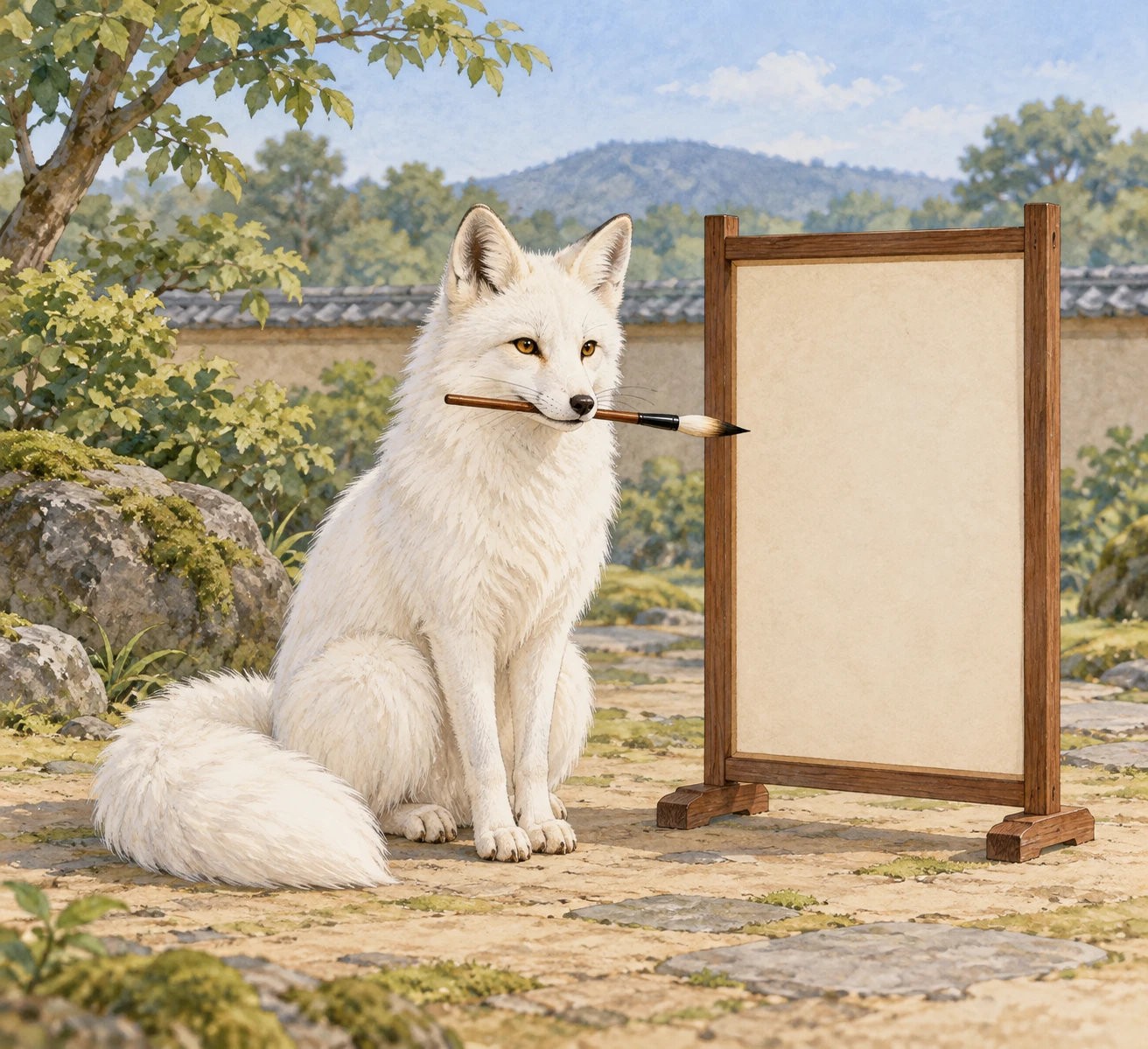
AI interpretation of Kuzunoha: white fox, brush and blank panel form a symbolic composite of Joly’s narrative and iconographic notices. Baby omitted; exact designs and setting are imagined, not historical evidence.
AI interpretation of Kuzunoha: white fox, brush and blank panel form a symbolic composite of Joly’s narrative and iconographic notices. Baby omitted; exact designs and setting are imagined, not historical evidence.
Overview
Henri L. Joly introduces Kuzunoha under Abe no Yasuna, whom he identifies as the father of Abe no Seimei. In his account, Yasuna is reciting poetry in an Inari temple garden when nobles arrive pursuing a fox for its liver. He hides the animal in the folds of his kimono before they enter the grounds. The rescue protects a living creature; the hunters’ medicinal purpose belongs to the narrated belief and is not presented as an effective treatment.
A year later Yasuna marries a woman named Kuzunoha, who bears a son and soon dies of a fever. Three days after her death she appears in his dream, tells him not to grieve and reveals that she was the fox he saved. The animal’s return as wife and mother connects the rescue to a family relationship rather than a simple attack by a disguised predator.
Joly then records another version: Kuzunoha lives with Yasuna for three years and leaves him. Before departing she writes a poem on the room’s panels, directing a lover who seeks her to Shinoda forest in Izumi. Joly’s rendering plays on her name and a kuzu leaf, followed by a brief note that the plant was used by weavers. This departure is a distinct ending, not an additional event after her death and dream appearance.
The book’s separate fox entry identifies an artistic motif of Kuzunoha as a fox holding a brush in its mouth while nursing a baby. That iconographic description does not establish the exact appearance of every telling. Joly’s account names a white fox but supplies no nine-tail count for this mother. His compilation addresses motifs in Japanese art; it does not name an oral narrator for this entry or establish the historical reality of Yasuna’s supernatural marriage.
Origins & earliest records
Henri L. Joly, Legend in Japanese Art, London/New York: John Lane, The Bodley Head,1908; entry1 Abe no Yasuna, printed p.1.
Records & interpretation
Complete numbered entry including both endings, poem and botanical note; separate fox iconography notice on p.69. English OCR witness, not an original-language collation.
Selected bibliography
Documented works and useful reading. This is not a list of every appearance.
- 01
Legend in Japanese Art
Entry1 ABE NO YASUNA, p.1, complete; FOX iconographic notice p.69. Title/imprint and relevant introductory framing read; no whole-volume reading claim.
Family, evolution & connections
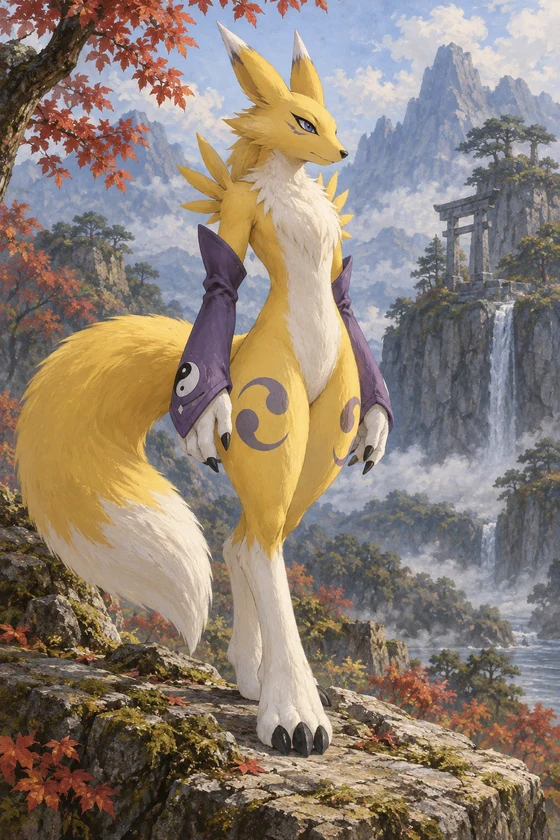
Renamon
Kuzunoha's change between fox and woman supplies historical context for a fox transformation motif beside Renamon's distinct fictional form. Joly preserves a named marriage and two alternative endings; neither that biography nor direct creator consultation is attributed to Renamon.
References
Sources supporting this profile. Linked pages have their own scope and editorial standards.
- Historical English art-reference compilationJoly1908, original edition OCRResearch access: 2026-10-26
Image credits
AI narrative interpretationAI interpretation of Kuzunoha: white fox, brush and blank panel form a symbolic composite of Joly’s narrative and iconographic notices. Baby omitted; exact designs and setting are imagined, not historical evidence.
AI interpretation of Kuzunoha: white fox, brush and blank panel form a symbolic composite of Joly’s narrative and iconographic notices. Baby omitted; exact designs and setting are imagined, not historical evidence.