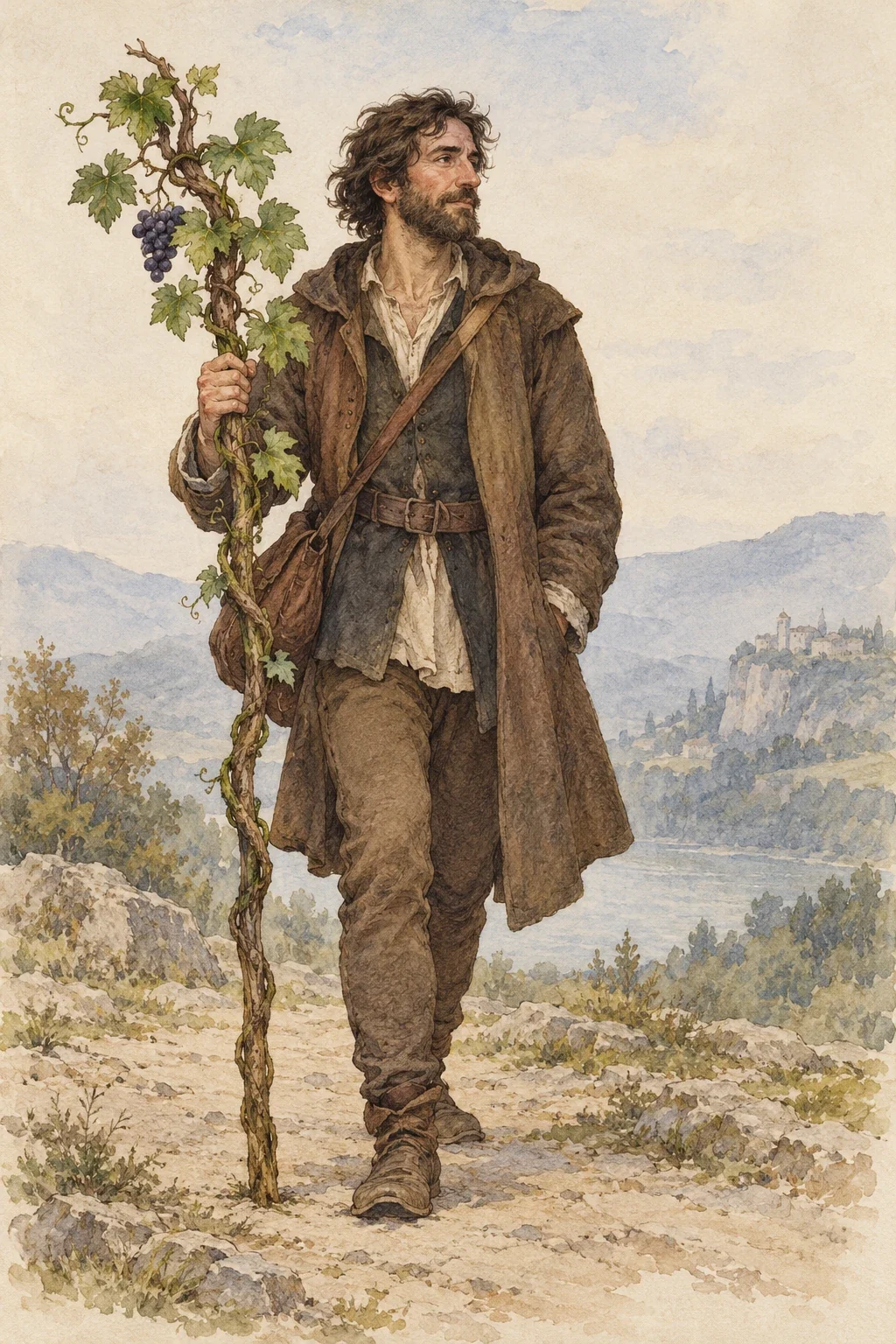
AI-generated literary interpretation of Kurent with the vine-stick in Wratislaw’s Carniolan narratives.
The vine-stick follows the text. Face, body, coat, colours, age and landscape are imaginative; modern carnival costume and historical ethnic portraiture are not asserted.
Overview
Wratislaw’s two adjacent Kurent narratives give a flexible character rather than one uniformly benevolent protector. In Kurent the Preserver, a flood destroys mankind except for Kranyatz. He climbs from one threatened height to another until only a vine remains above water. The vine is Kurent’s walking stick. Kurent notices the frightened survivor and, pleased that someone appears to seek his help, straightens and lengthens the vine until it reaches above the clouds. Kranyatz survives for nine years by clinging to it and living on grapes and wine. When the water finally recedes, Kurent directs the survivor’s gratitude toward the vine itself and demands a lasting covenant of praise from him and his descendants.
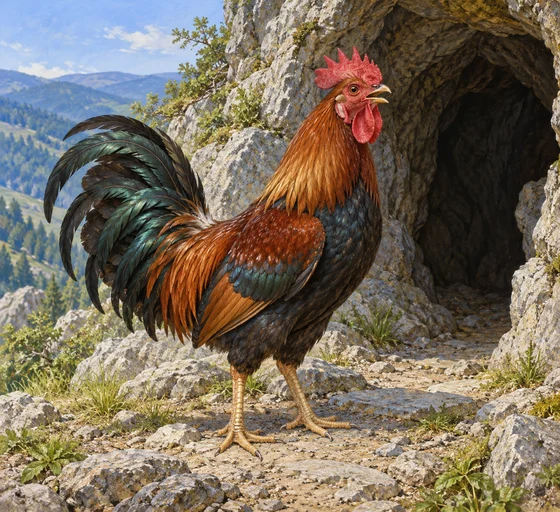
Kurent and Man begins again with a contest for dominion. Its human rival is enormous: the narrator uses his nostrils to suggest a scale far beyond present people. That gigantic body belongs to the man, not to Kurent. Kurent leaps across a sea but wets one foot; the man simply steps across and stays dry. Kurent splits a hollow rock by stamping, exposing brooding dragons. The man stamps more powerfully, opens the earth to a deep river of gold and sends the dragons falling into it. In the final trial, both shoot arrows upward. Kurent’s arrow returns after eight days, while the man’s returns on the tenth day carrying the celestial cock that had guarded God’s provisions. Kurent acknowledges defeat, and the man accepts him as an adopted brother.
The defeated rival then turns from strength to deception. He squeezes wine from his vine-stick and offers it to the man, but the first drink fails to win his enthusiasm. A second adulterated offering pleases him without making him lose restraint. A third, mixed with Kurent’s own blood, overcomes him while he eats at God’s table. God returns, discovers the trespass and casts the man down the mountain. He eventually recovers, but cannot regain his former immense powers. The narrator closes by attributing human weakness and Kurent’s dominion to this reversal. This later contest is a separate story, not an additional incident securely dated after Kranyatz’s flood.
The Carniolan introduction prints Professor Krek’s interpretation of Kurent as comparable to Dionysos and connected with wine and seasonal custom. Krek expressly calls it a rapidly formed subjective opinion and acknowledges a mixture of Christian and other elements. These remarks document nineteenth-century scholarship; they do not establish an ancient cult, a proved etymology or a continuous identity with every modern carnival figure called Kurent. The narrative witness supplies a vine-stick, travel, a removable coat, extraordinary actions and an unstable relationship with humanity, but no complete facial or bodily description. Historical Carniola is kept distinct from the anthology’s broad Serbian heading and from an exclusive modern national origin.
Origins & earliest records
Wratislaw 1889 chapters XLIX and L, presented in his historical Carniolan section through Erben’s 1865 anthology.
Records & interpretation
Complete chapters XLIX–L, printed 256–261; complete Carniolan introduction 252–254 and general preface read. Krek interpretation attributed.
Selected bibliography
Documented works and useful reading. This is not a list of every appearance.
- 01
Sixty Folk-Tales from Exclusively Slavonic Sources — XLIX Kurent the Preserver; L Kurent and Man
Complete chapters XLIX–L, printed 256–261; complete Carniolan introduction 252–254 and general preface read. Krek interpretation attributed.
Family & connections
A source-supported family tree or inspiration record has not yet been compiled for this profile. Related reading below indicates a connection in subject matter, not a proven lineage or creative influence.
References
Sources supporting this profile. Linked pages have their own scope and editorial standards.
- ReferenceWratislaw 1889, complete Kurent narrative pair and framingResearch access: 2026-10-21
Image credits
AI-generatedAI-generated literary interpretation of Kurent with the vine-stick in Wratislaw’s Carniolan narratives.
The vine-stick follows the text. Face, body, coat, colours, age and landscape are imaginative; modern carnival costume and historical ethnic portraiture are not asserted.