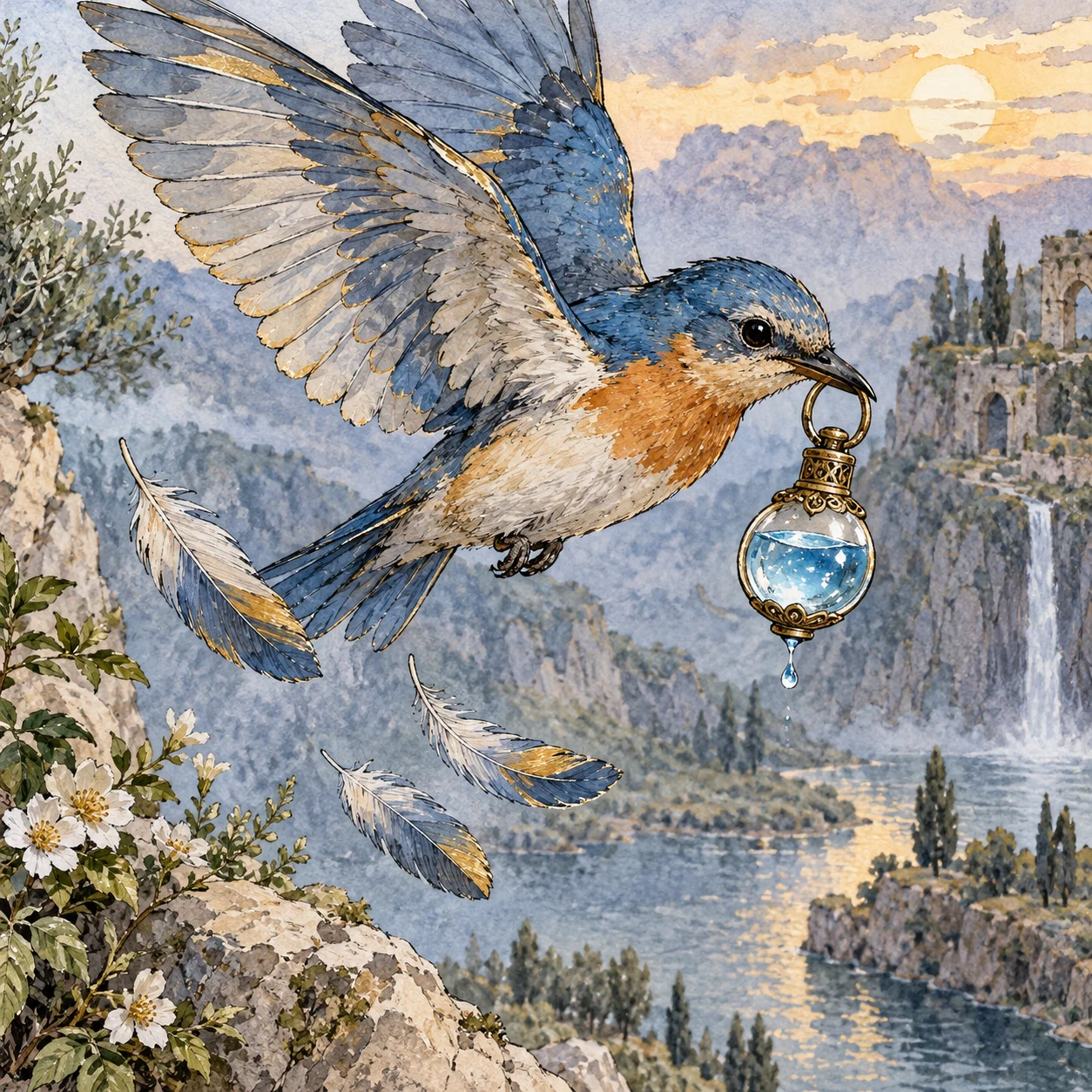
An imagined grateful bird carrying heavenly water in its beak.
AI-generated modern interpretation; undescribed appearance, clothing, colours and setting are imagination, not historical or ethnographic evidence.
Overview
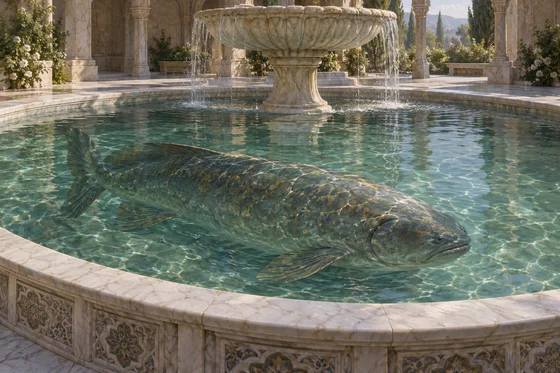
While travelling to seek the World’s most Beauteous Damsel, the prince rescues a little bird from a serpent and receives three feathers to burn if he needs help. When the princess’s father deliberately beheads a maid and requires the suitor to restore her, burning the feathers brings the bird before the prince has even spoken a summons. The bird has friends among the Peris and returns with a small vessel of heavenly water in its beak. The prince sprinkles the dead maid, who immediately rises alive. This is the third of three tasks assisted by grateful animals, following a fish’s recovery of a swallowed ring and ants’ separation of grain from gravel. The bird remains unnamed and unspecified in species; its Peri friendships do not make it the emerald Anka of other tales or establish that it is itself a Peri.
Origins & earliest records
Turkish storytelling collected in Anatolia, through Hungarian and English publication
Records & interpretation
Complete English tale and ending read, with its attached footnote where present.
3D model
An original procedural model made for the Mythscribe World Builder. It is an interpretation based on this entry, not a historical source or a depiction from the records cited here.

Procedural folklore creature kit · 20,030 triangles · 1.7 MB
Opens mythscribe.cloud in a new tab. Sign-in is required.
Selected bibliography
Documented works and useful reading. This is not a list of every appearance.
- 01
Turkish Fairy Tales and Folk Tales
“The World’s most Beauteous Damsel,” pp.154–165. London:A.H.Bullen,1901. Complete English tale; no attached footnote.
Family & connections
A source-supported family tree or inspiration record has not yet been compiled for this profile. Related reading below indicates a connection in subject matter, not a proven lineage or creative influence.
Primary records and illustrations
Turkish Fairy Tales and Folk Tales
Ignácz Kúnos / R. Nisbet Bain; London: A. H. Bullen, 1901. The World’s most Beauteous Damsel, pp.154–165
Complete kunos-bain-13.txt,14791characters, no footnote. All three grateful-animal tasks, two garden guardians, Earless journey, fifty singing pomegranates, wedding-night vigil and final succession read. Guardian’s promised protection distinguished from later demonstrated rescue. Heroine compared with Peris, not explicitly classified as one.
References
Sources supporting this profile. Linked pages have their own scope and editorial standards.
- Historical English folktale translation through HungarianKúnos/Bain1901, The World’s most Beauteous DamselResearch access: 2026-10-05
Image credits
Modern interpretationAn imagined grateful bird carrying heavenly water in its beak.
AI-generated modern interpretation; undescribed appearance, clothing, colours and setting are imagination, not historical or ethnographic evidence.