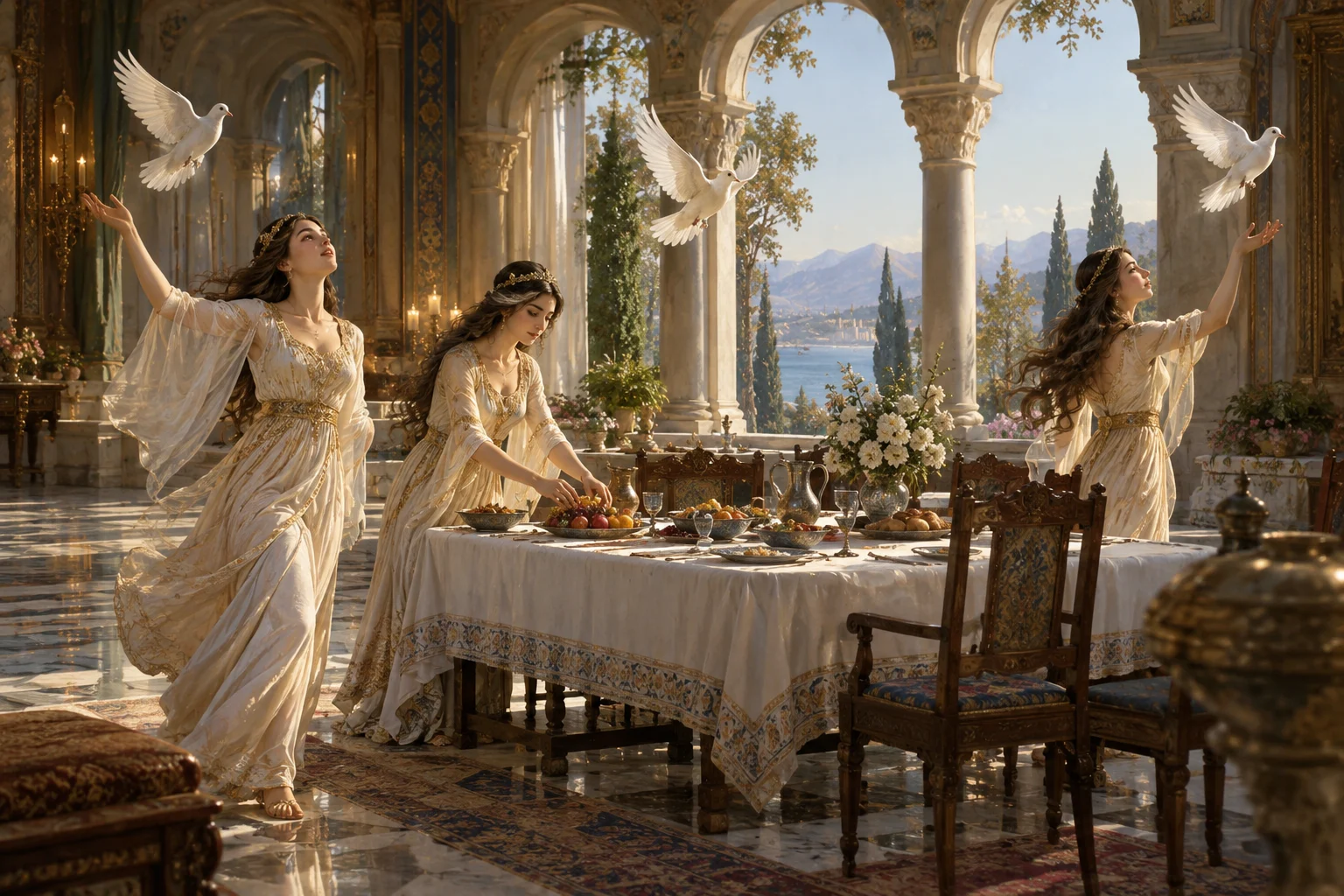
AI interpretation of the three dove attendants preparing the palace table.
AI-generated unofficial original narrative interpretation. Only the initial three attendants and their dove/damsel forms shown as a narrative montage; not all forty Peris. Not a historical reconstruction or community portrait.
Overview
In “The Padishah of the Forty Peris,” the forty Peris have abducted Bahtiyar Bey from his mortal mother at three days old and made him their ruler, allowing him only two hours of freedom in each day. The hidden palace first reveals three dove attendants who become beautiful damsels to sweep, lay the table and provide food, then resume their bird forms. Bahtiyar warns his human beloved that the forty Peris would kill her if they found her with him; the threatened killing does not occur.
After the couple have a child, Bahtiyar’s mother arranges for him to overstay his permitted visit and covers the cypress where the forty doves sometimes alight with venomous needles. They come to seek their overdue ruler, settle there and fall poisoned to the ground. His release closes the story with a family feast. These particular Peris’ captivity and vulnerability are source-specific; their separate identities, ancestry and reason for choosing the infant are not supplied.
Origins & earliest records
Turkish storytelling collected in Anatolia, through Hungarian and English publication
Records & interpretation
Complete English tale and ending read, with its attached footnote where present.
3D model
An original procedural model made for the Mythscribe World Builder. It is an interpretation based on this entry, not a historical source or a depiction from the records cited here.

Procedural folklore creature kit · 38,944 triangles · 2.7 MB
Opens mythscribe.cloud in a new tab. Sign-in is required.
Selected bibliography
Documented works and useful reading. This is not a list of every appearance.
- 01
Turkish Fairy Tales and Folk Tales
“The Padishah of the Forty Peris,” pp.166–175. London:A.H.Bullen,1901; complete English account, no attached footnote.
Family & connections
A source-supported family tree or inspiration record has not yet been compiled for this profile. Related reading below indicates a connection in subject matter, not a proven lineage or creative influence.
Primary records and illustrations
Turkish Fairy Tales and Folk Tales
Ignácz Kúnos / R. Nisbet Bain; London: A. H. Bullen, 1901. The Padishah of the Forty Peris, pp.166–175
Complete cache kunos-bain-14.txt,12753characters, no footnote. Ring/bracelet/handkerchief thefts, bath frame and healed visitors, three dove servants, mortal origin, wife/child, mother’s poisoned-needle trap and final feast all read. Two hours of freedom versus remaining Peri service; no explicit removal of bird-changing faculty at ending.
References
Sources supporting this profile. Linked pages have their own scope and editorial standards.
- Historical English folktale translation through HungarianKúnos/Bain1901, The Padishah of the Forty PerisResearch access: 2026-10-05
Image credits
AI-generated interpretationAI interpretation of the three dove attendants preparing the palace table.
AI-generated unofficial original narrative interpretation. Only the initial three attendants and their dove/damsel forms shown as a narrative montage; not all forty Peris. Not a historical reconstruction or community portrait.