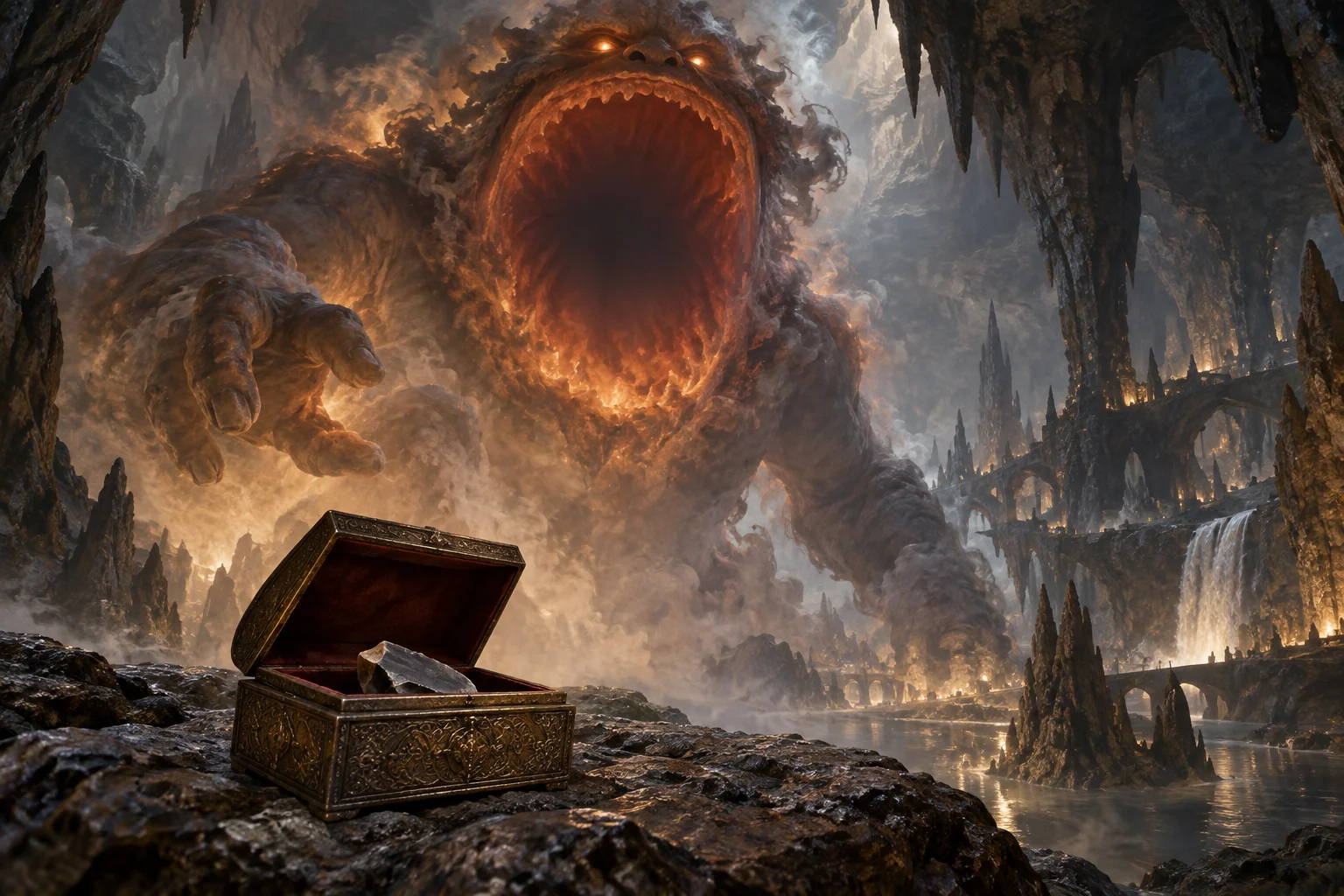
AI interpretation of the summoned flint efrit’s vast mouth above a casket.
AI-generated unofficial original narrative interpretation. Selected casket/flint summoning and vast-mouth interpretation; face, body, mist and underground setting imagined. Not a historical reconstruction or community portrait.
Overview
A princess gives Cinder-Youth a casket containing a flint before his brothers abandon him in a well. She says striking it will summon an efrit able to fulfil his desires. He first uses it in the seventh world to obtain the immense supply of meat and water needed by the emerald Anka. The apparition has a mouth compared to the size of the world and immediately asks for orders.
After the Anka returns the youth to the surface, he strikes the flint again and requests news of the three princesses. The efrit returns with the women themselves, enabling their onward journey to their father. The narrative gives this helper no personal name, explains no imprisonment inside the flint and imposes no limit of three wishes. Its human-like racialised description in the English text is not a category of real peoples.
Origins & earliest records
Turkish storytelling collected in Anatolia, through Hungarian and English publication
Records & interpretation
Complete English tale and final comparative footnote read, preserving separate opponents and journeys.
Selected bibliography
Documented works and useful reading. This is not a list of every appearance.
- 01
Turkish Fairy Tales and Folk Tales
“The Cinder-Youth,” pp. 84–96; footnote10 compares the flesh-offering incident with Bird Zhar and Bird Mogol tales. London: A. H. Bullen. English through Hungarian1889, as stated in preface.
Family, evolution & connections
Efreeti (Dungeons & Dragons)
In Kúnos–Bain’s 1901 Cinder-Youth tale, an efrit called by striking flint brings meat and water for the Anka’s journey and later brings the three princesses to the hero. This particular helper supplies a historical English Efrit context beside the fictional name Efreeti. The comparison does not make their bodies, powers or histories identical, or show that the game’s creators consulted this tale.
Ifrit (Final Fantasy)
In Kúnos–Bain’s 1901 Cinder-Youth tale, an efrit called by striking flint brings meat and water for the Anka’s journey and later brings the three princesses to the hero. This particular helper supplies a historical English Efrit context beside the fictional name Ifrit. The comparison does not make their bodies, powers or histories identical, or show that the game’s creators consulted this tale.
Primary records and illustrations
Turkish Fairy Tales and Folk Tales
Ignácz Kúnos / R. Nisbet Bain; London: A. H. Bullen, 1901. The Cinder-Youth, pp. 84–96; footnote10
Complete cache kunos-bain-7.txt,16609characters. Full three-faceddevil/wife rescue, separatewelldevil, betrayedbrother, blackramdescent, nestrescue and bothAnkajourneys, restoredthigh/finalkingdommarriage read. Firstflightnohumanflesh; whiteascentonlyprincessprediction. Simurghrawunchanged, regionalbirdnotassertednewuniversalidentity. No original-language/artworkcollation.
References
Sources supporting this profile. Linked pages have their own scope and editorial standards.
- Historical English folktale translation through HungarianKúnos/Bain1901, The Cinder-YouthResearch access: 2026-10-05
Image credits
AI-generated interpretationAI interpretation of the summoned flint efrit’s vast mouth above a casket.
AI-generated unofficial original narrative interpretation. Selected casket/flint summoning and vast-mouth interpretation; face, body, mist and underground setting imagined. Not a historical reconstruction or community portrait.