
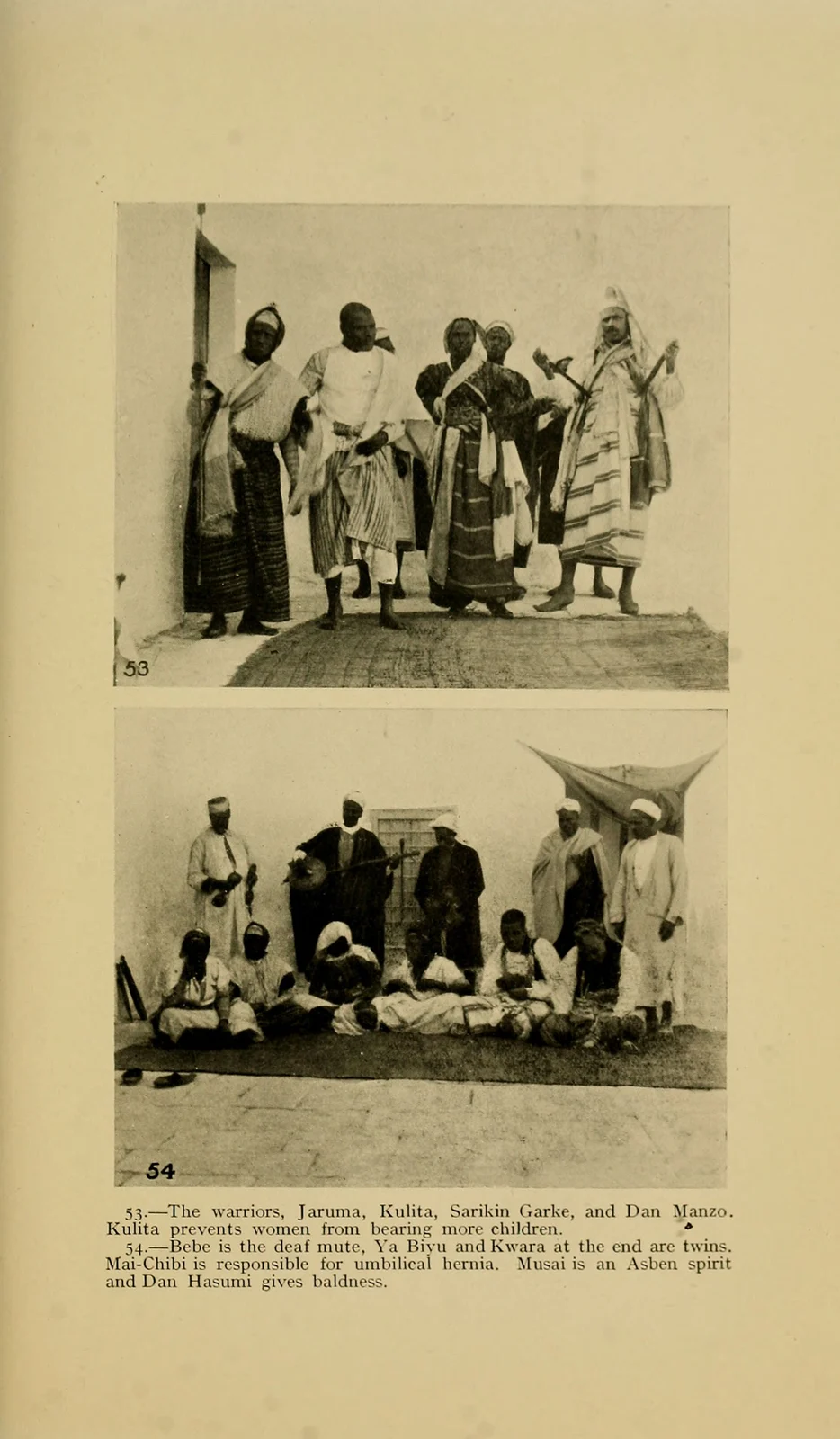
Human representatives of Kulita and other named warrior spirits in photograph53, 1914
The upper photograph53 names Kulita among the represented warrior spirits, with Jaruma, Sarikin Garke and Dan Manzo. Individual positions are not assigned here. The image is a recorded human group representation, not a portrait proving the spirit’s anatomy.
Overview
Kulita is a fierce spirit associated with drummers accompanying troops. His names include Auta, Little One, and Ja-Ja-Maiya, Attracter of the Great. His spoken praise calls him the smallest warrior and connects him with Gozo, while the prose gives him as a son or nephew of Sarikin Rafi. That uncertainty is retained. Another title associates him with the ending of child-bearing, without making the attributed effect a medical fact.
His representation kneels and strikes the ground with fists, then stands and repeatedly removes and replaces a shoulder cloth because he is hot. He asks for plates and breaks them upon his head, balances as though intoxicated and calls other participants to kneel before him. The song praises a young but strong and supple figure through pestle, grain, acacia and pepper comparisons. Those comparisons do not establish separate plant or animal transformations.
Origins & earliest records
A. J. N. Tremearne combines interviews and descriptions of bori performances with comparative interpretation. These selected notices do not consistently name individual speakers; printed attributes are distinguished from his conjectures.
Records & interpretation
Complete selected notice in chapter XXV, printed pp. 359–360; full chapter read.
Selected bibliography
Documented works and useful reading. This is not a list of every appearance.
- 01
The Ban of the Bori: Demons and Demon-Dancing in West and North Africa
Chapter XXV, printed pp. 359–360; complete spirit notice, song and attributed relationships.
Family & connections
A source-supported family tree or inspiration record has not yet been compiled for this profile. Related reading below indicates a connection in subject matter, not a proven lineage or creative influence.
References
Sources supporting this profile. Linked pages have their own scope and editorial standards.
- Digitized historical ethnographic accountTremearne — KulitaResearch access: 2026-10-05
Image credits
Historical ritual performance photographHuman representatives of Kulita and other named warrior spirits in photograph53, 1914
The upper photograph53 names Kulita among the represented warrior spirits, with Jaruma, Sarikin Garke and Dan Manzo. Individual positions are not assigned here. The image is a recorded human group representation, not a portrait proving the spirit’s anatomy.