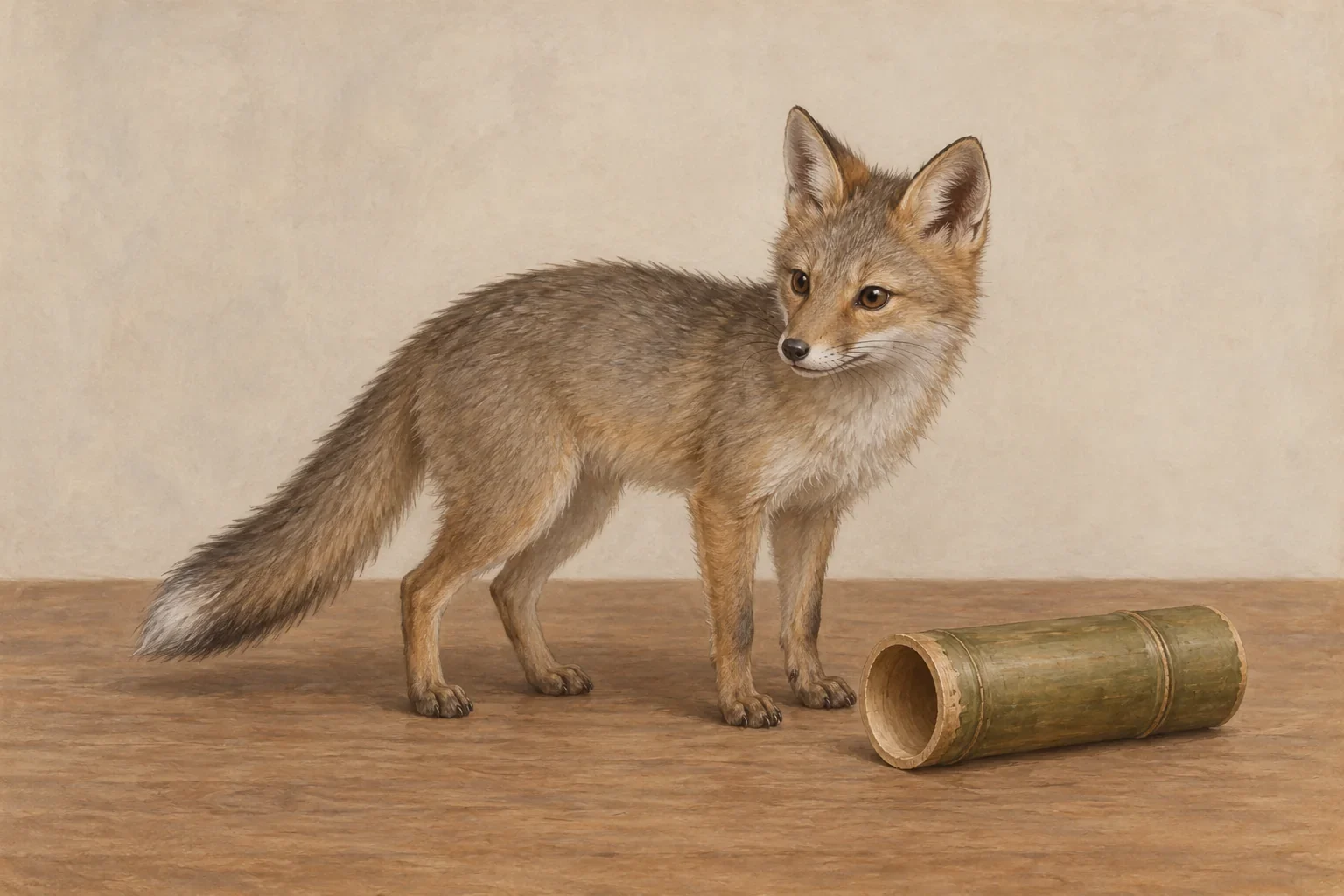
AI-generated illustration. AI interpretation of the small field-fox witness quoted from Zenan zuihitsu. Tube, relative scale, coloration and anatomy are imagined; conflicting kuda descriptions are not combined, and no zoological or ritual authenticity is claimed.
AI interpretation of the small field-fox witness quoted from Zenan zuihitsu. Tube, relative scale, coloration and anatomy are imagined; conflicting kuda descriptions are not combined, and no zoological or ritual authenticity is claimed.
Overview
M. W. de Visser’s 1908 study brings together several accounts of kuda-gitsune, or pipe-foxes, rather than describing one standardized animal. A passage quoted from Shōzan chomon kishū distinguishes an unseen household kuda of Shinano from the rat-sized fox of Mikawa and Tōtōmi that can fit inside a pipe. The shared pipe name connects these reports, but their different descriptions should remain visible.
A second quoted work, Zenan zuihitsu, describes kwanko as weasel- or rat-sized, with thinner hair than field foxes and eyes called vertical in the English rendering. The keeper holds a bamboo pipe, and the fox appears in it to answer questions. That work attributes the practice to a yamabushi who obtained it from the Tengu of Kimpusen. It also associates the creatures with osaki-foxes, while acknowledging uncertainty over two proposed village locations. These explanations are reported traditions, not evidence of an identifiable historical animal or an established origin.
De Visser next quotes a newspaper account transmitted through Inoue Enryō’s Yōkaigaku kōgi. Its mouse-sized, fox-shaped creature is said to remain close to a keeper, live in a pocket or sleeve, investigate matters and climb toward the ear to report its findings. The information supposedly enables accounts of the past and predictions of the future. An accompanying origin story connects it with a small fox picture borrowed from Fushimi Inari and later sealed by priests, but says its later condition is unknown. The quoted writer’s assertion that pipe-foxes exist remains part of that historical testimony, not a zoological finding.
The descriptions resist a single composite portrait. An earlier passage in the same study calls a Shinano kuda cat-sized, with a cat’s head, an otter’s trunk and a large tail; the newspaper account instead explains its name through a tail compared to a divided pipe. Neither description can automatically be imposed on the small field-fox form of Zenan zuihitsu. The surrounding reports also connect supposed fox keeping with family stigma and restrictions on marriage. Such allegations document historical social attitudes; they do not identify real families as possessing spirits or establish supernatural causes for illness.
Origins & earliest records
M. W. de Visser, The Fox and the Badger in Japanese Folklore, Transactions of the Asiatic Society of Japan36(3),1908. Historical English study quoting Japanese texts and reported observations.
Records & interpretation
Complete selected pipe-fox passages and notes on printed pp.122–124; related kuda notice and source note p.92, surrounding context pp.121,125 and opening framing. Selected pages visually checked against native PDF. Original Japanese works were not independently collated.
Selected bibliography
Documented works and useful reading. This is not a list of every appearance.
- 01
The Fox and the Badger in Japanese Folklore
Transactions of the Asiatic Society of Japan36(3); complete selected passages pp.122–124 and attached notes; p.92 related notice; pp.121,125 framing. PDF indexes123–125 correspond to printed122–124.
Family, evolution & connections
Sakuyamon
De Visser records small pipe-fox helpers that answer questions and report discoveries. Sakuyamon’s official-reference profile explicitly names four pipe foxes used to gather information as well as fight. The fictional elemental and combat design is distinct; no creator consultation of de Visser is established.
References
Sources supporting this profile. Linked pages have their own scope and editorial standards.
- Historical English scholarly study, with quoted earlier witnessesDe Visser1908 original journal scanResearch access: 2026-10-27
Image credits
AI narrative interpretationAI-generated illustration. AI interpretation of the small field-fox witness quoted from Zenan zuihitsu. Tube, relative scale, coloration and anatomy are imagined; conflicting kuda descriptions are not combined, and no zoological or ritual authenticity is claimed.
AI interpretation of the small field-fox witness quoted from Zenan zuihitsu. Tube, relative scale, coloration and anatomy are imagined; conflicting kuda descriptions are not combined, and no zoological or ritual authenticity is claimed.