
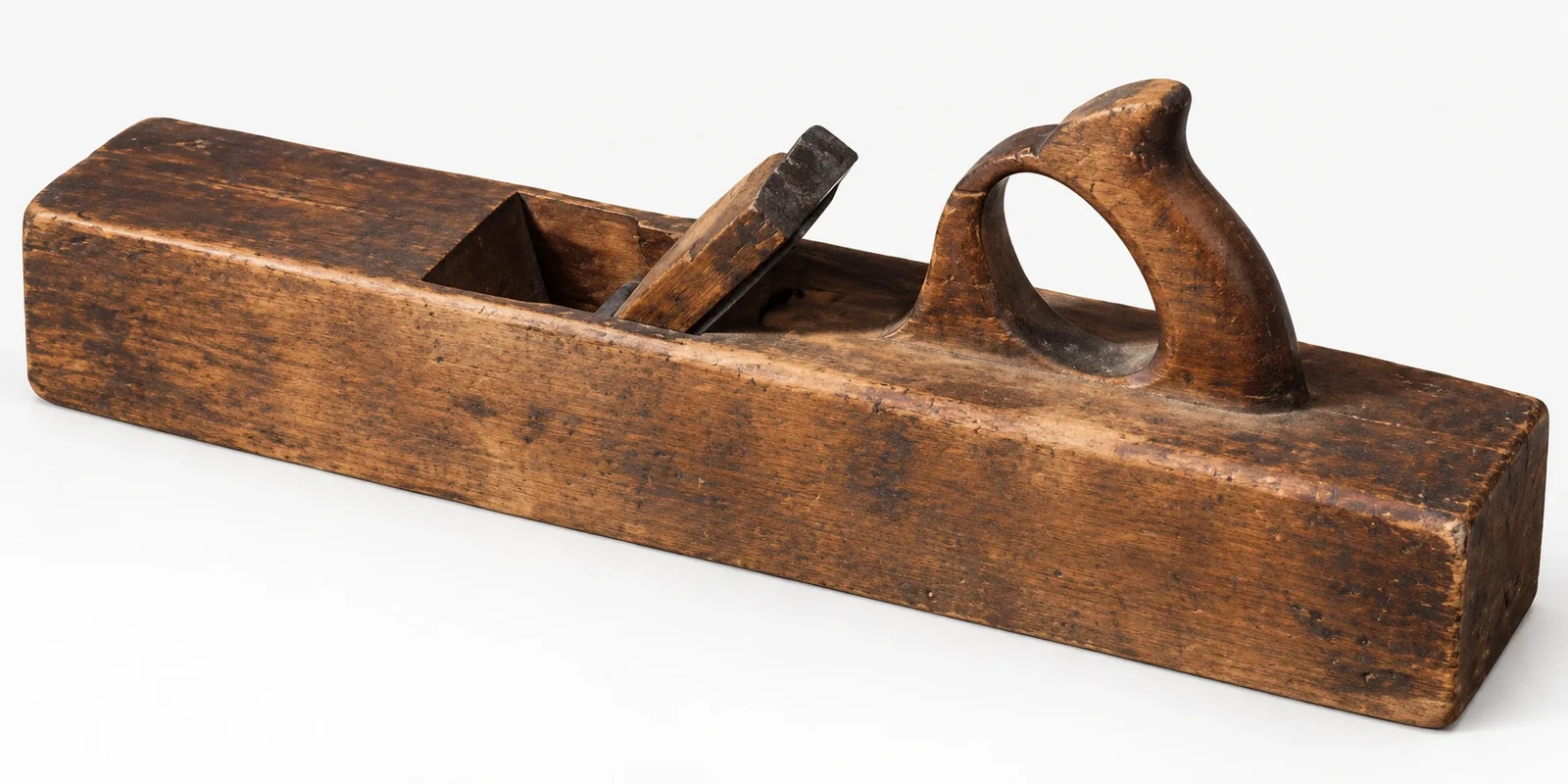
AI-generated contextual material interpretation; not a photograph of the accessioned object or an authenticated replica.
Overview
The jack or foreplane that Welsh illustrates in figure 26 is linked in his prose to accession 61.547, A. Klock and the date 1818. The caption identifies the example as American and describes the name and date as markings on the tool. Its function is the carpenter’s first, rapid surfacing of timber. The cutting iron’s bevelled, slightly convex edge distinguishes this role. The native photograph shows a long rectangular wooden stock, an inclined iron and wedge assembly, and an open rear handgrip rising above the body. It supplies the overall arrangement, but no measured dimensions.
Welsh sets this plane beside a plow plane for channels and a rabbet plane for edge notches, distinguishing tasks rather than treating all planes as interchangeable. In his comparison, the Klock example provides an unusually firm dated point: the neighbouring White and Carpenter planes require additional evidence for their approximate dating. The year 1818 therefore belongs to this marked example. It is not a proposed date for the invention of the jack plane or for every tool with a similar wooden stock.
The larger argument concerns the relationship between British toolmaking and early American workshop equipment. Welsh compares the shape of the American plane with Sheffield patterns and sees continuity in basic bench-tool design. That interpretation does not establish that this particular object was imported, nor does the shortened name identify a fully documented individual biography. The profile retains the catalogue’s attribution while leaving wood species, exact dimensions and later ownership open. Its material form can be represented without adding the metal body, front adjustment knob or projecting mechanisms of a later plane.
History & identity
Peter C. Welsh’s curator-authored Smithsonian historical study, published by the U.S. Government Printing Office in 1966.
Sources & representation
Complete selected framing and configuration passages plus figure 26 caption read; complete native photograph viewed. Prose links A. Klock, 1818 and accession 61.547.
Selected bibliography
Documented works and useful reading. This is not a list of every appearance.
- 01
Woodworking Tools, 1600–1900
Contributions from the Museum of History and Technology, Paper 51, pp.178–228; U.S. Government Printing Office, Washington.
Language & cultural connections
Source-supported language and cultural connections have not yet been compiled for this profile.
References
Sources supporting this profile. Linked pages have their own scope and editorial standards.
- Curator-authored Smithsonian collection studyWelsh’s institutional tool study and original collection photographsResearch access: 2026-10-21
Image credits
AI-generatedAI-generated contextual material interpretation; not a photograph of the accessioned object or an authenticated replica.