
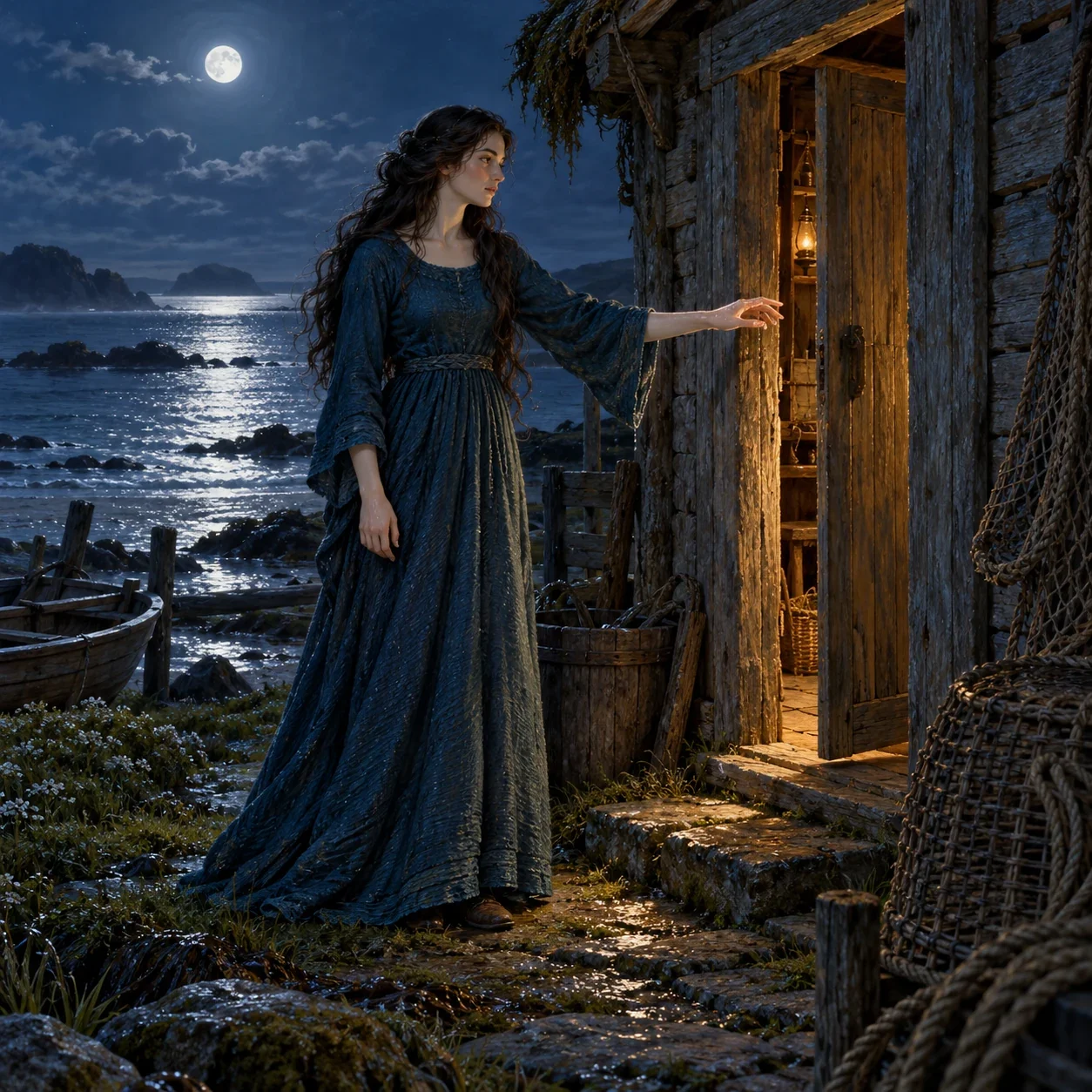
AI-generated interpretation of the sea nymph’s approach to the fishing hut. The story describes only a pale wet hand and arm at the door; the complete humanlike woman, face, hair, dress, body, cottage and moonlit shore are artistic inventions. No fish tail or other anatomy is authenticated by the source, and this scene depicts no abduction or injury.
AI-generated interpretation of the sea nymph’s approach to the fishing hut. The story describes only a pale wet hand and arm at the door; the complete humanlike woman, face, hair, dress, body, cottage and moonlit shore are artistic inventions. No fish tail or other anatomy is authenticated by the source, and this scene depicts no abduction or injury.
Overview
The Sea Nymph begins among fishermen sleeping in a hut near an island’s northwest shore. They see a pale woman’s hand, wet with dew, reach through the door. They identify the unseen visitor as a dangerous sea nymph and pretend not to notice. The next day a newly married man from Kinnar in Lummelund joins them. Hearing their story, he mocks their hesitation and boasts that he would have taken the offered hand. The narrator suggests that fear of being mocked in return may help explain what he does next, rather than presenting that motive as a known certainty.
When the arm reappears that evening, the man rises and takes the hand. His companions see him drawn silently through the doorway, which then closes. He does not return by morning, and their search fails. The text describes only the visitor’s hand and arm at this meeting. It supplies no tail, scales, wings, complete face or fixed body for the nymph, and those features should not be added as authenticated local anatomy.
Three years pass without news. The missing man’s wife, having mourned him as dead, agrees to another marriage. At the wedding celebration a stranger enters, and some guests recognize her former husband. He explains that the nymph drew him into the sea and that, in her pearly halls, he forgot wife, parents and everything he had loved. This account of life below the water comes through his explanation within the story, rather than an independent report by the fishermen who witnessed his disappearance.
On the morning of the wedding, the nymph announces that there will be a clearing-out in Kinnar that evening. His memory returns, and he asks whether his wife is to be the bride. She confirms it. At his urgent request she allows him to go above and see his wife dressed for the wedding, but requires him to remain outside the house. Seeing his wife wearing her garland and crown, he enters despite that condition. A tempest removes half the roof; he becomes ill and dies three days later. The narrative does not supply another release, renewed underwater life or a successful reunion.
The tale’s power lies partly in its changing boundaries: a hand crosses the hut’s doorway, the man passes beneath the sea, and his return is permitted only if he respects another threshold. That reading follows the story’s arrangement without making the storm or illness a factual supernatural event. The selected witness is the complete chapter in Hofberg’s collection, translated by Myers in the 1890 English edition. No attached tale note appears there. The translator’s preface says that some original notes were omitted, so absence of a printed note does not establish that the Swedish source had none.
Origins & earliest records
Herman Hofberg, Swedish Fairy Tales, W. H. Myers translator, Chicago: Belford-Clarke Co.,1890. The Sea Nymph, pp75–77.
Records & interpretation
Complete selected chapter read through its ending; no attached tale note. Both retained editorial prefaces consulted; original Swedish apparatus not independently collated.
Selected bibliography
Documented works and useful reading. This is not a list of every appearance.
- 01
Swedish Fairy Tales — The Sea Nymph, pp75–77
Complete selected historical English chapter, with editorial mediation distinguished.
Family & connections
A source-supported family tree or inspiration record has not yet been compiled for this profile. Related reading below indicates a connection in subject matter, not a proven lineage or creative influence.
References
Sources supporting this profile. Linked pages have their own scope and editorial standards.
- Historical collected narrative in English translationHofberg/Myers1890 — The Sea Nymph, pp75–77Research access: 2026-10-27
Image credits
AI-generated illustrationAI-generated interpretation of the sea nymph’s approach to the fishing hut. The story describes only a pale wet hand and arm at the door; the complete humanlike woman, face, hair, dress, body, cottage and moonlit shore are artistic inventions. No fish tail or other anatomy is authenticated by the source, and this scene depicts no abduction or injury.
AI-generated interpretation of the sea nymph’s approach to the fishing hut. The story describes only a pale wet hand and arm at the door; the complete humanlike woman, face, hair, dress, body, cottage and moonlit shore are artistic inventions. No fish tail or other anatomy is authenticated by the source, and this scene depicts no abduction or injury.