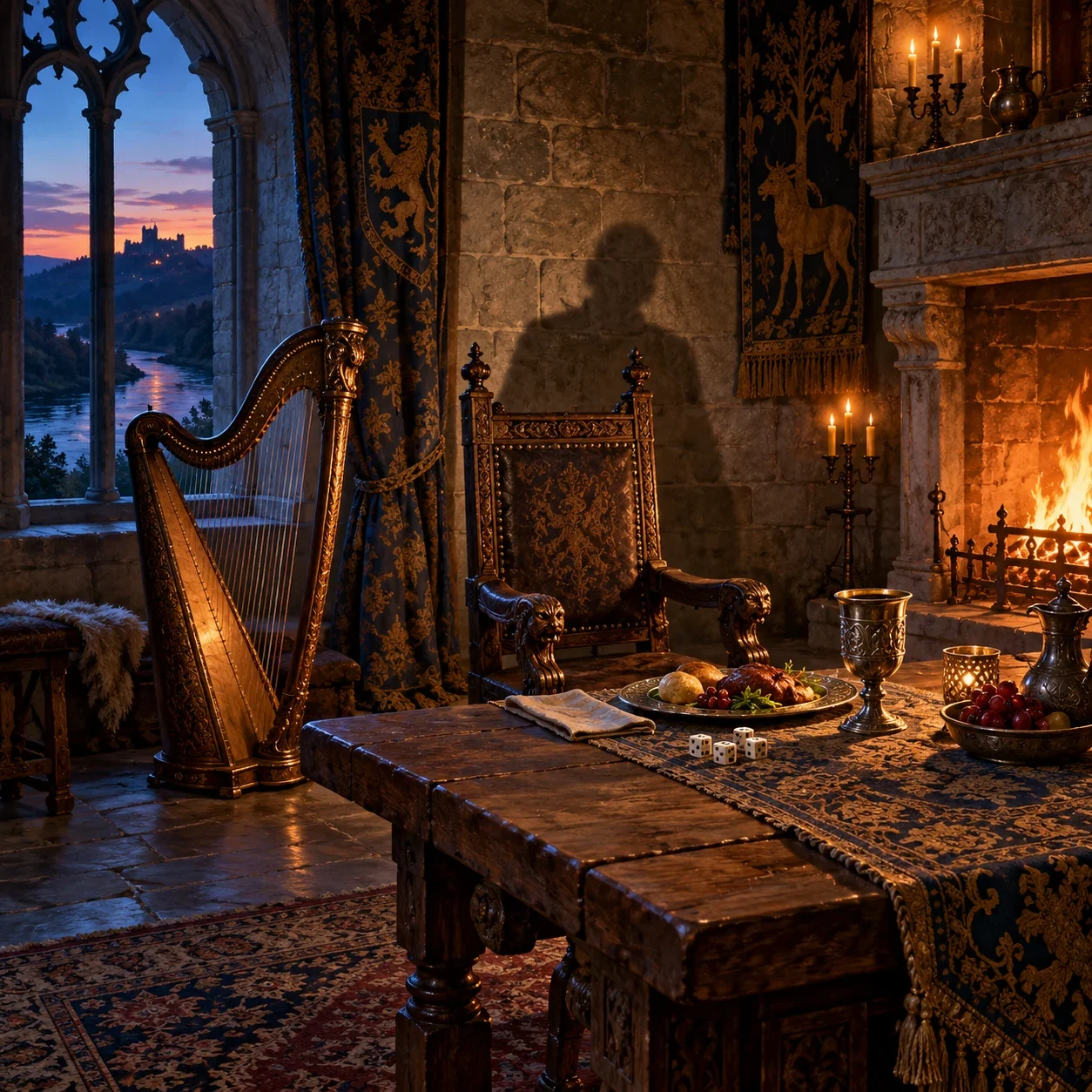
AI-generated interpretation of King Goldemar’s unseen hospitality: harp, dice, reserved meal and a shadow beside an empty chair. The chamber, furnishings, shadow design and landscape are imagined; this is not a historical portrait or archaeological reconstruction.
AI-generated interpretation of King Goldemar’s unseen hospitality: harp, dice, reserved meal and a shadow beside an empty chair. The chamber, furnishings, shadow design and landscape are imagined; this is not a historical portrait or archaeological reconstruction.
Overview
King Goldemar belongs to the household-spirit accounts collected by Thomas Keightley under Kobolds. His residence is Hardenstein on the Ruhr, where he becomes an intimate companion of Neveling von Hardenberg. He calls his host brother-in-law, sometimes shares his bed, gives warnings and speaks with people of different ranks. His disclosures embarrass clergy by revealing their concealed misconduct. These are claims within a transmitted legend, rather than independently established episodes in the castle’s history.
The intimacy does not make his body ordinary. Keightley says Goldemar can be touched but cannot be seen. His thin hands feel cold and soft, with a comparison to a frog’s hands; this does not turn him into a frog-shaped creature. He is also an accomplished harp-player and a gambler prepared to stake large sums at dice. Another name, King Vollmar, accompanies a chamber associated with him. The account initially says that his three-year stay ended without anyone being offended, then presents a much more disturbing departure. Those statements remain an unresolved tension in the selected witness.
Goldemar requires a place at table and a stable stall for his horse. Food disappears, as do the horse’s hay and oats, although no more than shadows of the two occupants are seen. This makes hospitality a practical demand upon the household even when its guests cannot be inspected. An inquisitive person spreads ashes and tares along his route, hoping to trip him and discover his footprints. The attempt is not rewarded with a revealed face or a captured spirit. Goldemar attacks and kills the person, prepares the remains at the fire and has the food taken to his chamber, where joyful cries accompany its consumption. The narrative supplies an extreme punishment for an effort to make the invisible guest observable.
Afterward Goldemar is gone. Writing above his chamber predicts that the house’s former good fortune will become misfortune and its dispersed property will be reunited only when three Hardenbergs of Hardenstein live at the same time. The story extends into purported material traces: a spit and prepared meat were said to have survived until their loss in the Lorrain war in 1651, while a pot was reportedly built into the kitchen wall. Keightley’s present-tense survival claim is testimony from his transmitted account, not a modern inspection. His note cites Von Steinen through Grimm; those earlier witnesses have not been independently collated here. The dangerous household visitor provides one historical context for the name Kobold, without establishing the subterranean anatomy, metalworking culture or Titan devotion of Final Fantasy XIV’s distinct fictional people.
Origins & earliest records
Keightley, The Fairy Mythology, revised and enlarged edition, London: George Bell & Sons, 1892, pp.256–257, complete King Goldemar subsection and note292.
Records & interpretation
Complete subsection and attached note292 read from the preserved public-domain Gutenberg41006 master. The note names Von Steinen via Grimm, not independently checked originals.
Selected bibliography
Documented works and useful reading. This is not a list of every appearance.
- 01
The Fairy Mythology — King Goldemar, pp.256–257, note292
Complete named subsection and attached source note; preceding Kobold classification distinguished from modern taxonomy.
Family & connections
A source-supported family tree or inspiration record has not yet been compiled for this profile. Related reading below indicates a connection in subject matter, not a proven lineage or creative influence.
References
Sources supporting this profile. Linked pages have their own scope and editorial standards.
- Primary historical English compilationThe Fairy Mythology — King Goldemar, pp.256–257, note292Research access: 2026-10-27
Image credits
AI-generated illustrationAI-generated interpretation of King Goldemar’s unseen hospitality: harp, dice, reserved meal and a shadow beside an empty chair. The chamber, furnishings, shadow design and landscape are imagined; this is not a historical portrait or archaeological reconstruction.
AI-generated interpretation of King Goldemar’s unseen hospitality: harp, dice, reserved meal and a shadow beside an empty chair. The chamber, furnishings, shadow design and landscape are imagined; this is not a historical portrait or archaeological reconstruction.