
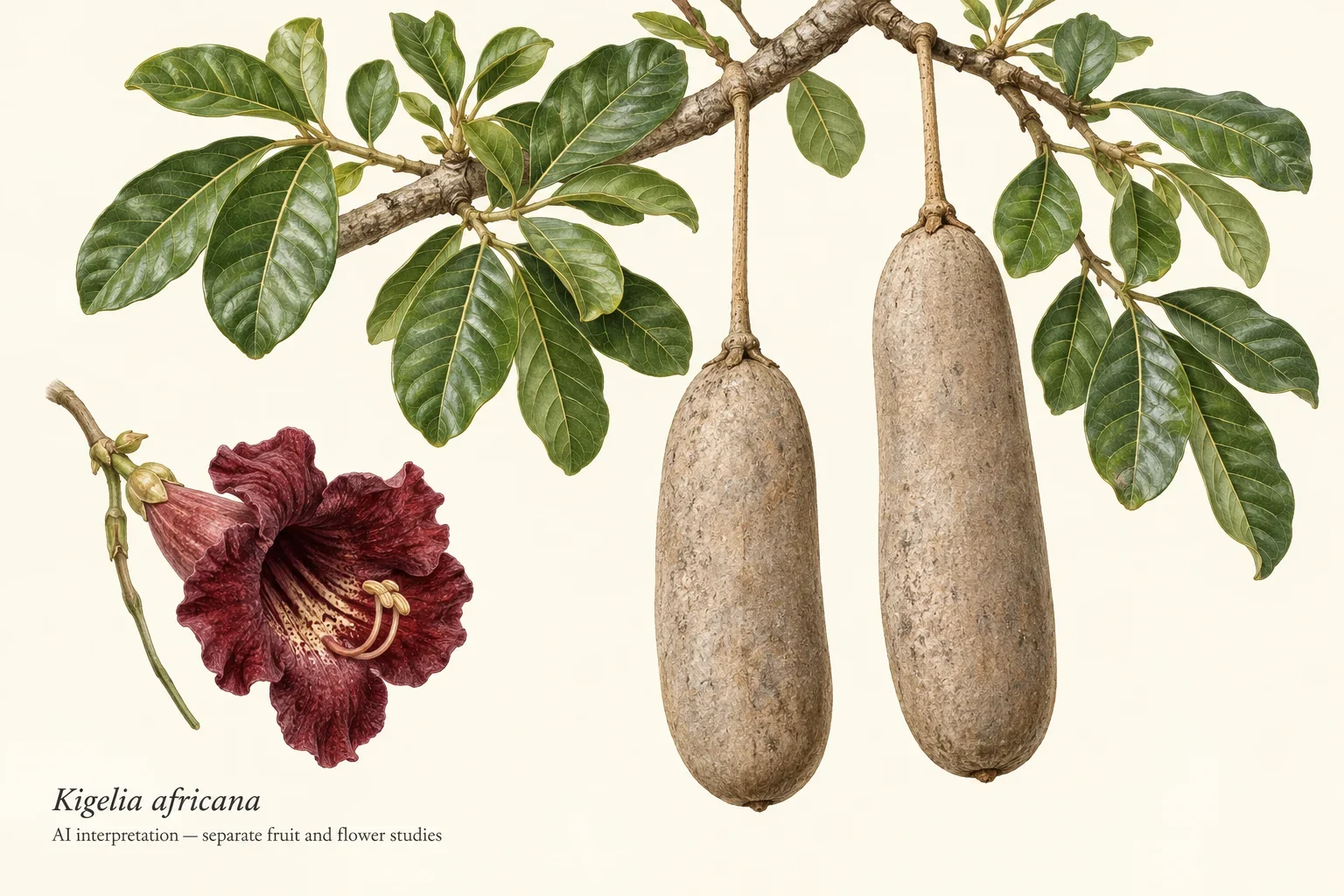
AI sausage tree fruit and separate flower studies.
AI interpretation of separate fruit and flower studies; not a collected specimen.
Overview
The botanical account describes a spreading crown, leathery foliage and grey-brown fruits on long stalks. Dark red, wrinkled trumpet flowers contain nectar. The separate illustrated organs are conceptual studies, not specimens collected together.
A Kruger National Park study combined riverbank surveys, flower treatments, cameras and seedling plots. Experimental selfing produced no fruit, supporting obligate out-crossing in the tested trees. Birds were the principal observed pollinators; anticipated bat visits were not observed there.
The sampled population was dominated by large trees. High seed availability did not explain the scarcity of recruits; dispersal limitations and seedling herbivory were considered. These proposed bottlenecks are local research interpretations, not a demonstrated extinction mechanism throughout Africa.
Origins & earliest records
The account combines a botanical-garden description with a 2019 study of Kruger reproductive ecology.
Evidence & interpretation
The primary paper retains methods and results; the botanical account describes the fruit, flowers and foliage.
Selected bibliography
Documented works and useful reading. This is not a list of every appearance.
- 01
- 02
Family, evolution & connections
Taxonomic classification
A hierarchy of classified groups, not a chain of direct ancestors.
Source note: Bignoniaceae placement is retained; pollination observations are not a computed phylogenetic tree.
- FamilyBignoniaceae
- GenusKigelia
- SpeciesKigelia africana
References
Sources supporting this profile. Linked pages have their own scope and editorial standards.
- Indexed institutional textBotanical garden accountResearch access: 2026-10-11
- Primary field researchKruger reproduction studyResearch access: 2026-10-11
Image credits
AI-generated interpretationAI sausage tree fruit and separate flower studies.
AI interpretation of separate fruit and flower studies; not a collected specimen.