
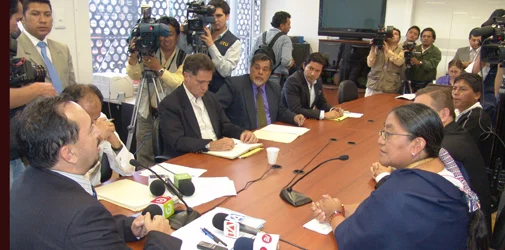
Nina Pacari sits at the near right of a conference table facing officials, with microphones, documents and press cameras around the room.
Nina Pacari at an Ecuadorian parliamentary commission appearance on 3 June 2009. This photograph records one public occasion involving a named Kichwa Otavalo jurist, rather than representing every community member or political position.
Overview
Kichwa Otavalo identifies a particular people and community world in Ecuador, rather than all speakers of Kichwa or every resident of the city of Otavalo. The Museo Viviente Otavalango presents itself as the museum of this people. Its own account says that twenty Otavalo Kichwa families acquired the former San Pedro textile factory in 2011. The museum connects this change of ownership with a history of exploited Indigenous labour at the site. It describes guides drawing on lived experience and professional preparation, and combines public interpretation with a community-centre role. This is an institutional self-account, not a census of all Otavalo communities.
The museum’s founders page names José René Zambrano Cachimuel and Luzmila Zambrano Maldonado. It recalls René’s earlier work in the factory, his return to find damaged buildings and missing equipment, and the cooperative effort to restore the place. Its account includes former workers and people from both rural and urban settings, including Indigenous and mestizo participants. Luzmila’s reflections express concern about cultural change and hope that the museum will support younger generations. Those concerns belong to a named participant’s perspective; changes in clothing, hairstyle or language use should not be turned into an external test of who is authentically Kichwa Otavalo. The undated biographical page also does not verify present officeholders.
Academic and literary work supplies another specific perspective. A September 2016 Universidad Andina Simón Bolívar report identifies Ariruma Kowii as a Quichua Otavalo poet and researcher of oral literature. It describes his participation in humanities congresses in Bolivia and records his earlier work in intercultural education. The report places an Otavalo intellectual within international scholarly exchange, rather than confining community knowledge to a local museum or tourist encounter. Planned additional activities in the report remain plans unless independently confirmed.
A separate university notice announced a June 2020 conversation between Kowii and researcher Luis Caisaguano, using Spanish and Kichwa. It identifies Kowii’s Mutsuktsurini as a 1988 collection written in Kichwa and also names his work on language policy. This is evidence for a bibliographic route and a proposed bilingual literary event. The collection and the event recording have not been examined here, and the notice does not establish an uncontested first-publication claim for all Kichwa literature. These sources offer particular examples of cultural authorship and institutional initiative while leaving wider community diversity open.
History & identity
Specific community self-identification; no equation of language, municipal residence and peoplehood.
Sources & representation
Complete museum introduction and founders body plus both university reports read; no book, event recording or museum tour inspected.
Selected bibliography
Documented works and useful reading. This is not a list of every appearance.
- 01
Mutsuktsurini
Bibliographic date in the2020 university notice; collection unexamined.
Language & cultural connections
Source-supported language and cultural connections have not yet been compiled for this profile.
References
Sources supporting this profile. Linked pages have their own scope and editorial standards.
- Community museumMuseo Viviente Otavalango: IntroductionResearch access: 2026-10-06
- Community museumMuseo Viviente Otavalango: Sobre NosotrosResearch access: 2026-10-06
- University reportUASB: Kowii in Bolivia,2016Research access: 2026-10-06
- Literary event noticeUASB: Secretos del oficio,2020Research access: 2026-10-06
Image credits
Documentary photograph of a named Kichwa Otavalo public figure at a dated parliamentary appearanceNina Pacari sits at the near right of a conference table facing officials, with microphones, documents and press cameras around the room.
Nina Pacari at an Ecuadorian parliamentary commission appearance on 3 June 2009. This photograph records one public occasion involving a named Kichwa Otavalo jurist, rather than representing every community member or political position.