
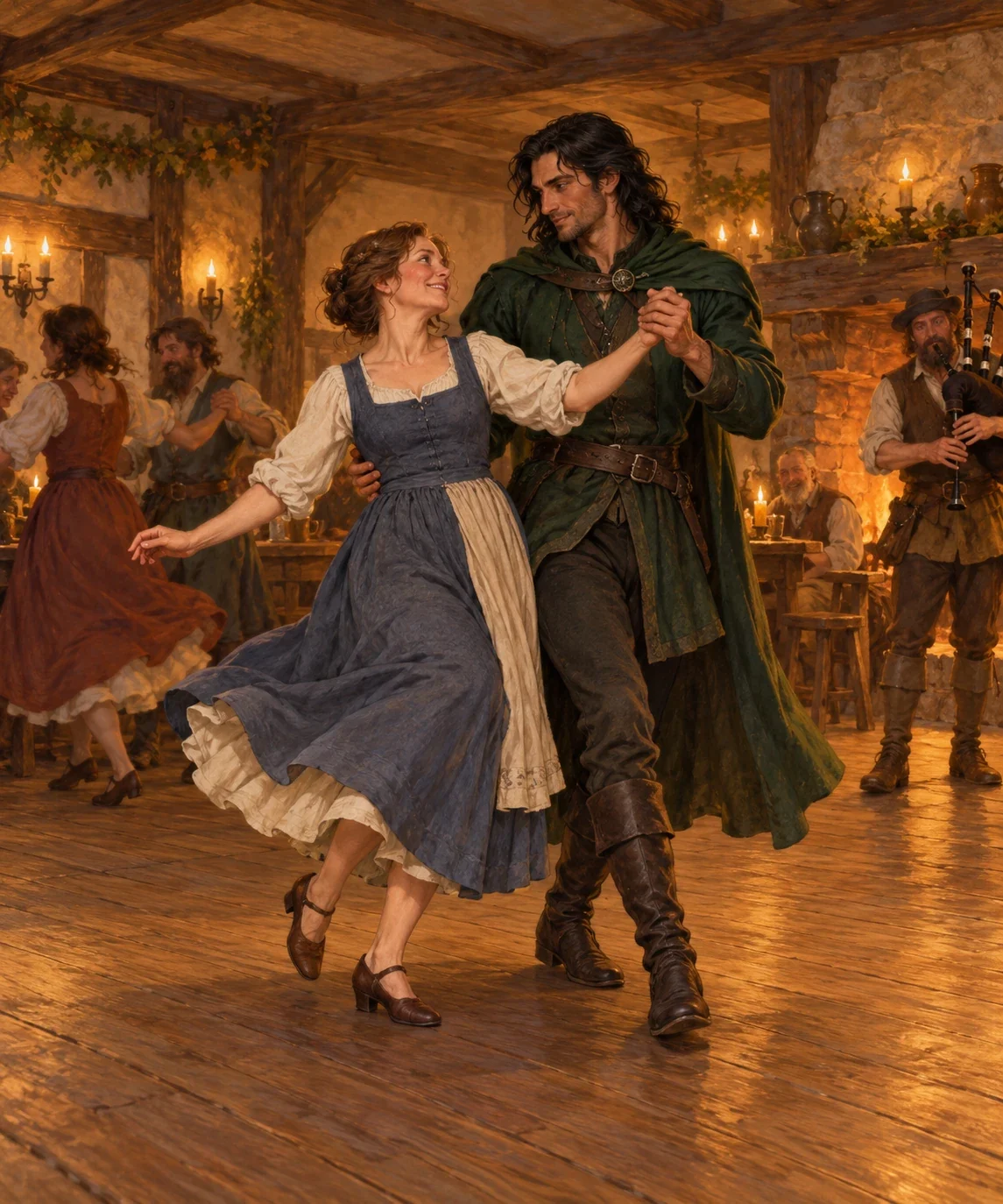
AI-generated interpretation of Katcha’s first dance in Fillmore’s selected retelling. Clothing, faces, palette and tavern architecture are editorial choices, not documented costume or a modern adaptation.
AI-generated interpretation of Katcha’s first dance in Fillmore’s selected retelling. Clothing, faces, palette and tavern architecture are editorial choices, not documented costume or a modern adaptation.
Overview
Katcha owns a cottage and garden in the village where Fillmore introduces her. His narrator presents her through a hostile comic portrait: she is forty, quick to scold, and repeatedly excluded when other villagers dance. Those judgments frame the selected retelling rather than establishing facts about women or Czech communities. She nevertheless returns to the Sunday gatherings and declares that she would accept the devil himself as a dancing partner. A stranger in green offers her drink, pays the piper and dances only with her. Her pleasure in the attention matters to the story: the audience sees an isolated villager enjoying the invitation before the partner reveals his supernatural identity.
When she wishes to keep dancing with him, the stranger asks her to put her arms around his neck. He becomes a devil and carries her down to hell. Katcha refuses to loosen her grip even when other devils try to remove her. The Prince of Darkness will not solve his subordinate’s problem and sends him back to earth with her still attached. Promises of property, persuasion and angry threats all fail. The apparent captor has become the exhausted carrier. A shepherd wearing a loose sheepskin coat offers to help; Katcha transfers her hold to the handsome young man and grips the coat’s collar. He then slips out of the coat and throws coat and passenger into a pond.
The tale does not follow Katcha out of the pond or provide an independent account of her later life. Its second movement follows the shepherd and the grateful devil instead. Two oppressive governors and their duke fear supernatural punishment. The devil arranges staged rescues of the governors so that the shepherd can receive gold, but warns him not to interfere when the duke is collected. The shepherd chooses to help the duke after securing his promise to govern justly. He frightens the devil away by saying that Katcha is alive and seeking him. That statement is the shepherd’s successful trick; the narrator does not separately verify it. Katcha’s remembered tenacity supplies the threat even though she is absent from the concluding scene.
The duke rewards the shepherd with a place as chief counselor, connecting the comic escape with a change in government. Katcha has no such narrated appointment, marriage or reconciliation. Keeping the two movements together prevents turning her into either a demon or a victorious ruler invented from the ending. Her selected role is that of a human whose persistence defeats the devil’s control and later survives as a frightening name. No appearance beyond the details given by this text, and no fixed anatomy for her supernatural partner, is required by that role.
Origins & earliest records
Fillmore’s prefatory note singles out Katcha and the Devil as particularly Czech in its humor. That is a documented cultural association for his chosen retelling, not proof of a single place of invention or of an exclusive national distribution. The collection was published in New York in 1919 and openly adapts earlier Czech, Slovakian and Moravian material. The note names Erben, Nemcova, Dobsinsky, Rimavsky, Benes-Trebizsky and Kulda at collection level; it does not identify a specific earlier text or named teller for this selected chapter. A modern opera or a similarly named Czech variant was not consulted and supplies no additional plot or visual detail here.
Records & interpretation
The complete chapter, including the governors’ staged rescues and the duke’s ending, supports this selected narrative identity. Katcha’s village life, dancing, journey to hell and transfer to the shepherd’s coat are narrated events. Her survival after the pond is asserted inside the shepherd’s deceptive warning and is not independently demonstrated. The preface supports the Czech association and the limits of Fillmore’s translation method. These are literary witnesses to a tale, not evidence that a historical woman travelled to hell.
Selected bibliography
Documented works and useful reading. This is not a list of every appearance.
- 01
Czechoslovak Fairy Tales
Parker Fillmore’s 1919 English retelling, written for American children. His prefatory note explicitly permits shortening and elaboration and names Czech, Slovakian and Moravian source collections without assigning an underlying collector or named oral teller to every selected tale. Original-language editions and a physical facsimile were not independently read.
Family & connections
A source-supported family tree or inspiration record has not yet been compiled for this profile. Related reading below indicates a connection in subject matter, not a proven lineage or creative influence.
References
Sources supporting this profile. Linked pages have their own scope and editorial standards.
- Primary historical English retellingFillmore 1919, complete Katcha and the Devil, pp.99–112; prefatory NOTE, pp.vii–viiiResearch access: 2026-10-23
Image credits
AI-generated illustrationAI-generated interpretation of Katcha’s first dance in Fillmore’s selected retelling. Clothing, faces, palette and tavern architecture are editorial choices, not documented costume or a modern adaptation.
AI-generated interpretation of Katcha’s first dance in Fillmore’s selected retelling. Clothing, faces, palette and tavern architecture are editorial choices, not documented costume or a modern adaptation.