
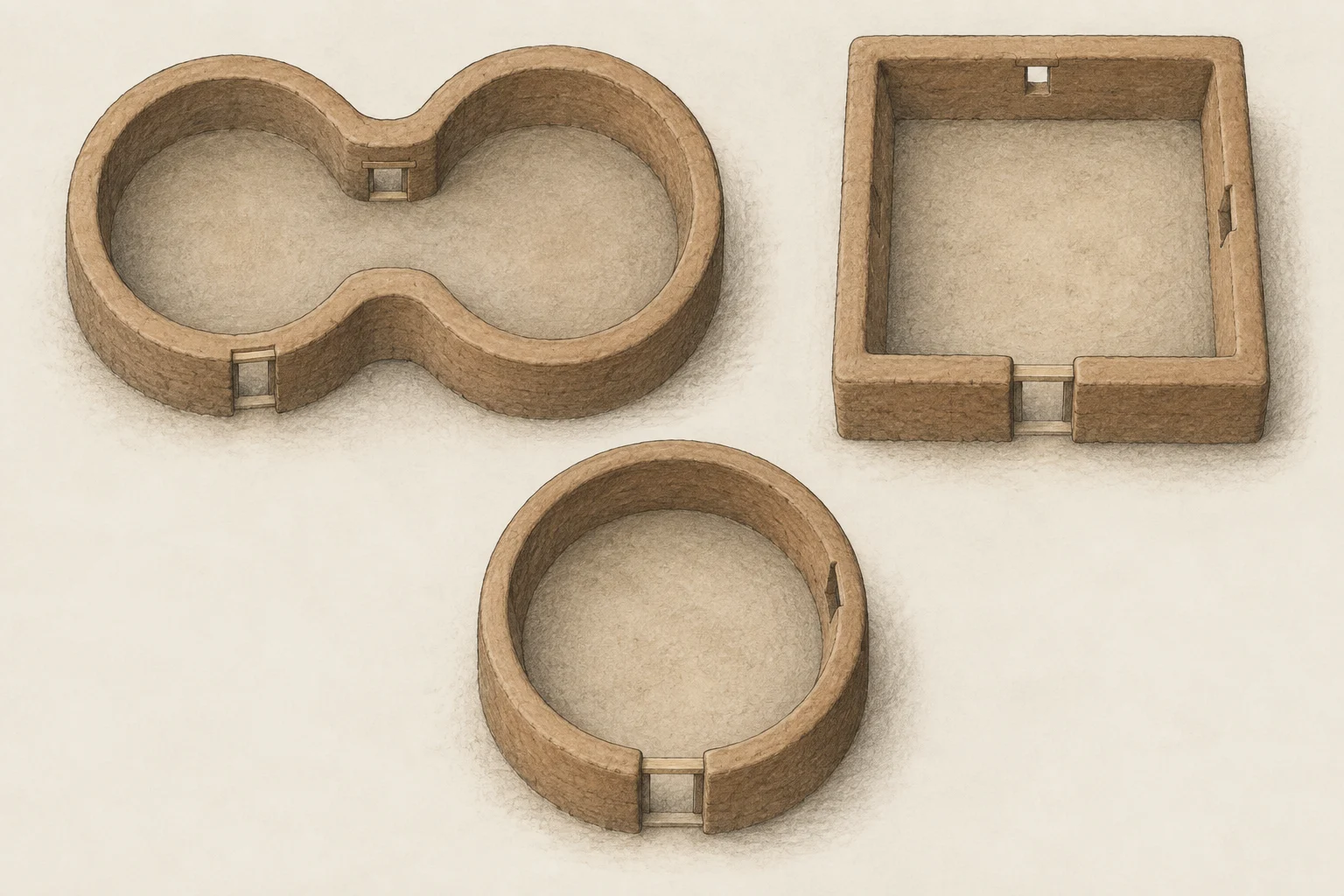
Interpretive Tiébélé Royal Court plans.
Plans interpreted. Compressed for display.
Overview
UNESCO describes Tiébélé’s Royal Court as a living expression of Kasena social organisation, with ceremonial and gathering places.
Women of the Court pass mural motifs through observation and practice, renewing designs across generations.
A 2022 university exhibition notice presents Tiébélé and Tangassoko as Kasena architectural examples. At the Royal Court, UNESCO distinguishes men’s building from women’s decoration.
History & identity
UNESCO dates the Royal Court to the sixteenth century; this dates a site, not the Kasena people.
Sources & representation
Selected institutional accounts.
Selected bibliography
Documented works and useful reading. This is not a list of every appearance.
- 01
Royal Court of Tiébélé - UNESCO World Heritage Centre
Selected bibliography.
- 02
Inhabiting and building the house | ACU | UPV
Selected bibliography.
Language & cultural connections
Source-supported language and cultural connections have not yet been compiled for this profile.
References
Sources supporting this profile. Linked pages have their own scope and editorial standards.
- Institutional heritage accountRoyal Court of Tiébélé - UNESCO World Heritage CentreResearch access: 2026-10-07
- Institutional heritage accountInhabiting and building the house | ACU | UPVResearch access: 2026-10-07
Image credits
AI-generated interpretationInterpretive Tiébélé Royal Court plans.
Plans interpreted. Compressed for display.