
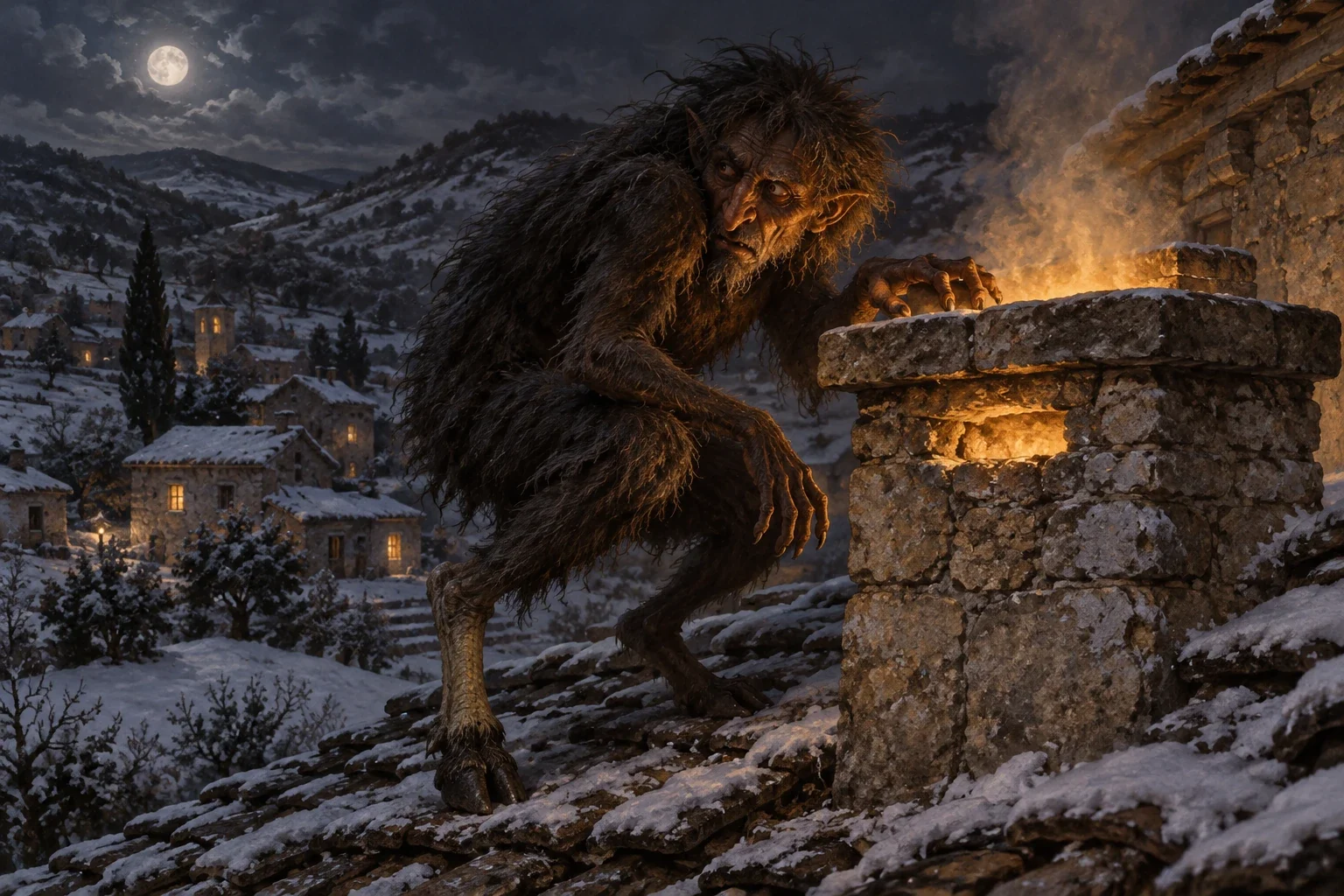
Kallikantzaroi - AI-generated imagined folklore illustration.
AI-generated imagined illustration of Kallikantzaroi based on the selected textual witness; not historical or ethnographic evidence.
Overview
Lawson emphasizes that the Kallikantzaroi, which he spells Callicantzari, have no single uniform body. His larger type ranges from human size to towering monsters, usually shaggy and dark, with glaring red eyes, long curved nails and animal-like ears or legs. Other accounts give mixed human and animal legs, twisted feet, tails, or baldness. These are reported alternatives rather than a checklist possessed by every individual. Small grotesque forms are more comic and frequently harmless, riding incongruously sized animals in nocturnal processions.
Their visit occupies the Twelve Days between Christmas and Epiphany. Outside that interval Lawson reports a lower-world occupation: cutting or gnawing the supports of the world. The support can be a great tree or columns. It recovers while the beings visit the surface, frustrating the destruction each year. During the visit they hide by day in caves or beneath mills and emerge at night. They raid stores, spoil unused food, overturn household objects and compel unlucky travellers to dance. More violent versions exist, but the diversity of accounts makes a universally harmless Christmas goblin an inaccurate summary.
Fire and the approach of dawn provide practical boundaries to the danger within these narratives. A sustained hearth fire deters chimney entry. Firebrands can rescue a captive, and even a threat of burning brands can frighten the beings. Their quarrels and stupidity also allow victims to delay them until cockcrow. In the Scyros story Lawson says he collected, a traveller hides between two flour sacks on his mule. The pursuing beings repeatedly search before and behind the animal while mistaking the concealed man for another load. His wife admits him safely indoors. The tale explains a local cave and path name referring to a Callicantzaros foot.
Lawson links the beings historically to ancient Centaurs and Dionysian companions. This is his survivalist argument, separate from the collected conduct and bodily variants. The source does not establish that every modern community accepts that genealogy or that the small comic form is historically later. His confidence in an ancient explanation must therefore remain attributed.
Origins & earliest records
Lawson combines accounts he collected, earlier printed testimony and Nicolas Polites’s work. The 1910 publication dates the selected record rather than the origin of oral tradition.
Records & interpretation
Complete selected appearance, seasonal cycle, Scyros encounter and protection passages inspected in cached Lawson transcription, approximately lines 7359–7811. Historical etymology and survival claims are attributed.
Selected bibliography
Documented works and useful reading. This is not a list of every appearance.
- 01
Modern Greek Folklore and Ancient Greek Religion: A Study in Survivals
Callicantzari section; collected testimony and historical interpretation distinguished.
Family & connections
A source-supported family tree or inspiration record has not yet been compiled for this profile. Related reading below indicates a connection in subject matter, not a proven lineage or creative influence.
References
Sources supporting this profile. Linked pages have their own scope and editorial standards.
- Primary folklore collection with historical commentaryLawson: Callicantzari sectionResearch access: 2026-10-10
Image credits
AI-generated imagined folklore illustrationKallikantzaroi - AI-generated imagined folklore illustration.
AI-generated imagined illustration of Kallikantzaroi based on the selected textual witness; not historical or ethnographic evidence.